Marcus’s "Silent Goldmine": The Energy Revolution in a Palm Oil Mill
2025-08-21
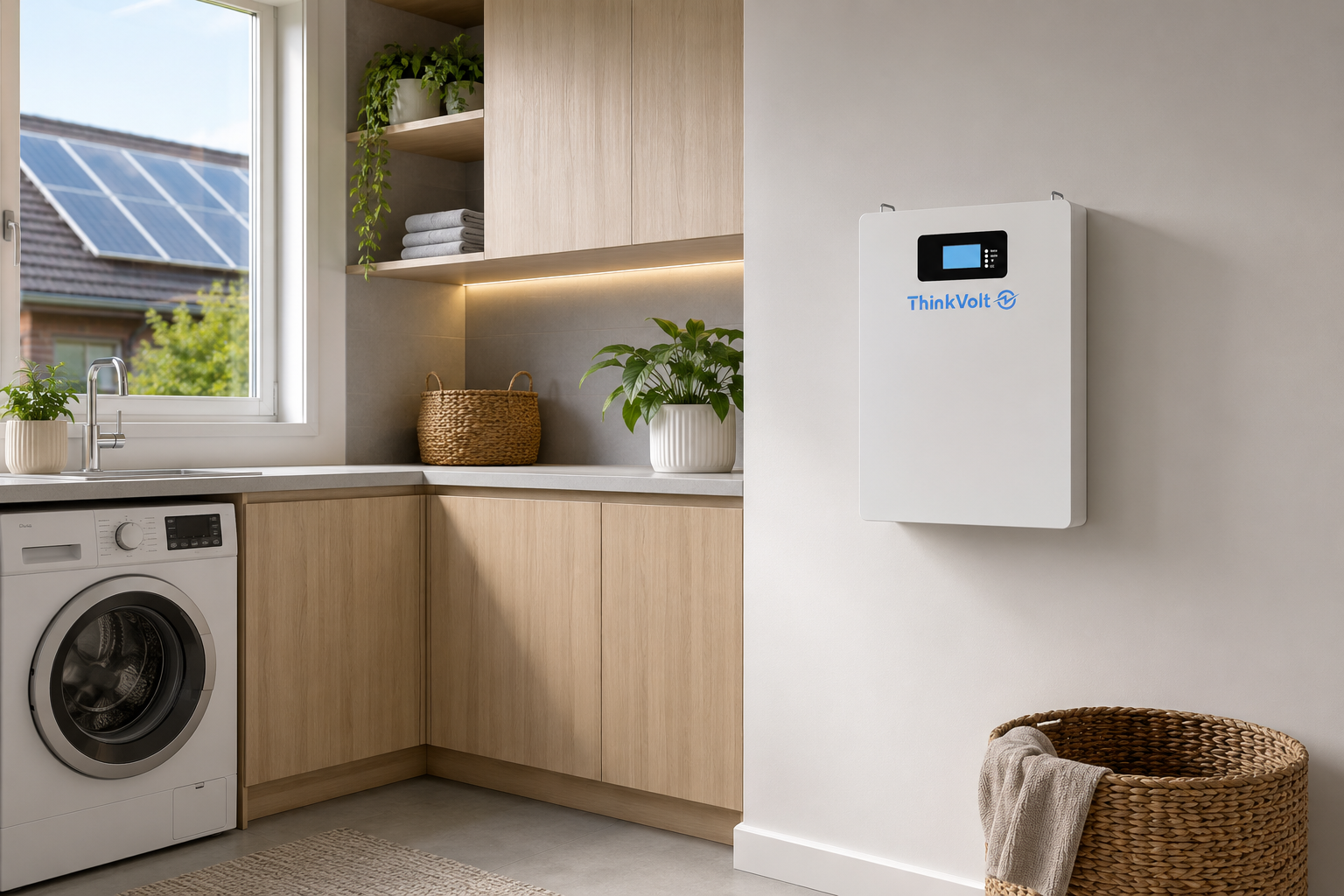
A home battery storage system stores electricity from solar panels, the grid, or another compatible source and supplies it when your home needs power. Its actual performance depends on usable battery capacity, power output, system configuration, and household loads.
A complete system usually includes a battery pack, battery management system (BMS), inverter, meters, and controls. Together, these components manage charging, energy storage, power conversion, and electricity flow between the battery, home, solar system, and grid.
A home battery storage system stores electrical energy for later use. Instead of using all available electricity immediately, the system can store part of it and discharge that energy when demand increases or another power source becomes unavailable.
Home batteries are commonly paired with solar panels, but solar is not required for every configuration. Some systems can also charge from the grid, depending on the inverter, system settings, and local requirements.
A home battery charges when the system directs available electrical energy into the battery, stores that energy electrochemically, and provides DC electrical energy during discharge.
In a solar-plus-storage system, charging often occurs when solar production exceeds current household demand. Where supported, grid electricity can also charge the battery.
Battery cells store the energy, while the BMS monitors battery conditions and helps keep charging and discharging within permitted operating limits.
When stored energy is needed, the battery discharges through the power-conversion system. The inverter provides the AC electricity required by typical household loads.
The basic energy flow is:
Energy source → control and conversion → battery → inverter → household loads
The exact path varies by system architecture, but the principle remains the same: charge, store, and discharge energy according to demand and system settings.
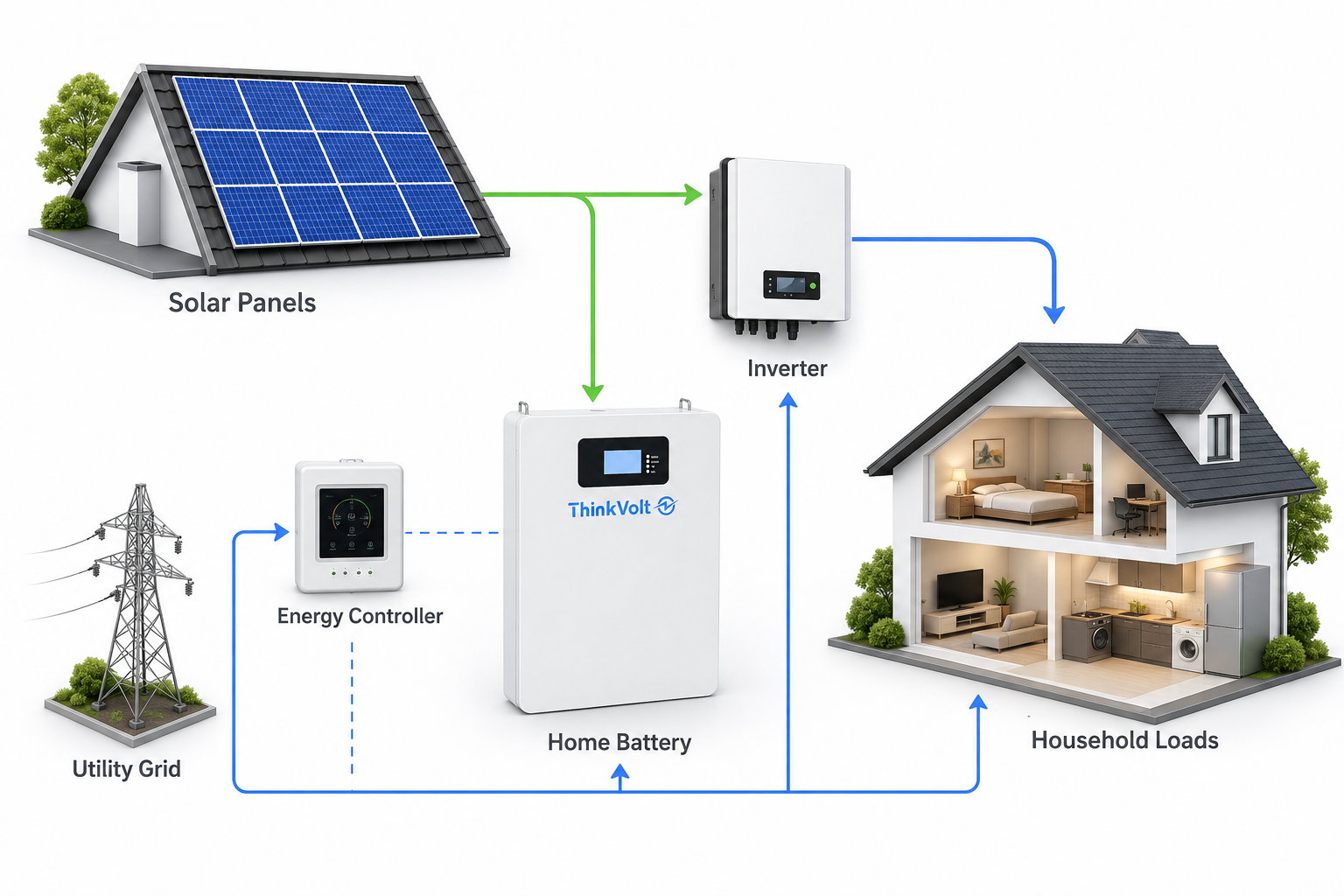
A home battery requires several coordinated components, not just a battery pack.
Component | Main function |
Battery pack | Stores energy and provides DC electrical energy during discharge |
BMS | Monitors battery conditions and manages protection |
Inverter | Converts power between DC and AC as required |
Meters/sensors | Measure relevant household, solar, battery, and grid energy flows |
System controls | Coordinate charging, discharging, importing, and exporting where applicable |
The BMS primarily manages battery-level operation, while the inverter and wider controls coordinate power conversion and system-level energy flow.
Battery and inverter compatibility must also be verified. Check the exact inverter model, firmware, battery voltage requirements, communication protocol, and system configuration rather than assuming that every model from a compatible brand will work.
A home battery system uses information such as solar production, household demand, state of charge (SOC), grid availability, reserve settings, and operating mode to coordinate energy flow.
The BMS monitors and protects the battery. The inverter, meters, and system-level controls handle or coordinate power conversion and decide how available energy is used according to the system design.
For example, a self-consumption strategy may use solar power for current household loads first and store surplus generation. Another configuration may preserve part of the battery as backup reserve or allow grid charging during selected periods.
The exact control logic varies between systems, so these functions should always be confirmed for the specific battery and inverter configuration.
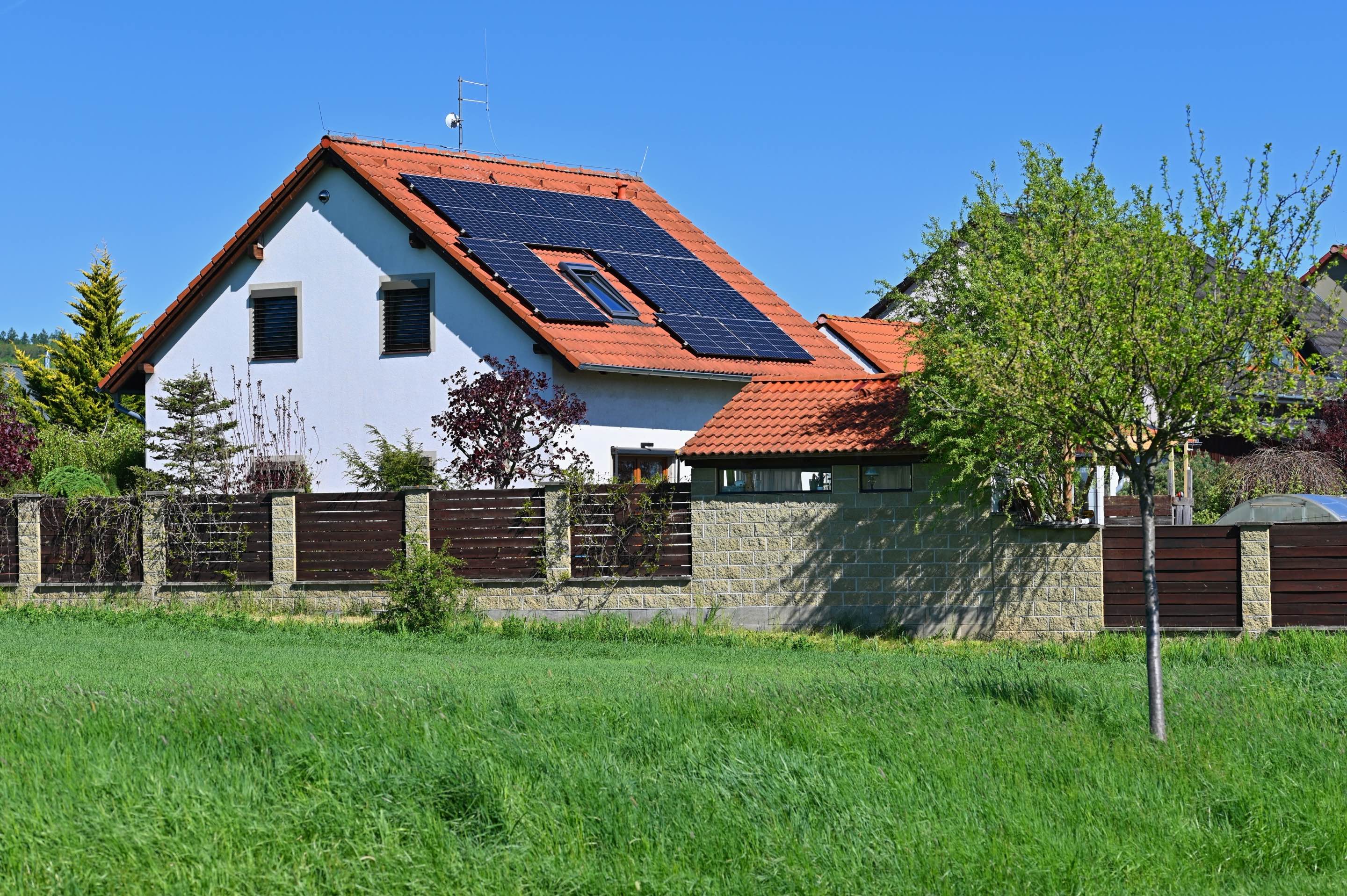
In a typical solar-plus-storage system, solar electricity supplies household loads first and surplus energy can charge the battery. When solar production falls below demand, stored energy can support the home.
Condition | Typical energy flow |
Excess solar | Solar powers the home and surplus can charge the battery |
Low solar production | Solar and stored battery energy can supply the load |
No solar | Stored energy can supply the home; the grid can cover remaining demand when available |
Grid charging enabled | Grid electricity can charge a compatible system under permitted conditions |
If the battery is already charged, additional solar energy may be exported to the grid or otherwise managed according to system settings and local rules.
A home battery is therefore not necessarily a solar-only battery. The available operating modes depend on the complete system and local requirements.
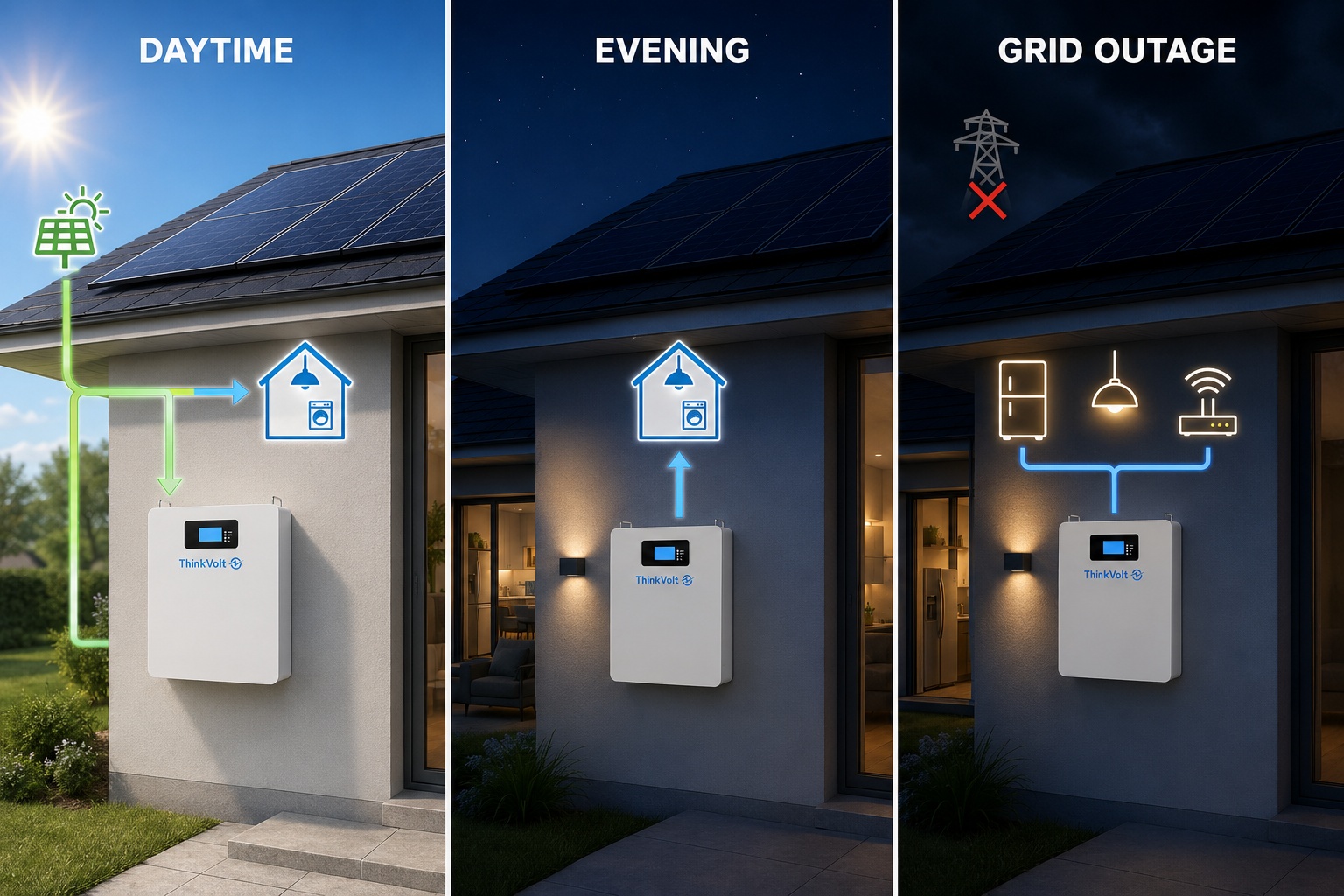
A home battery can supply selected loads during an outage if the system is designed and configured for backup operation. A charged battery alone does not guarantee backup power.
A backup-capable system isolates the required circuits from the utility grid and uses the battery and inverter to supply permitted loads.
Critical-load backup powers selected circuits, such as refrigeration, lighting, communications, or other prioritized equipment. Reducing the number of backup loads can extend runtime and reduce required power.
Whole-home backup requires enough usable battery energy and sufficient inverter power to support a much larger group of loads.
This distinction is important for air conditioners, pumps, heat pumps, and other high-power equipment. The battery may still contain energy even when a load exceeds the system’s continuous or peak power capability.
When the battery reaches its upper or minimum SOC limit, the system changes how energy is managed.
If the battery reaches its upper charging limit, charging stops or is restricted. Surplus solar may then be exported or otherwise managed according to system settings.
When the minimum SOC limit is reached, normal discharge stops or is restricted. If solar cannot meet household demand, the grid can supply power when available. During an outage, backup may stop after the configured discharge limit is reached unless another energy source is available.
An “empty” battery therefore does not necessarily mean the cells contain absolutely no energy. The system operates within defined limits and may preserve a configured reserve.
Capacity alone does not determine how a home battery will perform. The most important specifications include:
Specification | Why it matters |
Capacity (kWh) | Indicates how much energy can be stored |
Power (kW) | Indicates how much load can be supplied at once |
Usable capacity | Shows how much rated storage is available for use |
SOC / DoD | Describes battery charge level and capacity use |
Efficiency | Affects how much stored energy is ultimately delivered |
Load demand | Determines power requirements and how quickly energy is consumed |
The key distinction is kWh versus kW. kWh describes energy quantity; kW describes power at a given time.
A battery may contain enough energy for several hours but still be unable to operate every appliance simultaneously if the required power exceeds the system’s output capability.
Backup time mainly depends on usable battery energy and the average load being supplied.
A simple estimate is:
Backup time ≈ usable battery energy (kWh) ÷ average load (kW)
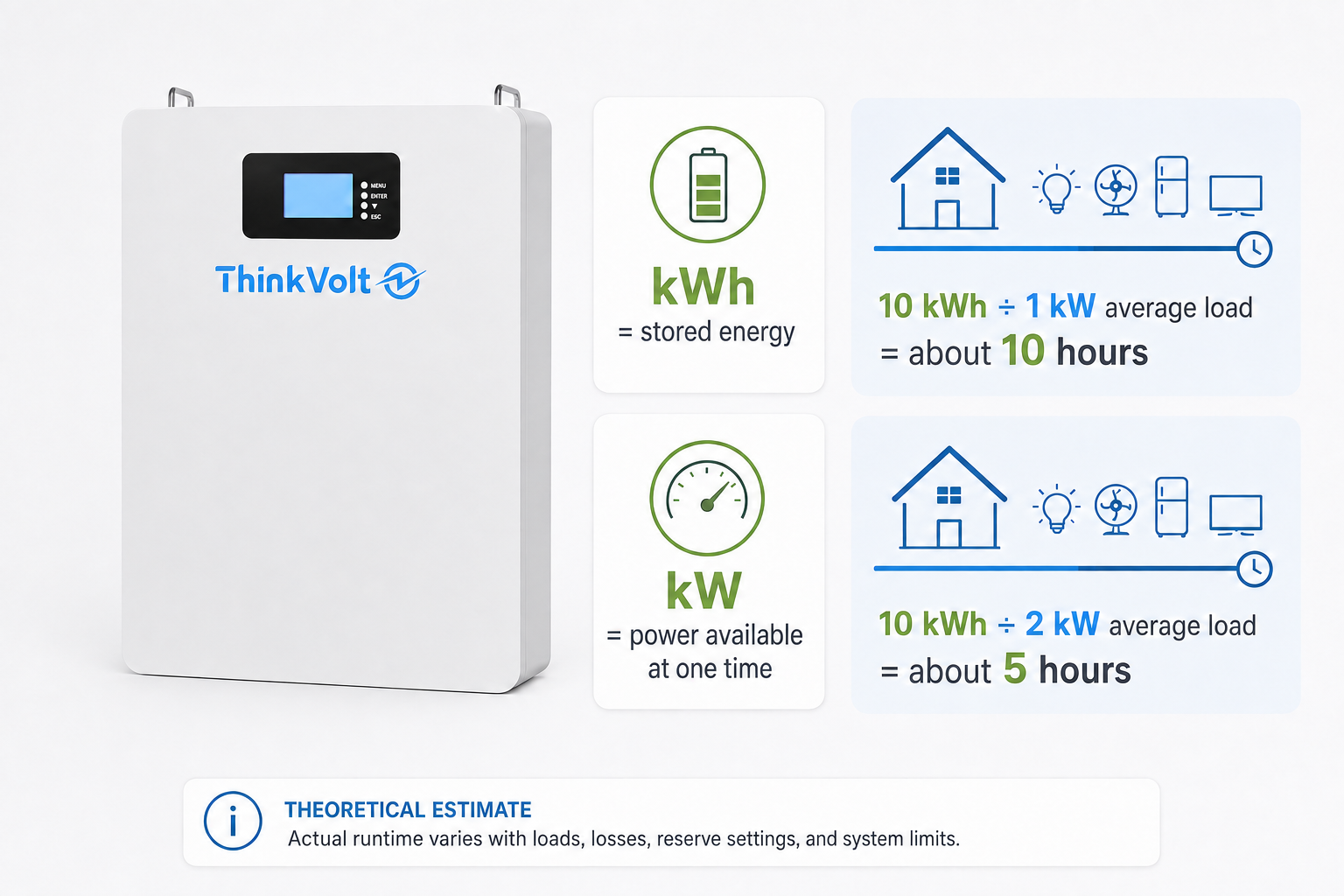
For example, 10 kWh of usable energy supporting an average 1 kW load gives a theoretical runtime of about 10 hours. At an average 2 kW load, the theoretical runtime falls to about 5 hours.
Actual runtime can be shorter because loads change, conversion losses occur, and the system may maintain a minimum SOC or backup reserve. Continuous and peak power limits must also be checked separately.
Choose a home battery based on the application rather than capacity alone. Start with:
· Daily energy consumption
· Peak load
· Required backup time
· Critical or whole-home backup requirements
· Existing solar system
· Exact inverter model
· Grid-charging requirements
· Installation environment
· Future expansion needs
If solar or an inverter is already installed, confirm the exact inverter model, battery voltage requirements, firmware, communication protocol, and system architecture.
Expansion should also be planned in advance. Adding batteries later may depend on the BMS, inverter, communication, cabling, protection equipment, and permitted system configuration.
Yes. Some systems can charge from the grid without solar panels. Grid-charging capability depends on the battery, inverter, operating settings, and local requirements.
Yes, if the system is designed for whole-home backup and has sufficient usable energy and power capability. The required configuration depends on which loads must operate and for how long.
Possibly. Check both continuous and peak power requirements. A battery’s kWh capacity alone cannot determine whether an air conditioner or another high-power appliance can operate.
Often yes, but compatibility must be checked. The existing inverter, PV configuration, battery requirements, communication method, and AC- or DC-coupled architecture can affect the solution.
Yes. Verify the exact inverter model, voltage window, firmware, communication protocol, and supported operating modes. Brand-level compatibility alone is not enough.
Some systems support expansion, but limits depend on the battery, BMS, inverter, communication, protection, and system configuration. Confirm expansion requirements before installation.
Provide daily energy use, peak load, required backup time, critical loads, solar system details, and the exact inverter model. Installation conditions and future expansion requirements may also affect sizing.
A home battery stores available energy and supplies it when your home needs it, but real performance depends on usable capacity, power capability, loads, system architecture, and operating settings.
ThinkVolt provides residential LFP battery and energy storage solutions for solar storage, backup, and off-grid applications. If you are evaluating a project, send us your daily energy use, peak load, required backup time, solar system details, inverter model, and installation conditions so the system configuration can be evaluated against your application.