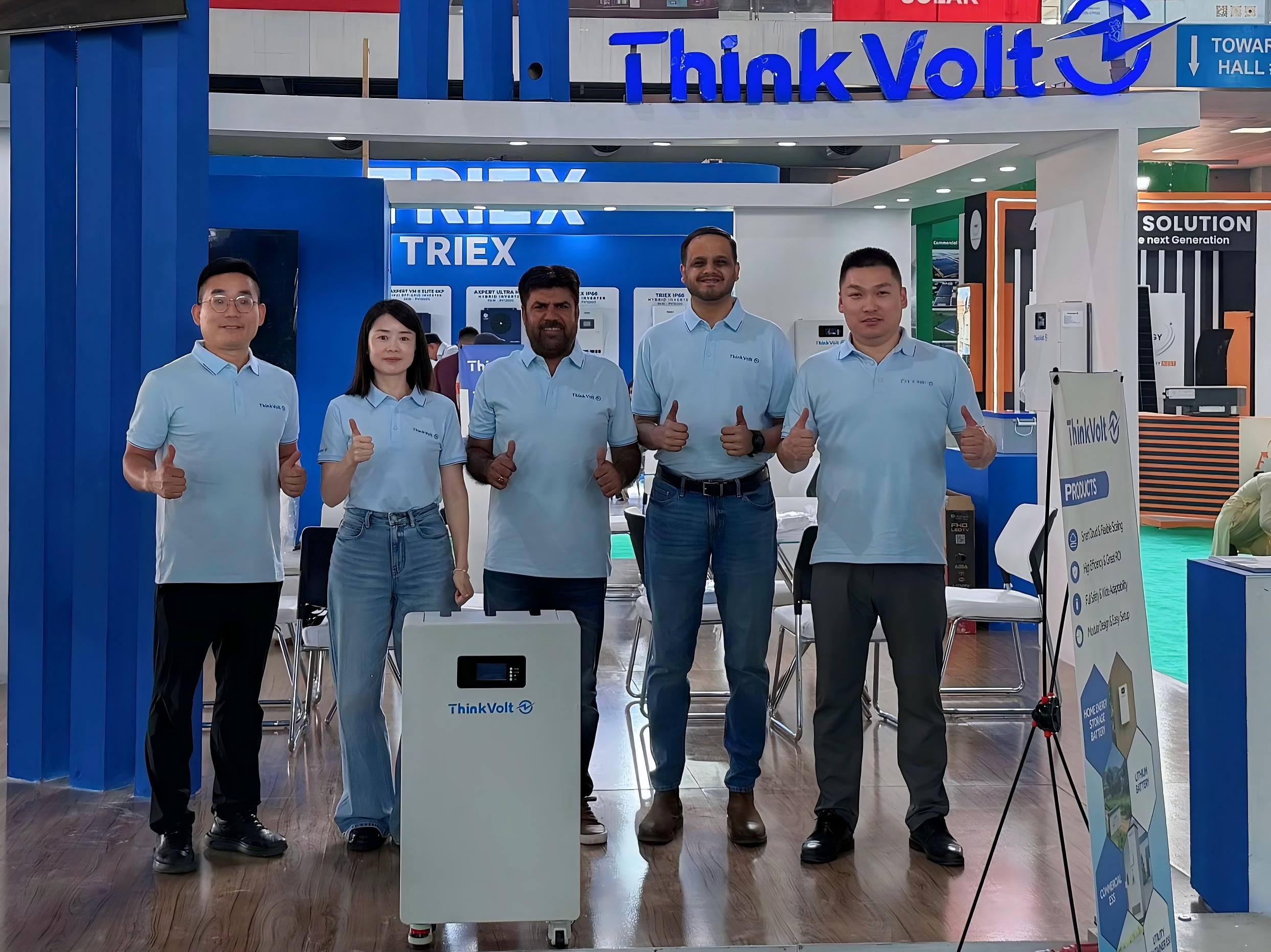
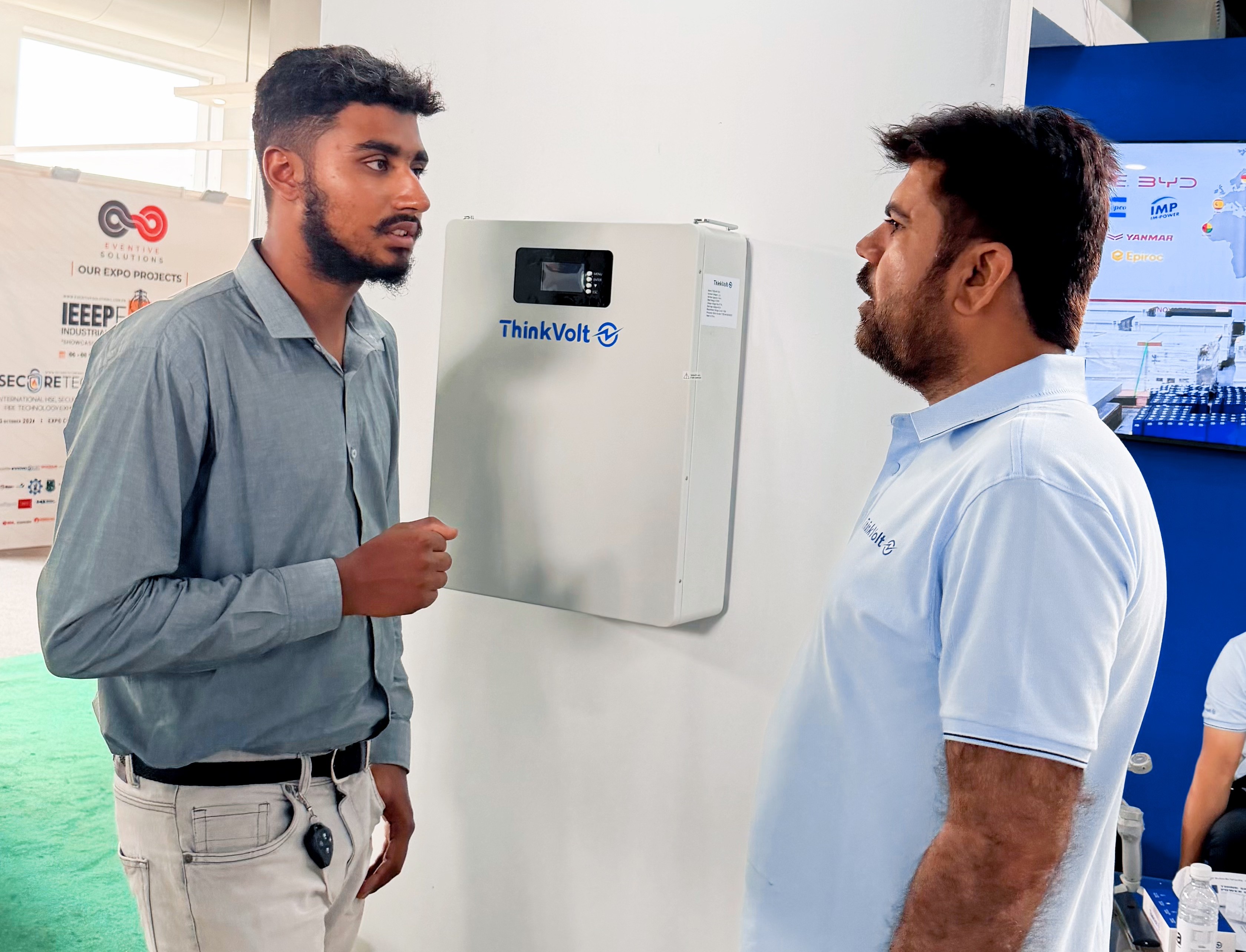
ThinkVolt at Solar & Storage Expo Pakistan 2026: Connecting with Pakistan’s Energy Storage Market
2026-07-23
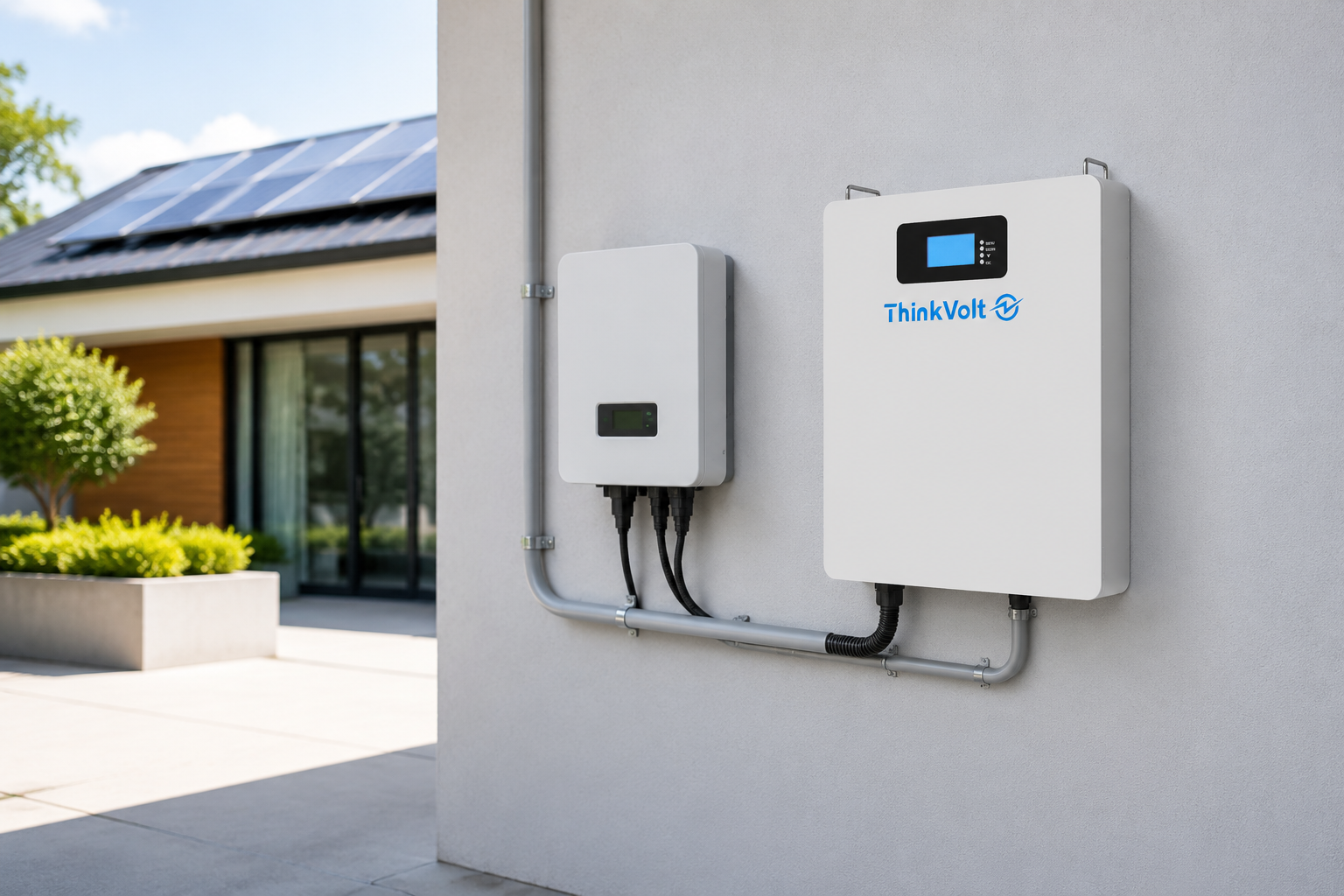
In home battery storage, kW (kilowatts) measures power—how much electricity the system can deliver at a given time—while kWh (kilowatt-hours) measures energy—how much electricity the battery can store and supply over time. In practical terms, kW helps determine which loads your battery can support at once, while kWh helps determine how long those loads can run.
This distinction matters when comparing home batteries because a larger capacity does not automatically mean higher power output. To choose the right system, you need to evaluate both sides of the equation: the kW required by your loads and the usable kWh required for your target backup time.
The difference between kW and kWh in battery storage is simple: kW measures power, while kWh measures energy. Power tells you how quickly a battery system can deliver electricity at a given moment, while energy tells you how much electricity is available over a period of time.
A kilowatt (kW) is a unit of power. For a home battery system, the kW rating helps you understand whether the system can support the electrical loads you want to run. If several appliances operate at the same time, their combined power demand needs to stay within the relevant output limits of the battery and inverter system.
A kilowatt-hour (kWh) is a unit of energy. It describes how much energy a battery stores or makes available for use. The kWh rating therefore matters when estimating how long your essential loads can remain powered during an outage or how much stored solar energy you can use later.
Rating | What It Measures | What Buyers Need to Know |
kW | Power | How much load can the system support at a given time? |
kWh | Energy | How much energy is available over time? |
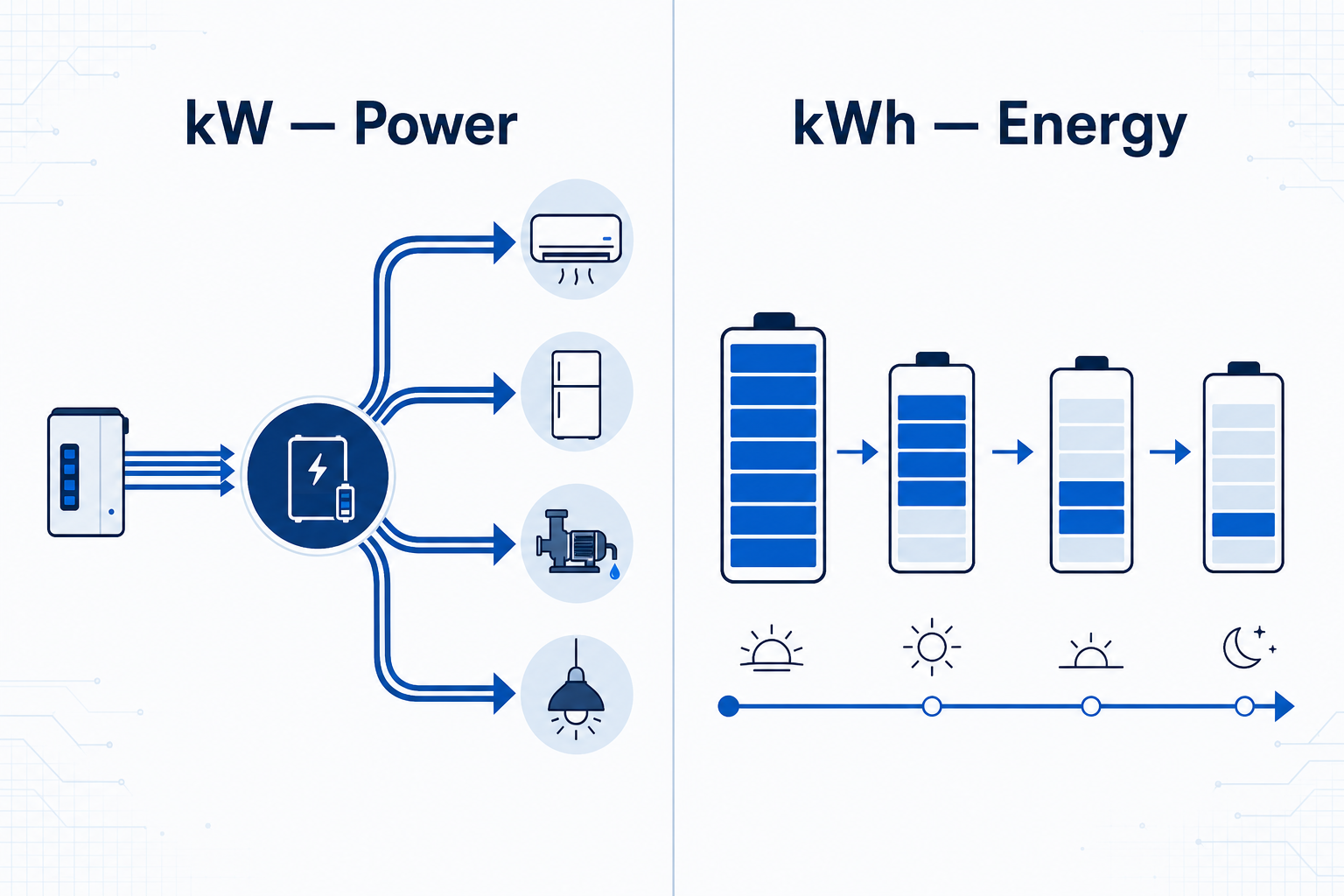
Battery capacity and battery power are therefore separate specifications. Understanding that distinction is the foundation for reading the rest of a home battery specification correctly.
kW, kWh, and operating time are connected by a simple relationship: Energy (kWh) = Power (kW) × Time (hours). For home battery storage, this relationship provides a useful starting point for estimating how long a given amount of usable energy could support a particular load.
For example, if a battery provides 10 kWh of usable energy and your home draws an average of 2 kW, the simplified calculation is:
10 kWh ÷ 2 kW = 5 hours
The same relationship works in the other direction. If the average load increased to 5 kW, the same 10 kWh of usable energy would theoretically last about two hours. A higher load consumes the available energy faster, while reducing the load extends the potential operating time.
However, this formula is a starting point rather than a guaranteed backup-time calculation. Real household loads change as appliances switch on and off, and actual runtime also depends on factors such as usable battery capacity, reserve settings, conversion losses, and system operating limits.
Use the formula to understand the relationship between power, energy, and time. For an actual project, use the battery and inverter specifications together with a realistic load profile.
The kW rating tells you how much power a home battery system can deliver, so it is one of the key specifications for determining which loads can operate at the same time.
Start by considering the loads that may run simultaneously. Their combined power demand needs to remain within the applicable output limit of the battery and inverter system. This becomes especially important when you want to support several major loads rather than only essential circuits such as lighting and basic electronics.
Continuous power describes the power a system can provide during normal sustained operation. When comparing batteries for backup, this rating helps you determine whether the system can continuously support your expected combination of loads.
Peak power, sometimes specified as surge power, refers to a higher output that may be available for a limited period. This can matter for equipment with motors or compressors that may require more power when starting than during normal operation.
The exact definition, duration, and operating conditions of a peak-power rating vary by product, so check the relevant technical documentation rather than comparing peak figures without their test conditions.
The inverter also matters. Battery power capability alone does not determine the AC power available to your home; the inverter and overall system architecture can impose their own limits. Compare your expected simultaneous and peak loads with the power specifications of the complete system.
The kWh rating tells you how much energy a home battery can store, making it a key specification for estimating how much electricity is available and how long your loads may be supported.
For buyers, the required battery capacity depends on how much energy you expect to use. A system designed to keep only essential loads running during an outage may require a different amount of energy from one intended to support broader household consumption.
Daily energy use can provide useful context, but it should not be treated as the only sizing number. The relevant kWh requirement should reflect what you actually want the battery to power and for how long.
When comparing home batteries, distinguish between rated or nominal energy and usable energy. The nominal kWh figure describes the battery’s stated energy capacity, while usable kWh indicates how much of that energy is available within the system’s defined operating limits.
The difference depends on the specific battery and its operating settings. Buyers should therefore avoid assuming that every system makes its full nominal capacity available to household loads.
For backup-time estimates, usable kWh is generally the more relevant figure to check. It provides a better basis for matching stored energy to your expected consumption and target runtime.
Yes. Two home batteries can have the same kWh capacity but different kW ratings, meaning they can store the same amount of energy while delivering power at different rates.
Consider three simplified examples:
Simplified Example | Power | Energy | Theoretical Full-Power Runtime |
Battery A | 5 kW | 10 kWh | 2 hours |
Battery B | 10 kW | 10 kWh | 1 hour |
Battery C | 5 kW | 20 kWh | 4 hours |
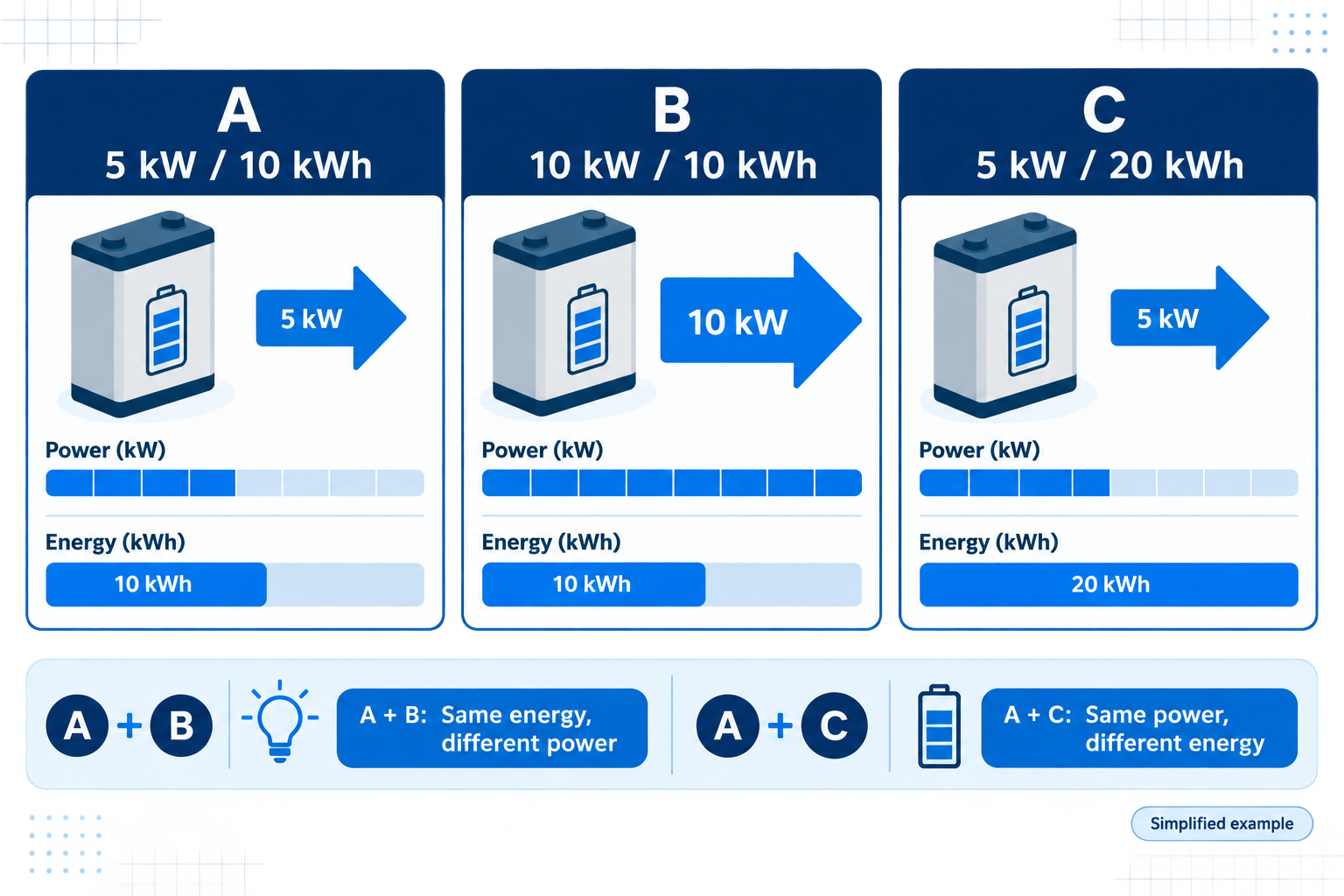
These values are illustrative only and are not product specifications. The runtime figures show the basic mathematical relationship and do not account for real system losses or operating limits.
Battery A and Battery B both have 10 kWh of energy, but Battery B has twice the power rating in this simplified comparison. It can deliver energy at a higher rate, while using the same amount of stored energy more quickly when operating at full power.
Battery A and Battery C show the opposite relationship. Both have a 5 kW power rating, but Battery C stores twice as much energy. Their power capability is the same in this example, while their theoretical runtime at the same power level differs.
This comparison gives buyers a useful rule: similar energy capacity does not necessarily mean similar power capability, and similar power ratings do not necessarily mean similar runtime.
The right home battery size depends on two separate requirements: the kW needed to support your expected loads and the kWh needed to provide energy for your target operating time. Estimate them separately before matching them to a battery and inverter system.
Start with the loads you want the battery to support. For backup applications, decide whether you need only essential loads or a broader set of household equipment.
Next, identify which loads are likely to operate at the same time. Their combined demand gives you a better indication of the continuous power your system needs than simply adding every appliance in the home. Equipment with motors or compressors may also have higher starting requirements, so peak demand should be checked where relevant.
You can then compare these requirements with the continuous and peak output specifications of the complete battery and inverter system.
For energy capacity, focus on how much electricity your selected loads will consume during the period you want them supported.
A basic approach is to estimate each load’s energy use from its power and expected operating time, then combine the results. For example, a load averaging 1 kW for four hours would require approximately 4 kWh of energy in a simplified calculation.
Your final requirement should also consider usable rather than nominal energy, along with applicable system losses and reserve settings. If the battery will be used for solar self-consumption rather than backup alone, your daily energy profile also becomes important.
There is no universal “right” kW or kWh rating for every home. A meaningful recommendation requires information such as your peak load, daily energy use, desired backup time, inverter model, and future expansion needs.
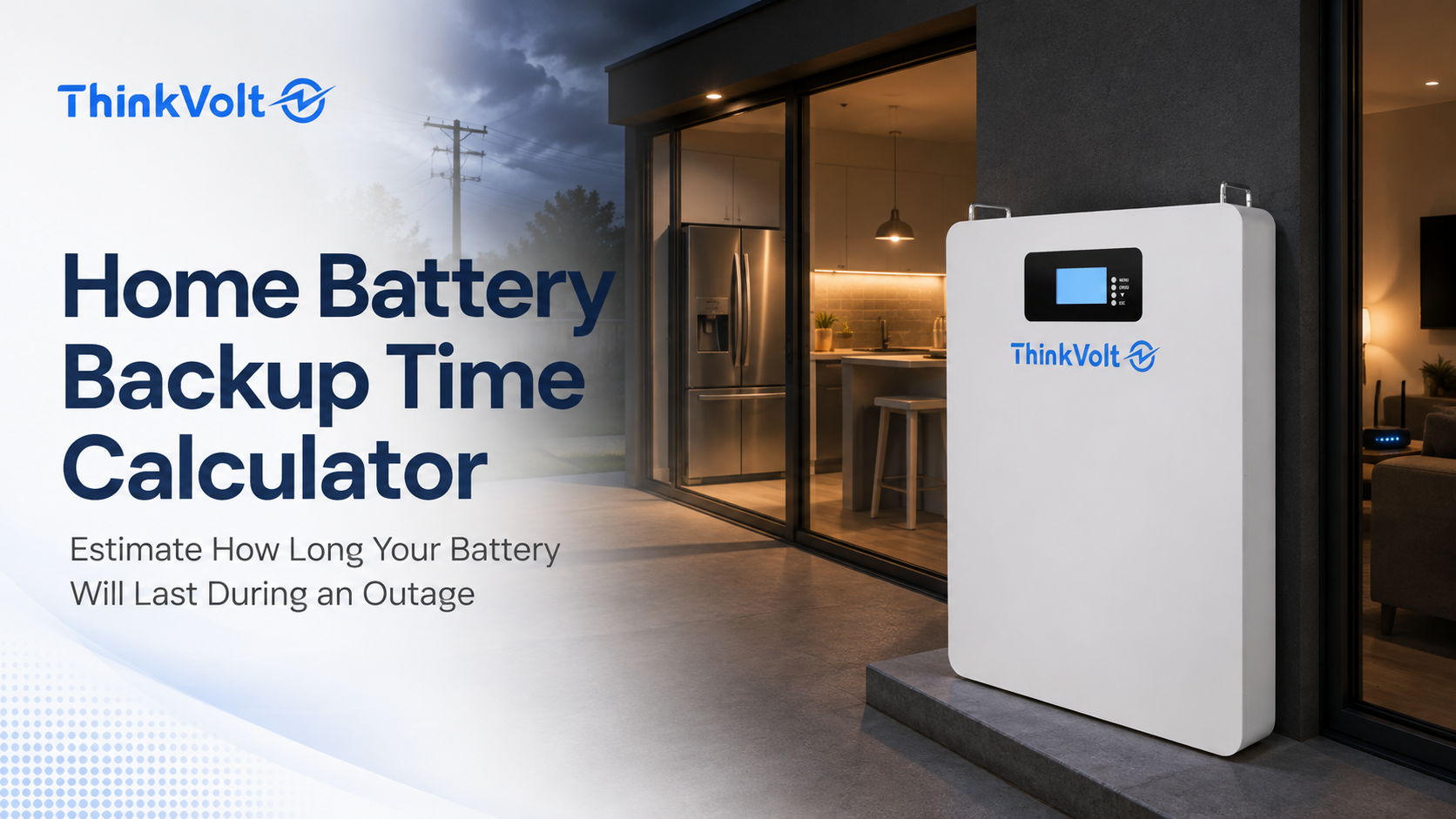
A 10 kWh home battery does not have one fixed runtime. How long it lasts depends mainly on the usable energy available from the battery and the average power demand of the loads it is supporting.
A simple estimate is:
Runtime (hours) ≈ Usable Energy (kWh) ÷ Average Load (kW)
For example, if 10 kWh of usable energy is available and the average load is 2 kW:
10 kWh ÷ 2 kW = approximately 5 hours
The effect of changing the load is easy to see:
Average Load | Usable Energy | Theoretical Runtime |
1 kW | 10 kWh | 10 hours |
2 kW | 10 kWh | 5 hours |
5 kW | 10 kWh | 2 hours |
These figures are simplified examples, not guaranteed battery runtimes.
In a real home, loads rarely remain constant. A refrigerator may cycle on and off, lighting use can change, and other appliances may be added or removed during an outage. Usable capacity, reserve settings, conversion losses, and other operating limits can further change the result.
If solar generation continues during the backup period, it may also extend how long the system can support the home. That requires a system-specific calculation because solar production and household demand both vary over time.
A home battery can support high-power appliances or whole-home backup only when the complete system has sufficient power output for the required loads and sufficient usable energy for the target runtime.
An essential-load backup system focuses on selected circuits or equipment that you want to keep operating during an outage. Because fewer loads need to operate together, the required power can be easier to manage, while the battery capacity can be planned around the energy those selected loads consume.
Whole-home backup presents a different challenge. More appliances may operate at the same time, so simultaneous demand becomes a central sizing consideration. Equipment with motors or compressors may also introduce starting or peak-power requirements.
Longer backup expectations add an energy requirement on top of the power requirement. A system may be capable of supplying the necessary loads but still need more usable kWh to maintain them for the desired period.
Before deciding that a battery can support high-power equipment or whole-home operation, compare the expected continuous and peak loads with the complete system’s power specifications, then evaluate usable energy against the required backup duration.
You should not choose a home battery by prioritizing kW or kWh alone. The goal is to find a system that passes a power check, an energy check, and a system-fit check for your application.
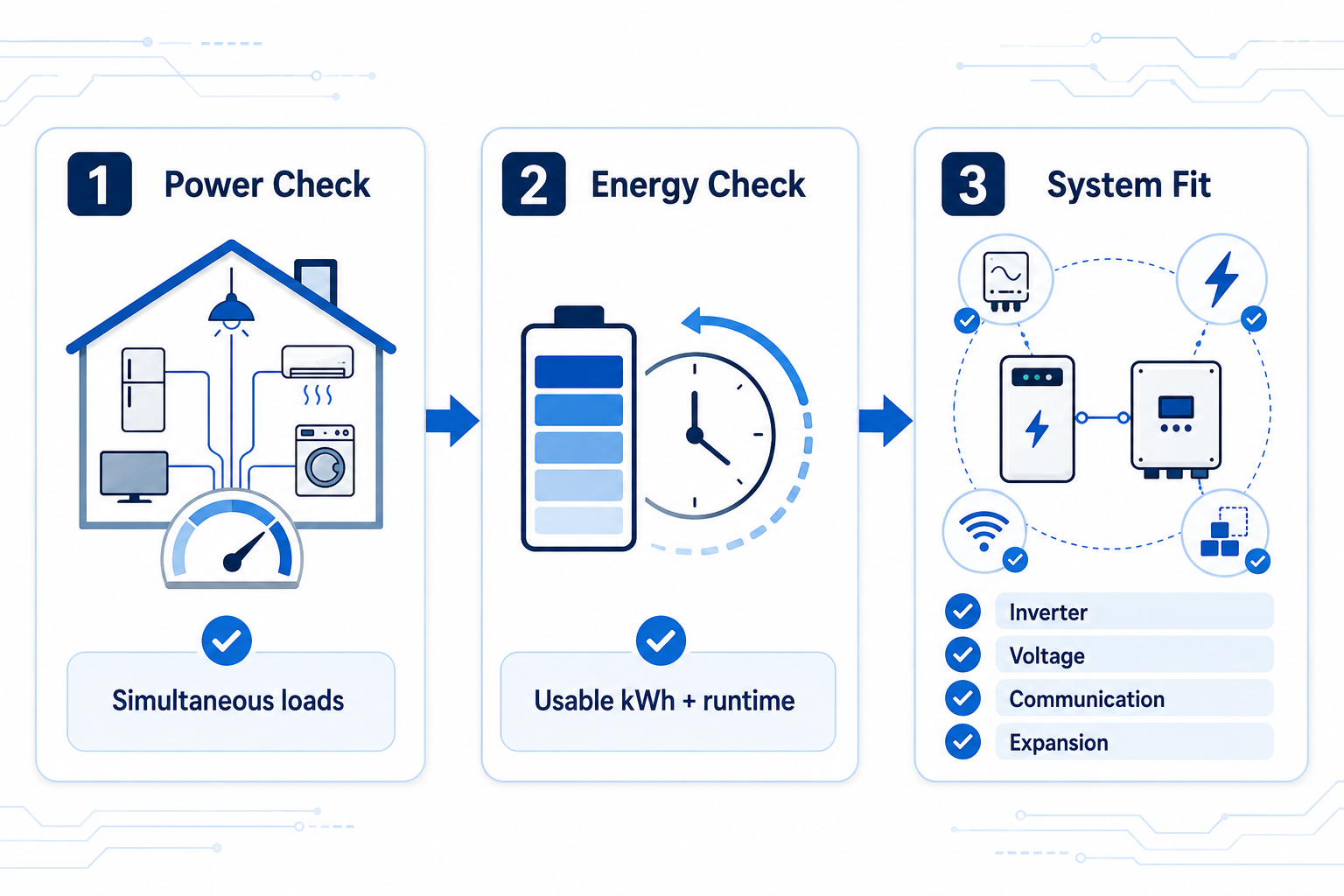
Compare the loads you expect to operate simultaneously with the system’s continuous power capability, and check starting or peak demand where relevant.
If one candidate battery system cannot support the required loads, having more stored energy does not solve that power constraint.
Compare your required operating time and expected energy consumption with the usable kWh available.
Two systems that can both supply your required power may still provide different backup durations because their usable energy capacities differ.
Once candidate systems satisfy your power and energy requirements, evaluate the rest of the installation. Check factors such as inverter compatibility, battery voltage, communication requirements, expansion options, and installation conditions.
Compatibility should be verified for the specific equipment rather than assumed from a brand name or general compatibility statement. The exact inverter model, firmware, voltage requirements, and communication protocol can all affect system integration.
The buying rule is straightforward: use kW to eliminate systems that cannot support your loads, use usable kWh to compare how well the remaining systems meet your runtime target, and then verify technical compatibility before making the final choice.
No. 10 kW describes power; 10 kWh describes energy capacity. One indicates how quickly a system can deliver power under specified conditions, while the other indicates how much energy is stored or available.
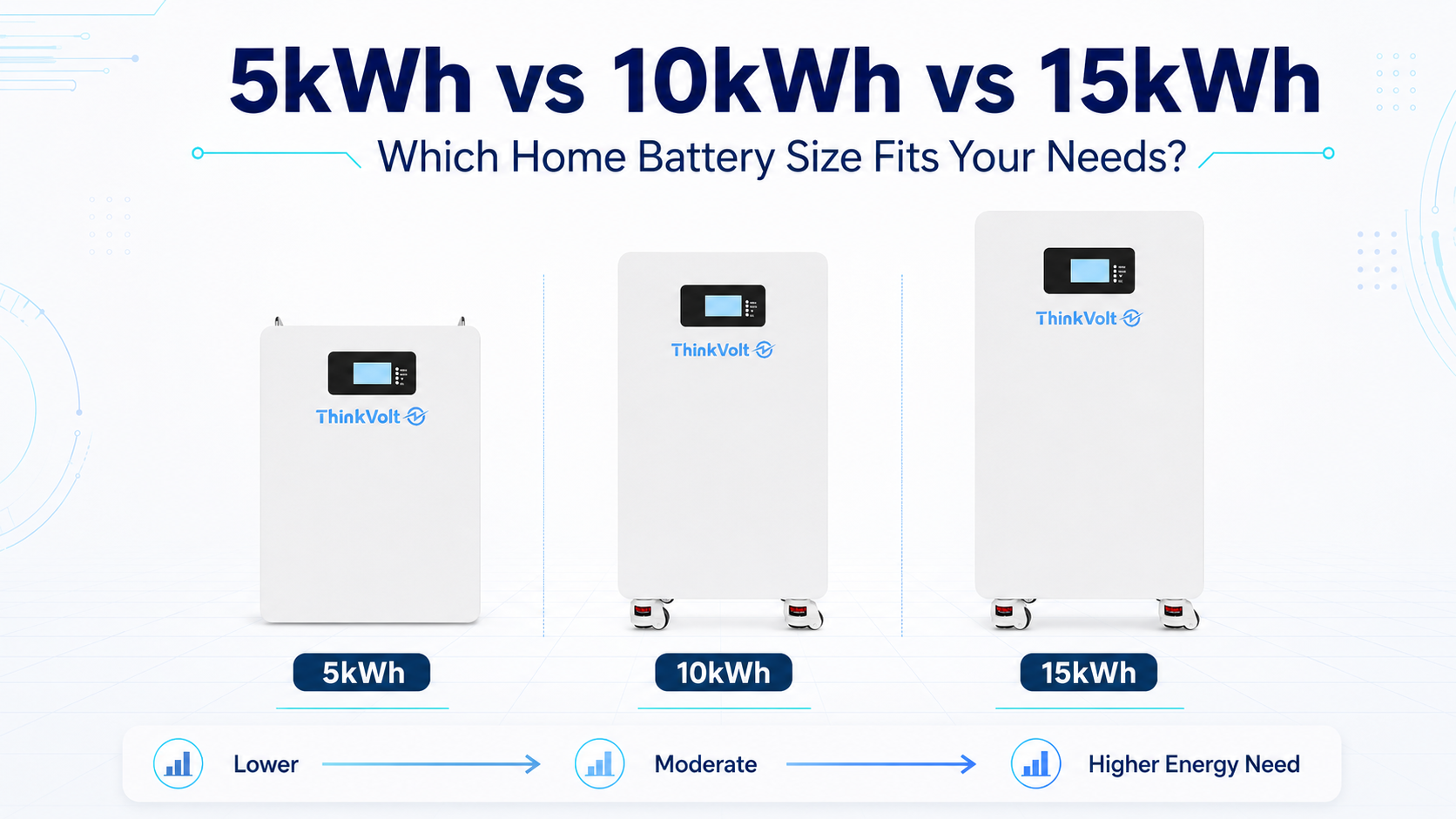
Not necessarily. A higher-kWh battery provides more energy capacity and may increase potential runtime, but it may also exceed what your application requires. The right capacity depends on energy use, backup targets, usable capacity, and future expansion plans.
If the required load exceeds the system’s applicable power limit, the system may not be able to support that combination of loads. The exact response depends on the battery, inverter, protection settings, and system design, so both continuous and peak limits should be checked.
For estimating practical backup time, usable kWh is generally more relevant. Nominal capacity states the battery’s rated energy, while usable energy reflects what is available within the system’s defined operating limits. The difference is product-specific.
Yes. The inverter is part of the power path between the battery and your AC loads, so its output capability and configuration can limit the power available to the home. Check the exact inverter model and the relevant battery compatibility requirements.
It can in some systems, but you should not assume power and energy will increase by the same proportion. Expansion behavior depends on the battery architecture, BMS, inverter, parallel configuration, protection, and manufacturer limits. Use the approved system configuration when planning expansion.
Provide your daily energy use, peak load, loads you want to back up, required backup time, inverter brand and model, installation conditions, and future expansion needs. For a project quotation, destination, quantity, and any certification or customization requirements are also useful.
Understanding kW vs kWh in battery storage makes home battery comparison easier: use kW to evaluate load capability and usable kWh to evaluate operating time, then verify that the battery, inverter, and overall system fit the application.
If you are evaluating a residential energy storage project, send ThinkVolt your peak load, daily energy use, required backup time, inverter model, and project requirements so the appropriate system configuration can be reviewed.