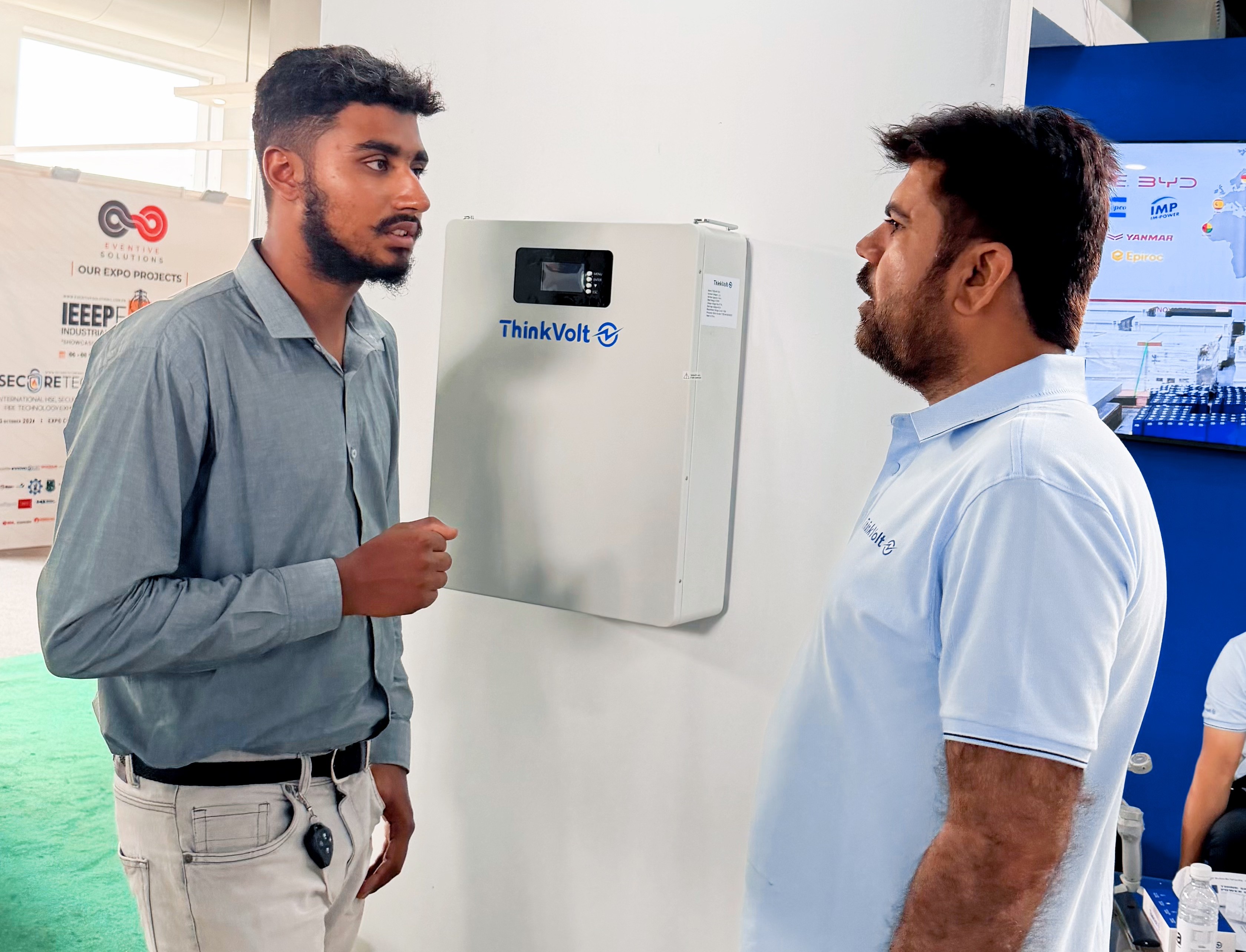
ThinkVolt at Solar & Storage Expo Pakistan 2026: Connecting with Pakistan’s Energy Storage Market
2026-07-23
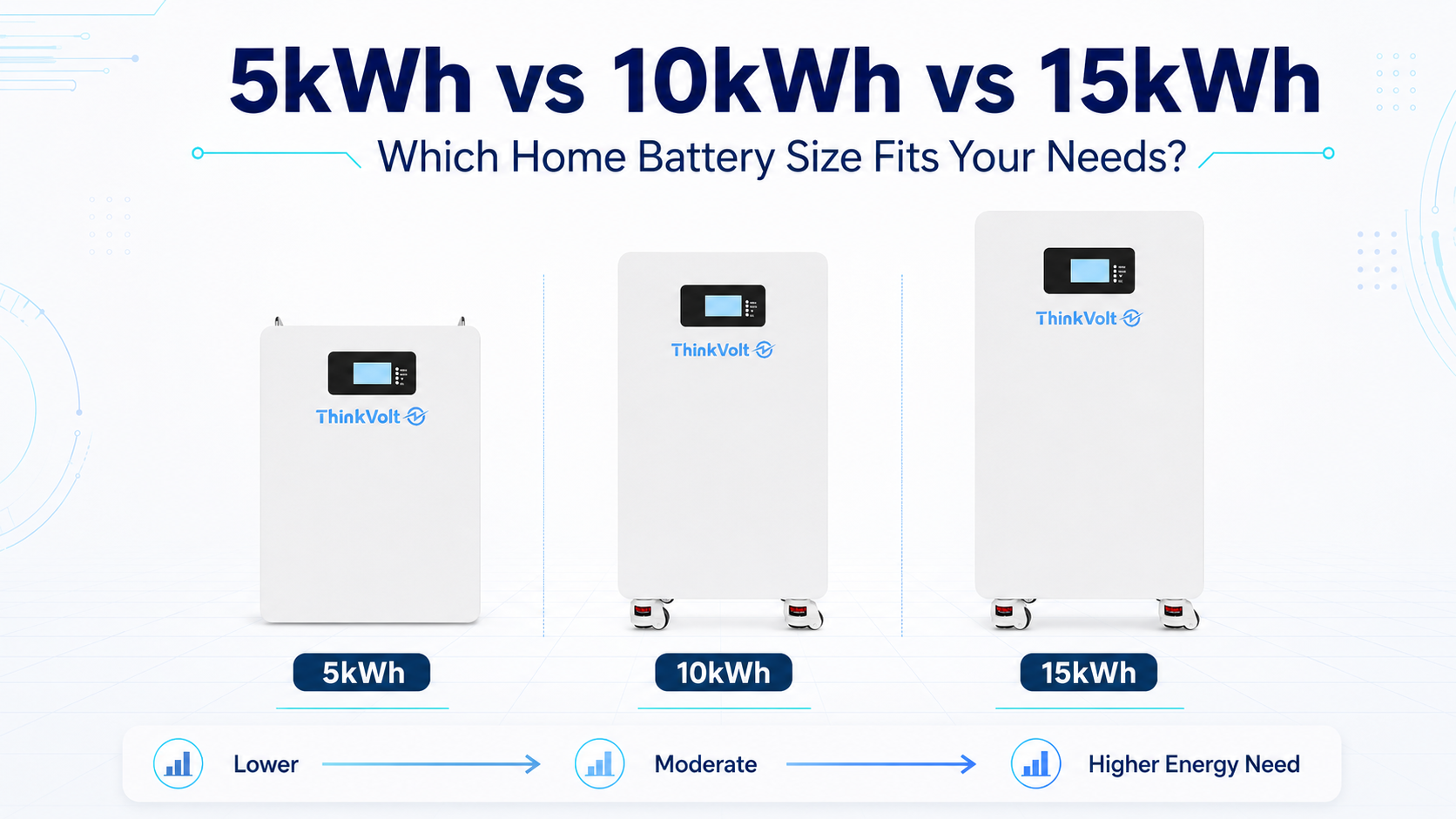
A 5kWh home battery is generally a better fit for lower energy needs or essential-load backup, while 10kWh provides more capacity for moderate evening use and longer backup. A 15kWh battery may make more sense when you need more stored energy for longer outages, higher overnight consumption, or greater solar energy storage.
However, the right size is not determined by household size alone. Your actual electricity use, backup loads, required backup time, usable battery capacity, solar generation, and future energy needs all affect the decision.
The main difference between a 5kWh, 10kWh, and 15kWh home battery is how much energy each one can store. Under similar system conditions, more capacity means more stored energy for your loads, but a higher kWh rating does not automatically mean higher power output.
A 5kWh battery is a practical starting point for lower energy requirements, such as essential-load backup or storing a smaller amount of surplus solar energy. A 10kWh battery provides twice the nominal energy capacity, giving you more room for evening consumption or longer backup.
A 15kWh battery provides three times the nominal capacity of a 5kWh battery. It can support a higher stored-energy requirement, but that does not make it the best choice for every home. Extra capacity has limited value if you rarely need or recharge it.
Battery Size | Stored-Energy Level | Good Starting Point for | Main Consideration |
5kWh | Lower | Essential loads and lower energy needs | Runtime becomes limited as demand increases |
10kWh | Medium | Moderate evening use and longer backup | Match capacity to actual consumption and solar availability |
15kWh | Higher | Higher energy needs and longer backup | Make sure the extra capacity can be used and recharged |
These figures describe nominal capacity. Actual usable energy can be lower depending on the battery’s operating limits, system settings, and efficiency.
The best battery size depends more on how much energy you expect the battery to supply than on how many people live in your home. Lower stored-energy needs may point toward 5kWh, moderate needs toward 10kWh, and higher energy requirements toward 15kWh.
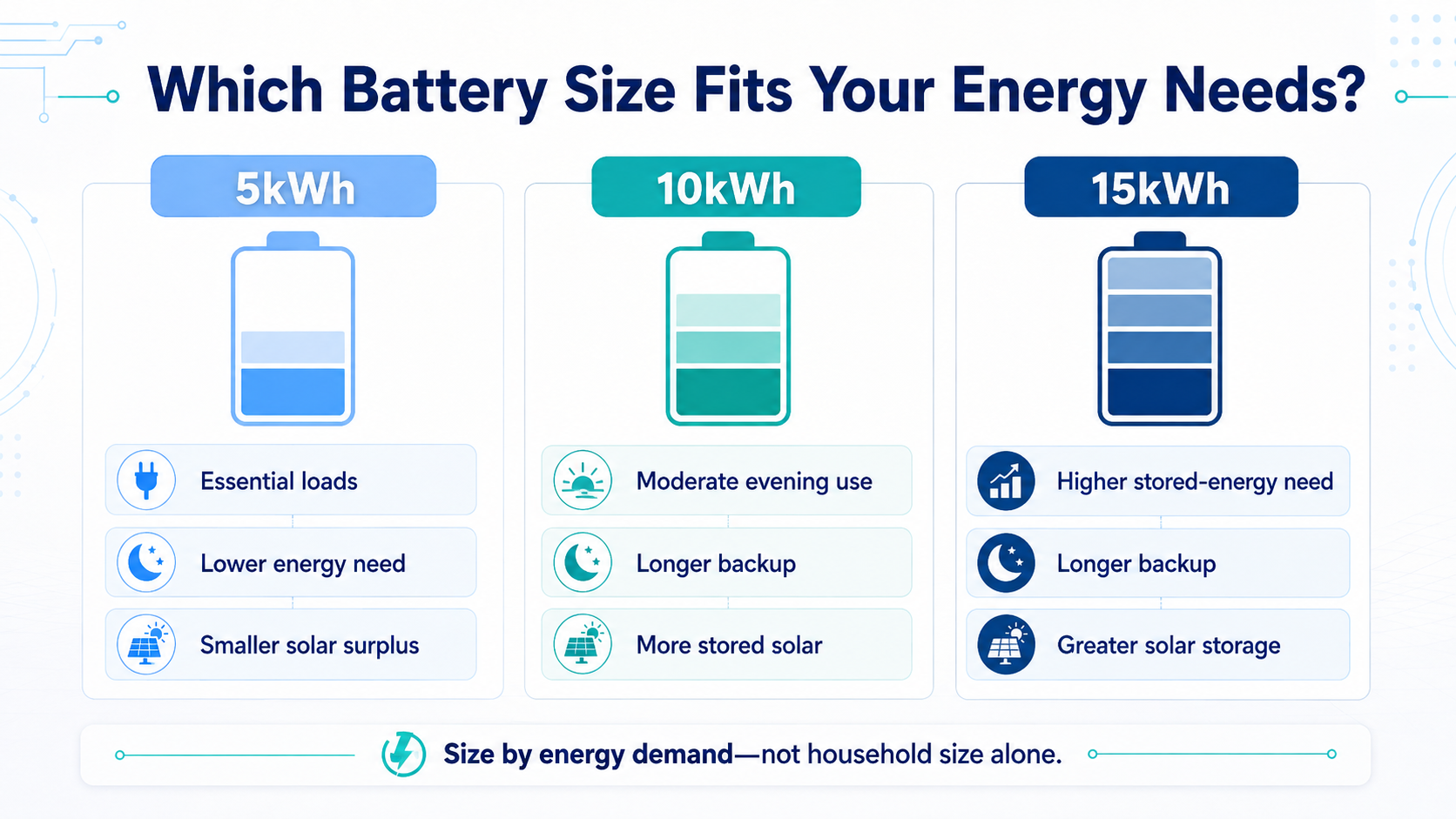
A 5kWh battery can be suitable if you mainly want to keep essential loads running during an outage or cover relatively low electricity use after sunset.
Your backup plan might include refrigeration, lighting, internet equipment, and selected outlets rather than every electrical load in the house. It can also make sense when you have a relatively small amount of surplus solar energy available for storage.
A 10kWh battery is worth considering when 5kWh does not provide enough stored energy for your evening use or desired backup duration.
It can offer a useful middle ground for households that want broader load coverage, longer essential-load backup, or greater use of stored solar energy without moving immediately to a larger system.
A 15kWh battery becomes more relevant when you need substantially more stored energy. This could result from higher evening consumption, longer backup requirements, or more surplus solar energy available for storage.
Additional loads such as EV charging, heat pumps, or air conditioning can also increase energy requirements if you expect the battery to support them. Their presence alone, however, does not mean you automatically need 15kWh.
Runtime depends on the battery’s usable energy and the average load it supplies. The higher the average load, the faster a 5kWh, 10kWh, or 15kWh battery will use its stored energy.
A simple estimate is:
Estimated runtime (hours) ≈ usable battery energy (kWh) ÷ average supported load (kW)
The table below is illustrative only. It assumes the full stated capacity is available and should not be treated as the guaranteed runtime of a specific battery system.
Battery Capacity | 0.5kW Average Load | 1kW Average Load | 2kW Average Load |
5kWh | 10 hours | 5 hours | 2.5 hours |
10kWh | 20 hours | 10 hours | 5 hours |
15kWh | 30 hours | 15 hours | 7.5 hours |
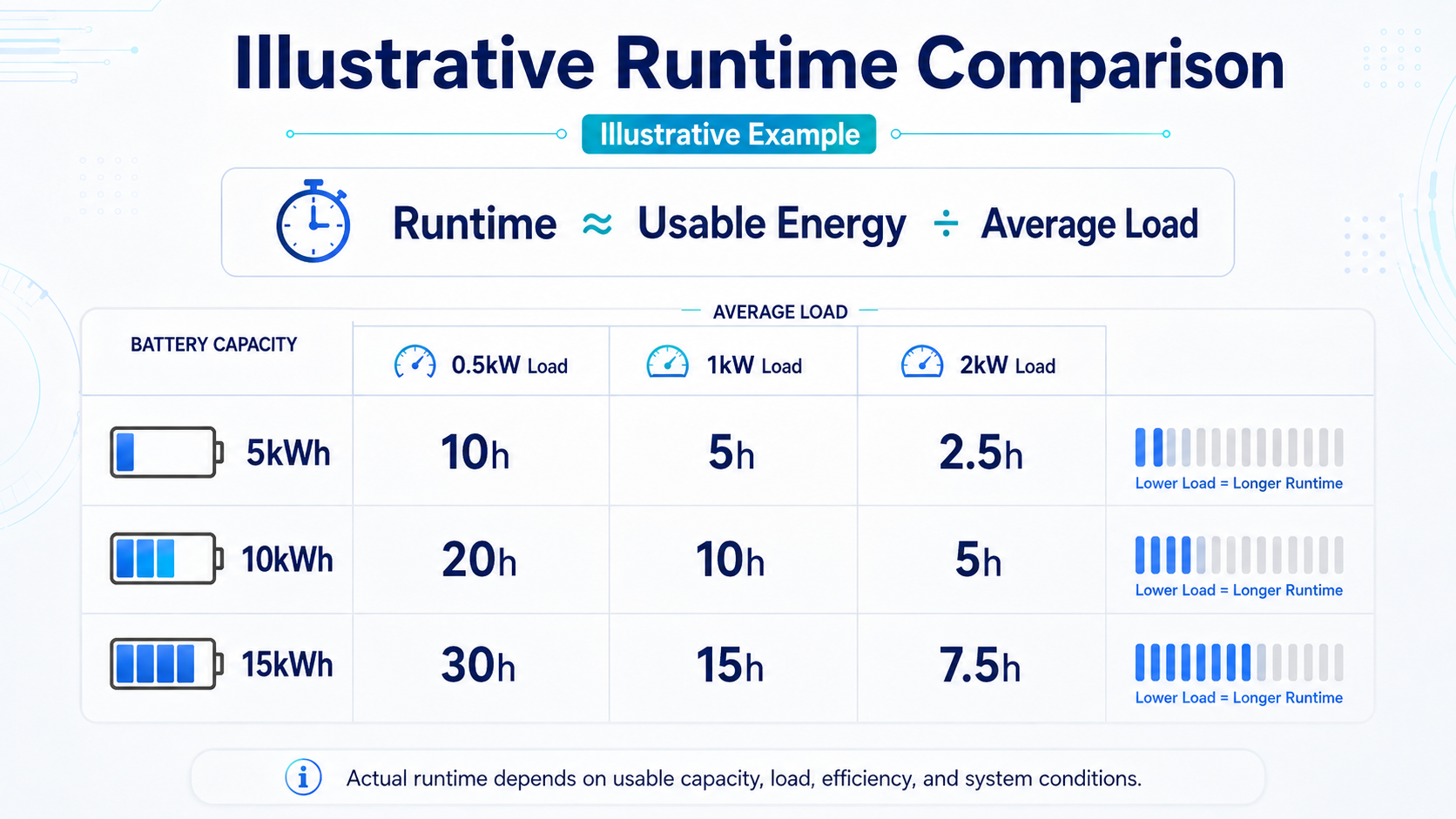
Actual runtime can be shorter because nominal capacity is not always equal to usable energy. Operating state-of-charge limits, conversion losses, system settings, and other conditions can reduce the energy available to your loads.
Household loads also change over time. Refrigerators cycle, lighting demand varies, and heating or cooling equipment may operate intermittently. A useful estimate should therefore be based on the loads you actually want to support and their expected energy use.
This is why there is no single answer to “How long will a 10kWh battery power a house?” The same battery can provide very different runtimes under different load profiles.
Battery capacity in kWh tells you how much energy the battery can store, while power in kW tells you how quickly the system can deliver energy. A 15kWh battery can store more energy than a 10kWh battery, but it does not automatically mean the system can run a larger load.
Capacity mainly affects how long supported loads can operate. Power determines whether the system can handle those loads at a given moment.
This distinction matters with air conditioners, heat pumps, pumps, and other equipment that may have relatively high operating or starting-power requirements.
Whether a battery system can support these loads depends on factors such as inverter output, battery discharge capability, and the combined power demand of equipment operating at the same time.
When comparing battery sizes, use kWh to evaluate how much energy you need and kW to verify whether the system can deliver the required power.
Start by calculating how much energy you want the battery to supply during your target period. Then account for the usable capacity and efficiency of the actual system you are considering.
Decide what you expect the battery to power.
For backup, you might prioritize refrigeration, lighting, internet equipment, and selected outlets. If air conditioning, electric heating, pumps, or other larger loads must also operate, include them in your assessment.
Sizing for essential loads can produce a very different result from sizing for broader household consumption.
Estimate how much energy those loads need over your required backup time.
At a basic level:
Required energy (kWh) = average supported load (kW) × required backup time (hours)
For example, if your supported loads average 1kW and you want eight hours of backup, the loads require about 8kWh of energy.
The load-energy figure is not necessarily the nominal battery capacity you should buy.
A practical relationship is:
Required nominal capacity ≈ required load energy ÷ usable-capacity fraction ÷ system efficiency
The correct usable-capacity and efficiency values should come from the specifications of the battery and system being evaluated rather than a generic assumption.
In the 1kW × 8-hour example, 8kWh is the load requirement. Once actual system limits and losses are considered, a capacity around the 10kWh class may be worth evaluating, but the final selection must be verified against the specific system.
Longer backup, higher evening consumption, more usable solar surplus, and additional loads can all push your requirement from 5kWh toward 10kWh or 15kWh.
A larger solar array does not automatically require a larger battery. What matters is how much surplus solar energy is available to charge the battery and how much stored energy you can use when solar production is low.
If you regularly export surplus solar power during the day and use significant electricity after sunset, more battery capacity may help shift that energy into evening use.
If your solar system rarely produces enough surplus to recharge additional storage, a much larger battery may provide less practical value unless another charging strategy is part of the system design.
An EV, heat pump, or air conditioner can increase battery requirements, but only when the battery is expected to support that load.
For example, an EV charged directly from the grid or daytime solar may have little effect on the storage required for overnight household backup. If battery energy will contribute significantly to EV charging, the calculation changes.
The same principle applies to heating and cooling: estimate how much energy the equipment will require during the period the battery is expected to support it.
Backup duration can change the required capacity even when the loads remain unchanged. At an average 1kW load, increasing the backup target from five to ten hours increases the load-energy requirement from 5kWh to 10kWh.
Planned EV charging, electric heating, cooling, or other future loads should also be considered before making the final choice.
A battery that is too small may not provide the stored energy or backup time you need, while an oversized battery can leave capacity regularly unused. The better choice is usually one that meets a defined requirement with reasonable room for future changes.
If the Battery Is Too Small | If the Battery Is Too Large |
Backup may end earlier than required | Part of the capacity may remain unused |
Longer outages leave less flexibility | Available solar surplus may not regularly recharge the extra capacity |
New loads may exceed the original plan | You may buy more storage than current needs justify |
If your essential loads require more usable energy than the system can provide, you either need to reduce the supported loads or increase battery capacity.
More capacity can provide additional backup potential, but only when you have a practical way to charge and use it. A larger battery cannot create additional solar surplus or reduce the energy demand of your loads.
Future growth can justify some extra capacity, but the decision should be based on a realistic plan rather than simply choosing the largest battery available.
If your future energy demand is uncertain, an expandable battery system may provide more flexibility than buying the largest capacity immediately. However, expansion capability must be confirmed before installation.
Buying more capacity now can make sense when you already expect a known increase in evening electricity use, backup duration, or supported loads.
If those requirements are uncertain, starting with a smaller configuration and expanding later may reduce the chance of installing capacity that remains underused.
However, a modular battery is not necessarily expandable without limits. The battery model, BMS, inverter, voltage requirements, communication, protection, and overall system design can affect what additional capacity is supported.
For homeowners, this means future expansion should be discussed before the first installation. For dealers and installers, expected future loads and expansion requirements should be part of customer qualification.
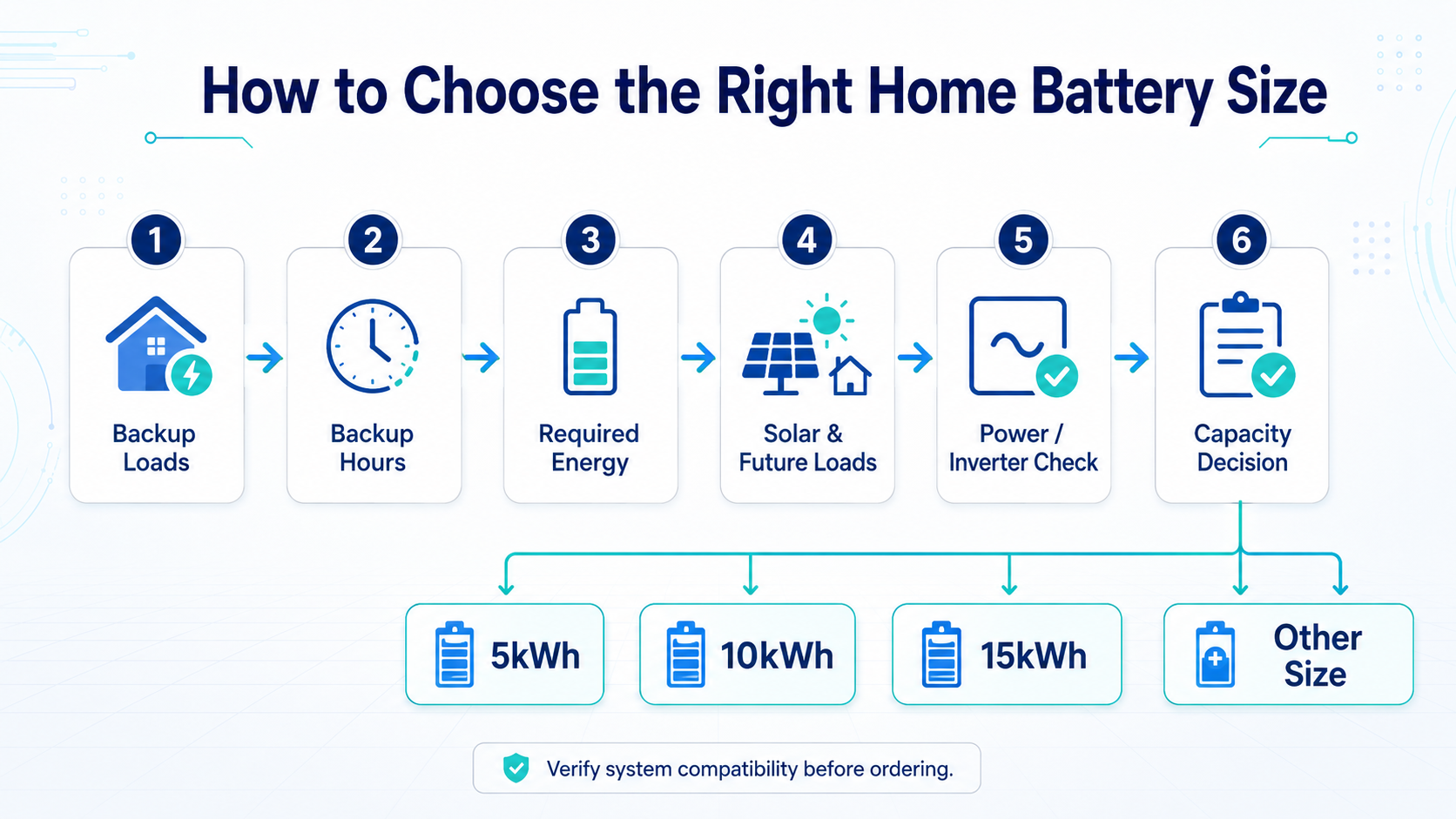
Choose the battery size that covers the energy you actually need rather than simply selecting the largest available option.
Consider 5kWh when your main goal is essential-load backup, relatively low evening consumption, or storing a smaller amount of surplus solar energy.
Consider 10kWh when 5kWh does not provide enough energy for your desired backup duration or evening use, and you need a practical middle ground.
Consider 15kWh when your calculated energy requirement is substantially higher, you want longer backup, or you have enough solar surplus and nighttime demand to use the additional storage.
Before ordering, verify your load profile, backup hours, usable battery capacity, solar generation, inverter model, power requirements, and future expansion plans. Your calculation may also show that a capacity outside the 5kWh, 10kWh, and 15kWh categories is a better fit.
It can be if your overnight loads fit within the battery’s usable energy. A 5kWh battery is more realistic for selected essential loads or relatively low overnight consumption than unrestricted whole-home use. Calculate the energy required between charging periods before deciding.
Possibly, but capacity alone cannot confirm it. You need enough usable energy for the required duration and sufficient inverter and battery output to support simultaneous loads. Homes with electric heating, cooling, pumps, or other high-power equipment require additional power checks.
No. The extra capacity is useful only when your energy demand, backup target, charging strategy, or future needs can make practical use of it. If the additional capacity regularly remains unused, a smaller or expandable system may be more appropriate.
Not necessarily. For backup, focus on the loads you need to support and the required hours. For solar self-consumption, also consider available solar surplus and electricity use when PV production is low. Daily consumption is useful data, but it is not a complete sizing rule.
Only if the system supports expansion. Battery model, BMS configuration, inverter compatibility, voltage, communication, and other system requirements can affect expansion. If future capacity is important, confirm the supported configuration before purchasing the initial system.
Not automatically. Increasing kWh capacity can extend runtime without increasing the power required by your loads. A larger inverter becomes relevant when your system must support greater simultaneous or peak power demand, so battery capacity and inverter power should be checked separately.
Provide your location and grid application, electricity-use data, required backup loads and hours, peak load, PV system information, and inverter brand and model. Also explain the installation environment and future expansion plans so the supplier can evaluate both battery capacity and system compatibility.
The right home battery is not simply the largest one you can install. Start with your required energy and backup time, verify power and system compatibility, and then choose the capacity that best fits those requirements.
If you are sizing a home energy storage project, send ThinkVolt your backup loads, required backup hours, daily energy use, PV system details, inverter model, and expansion requirements to evaluate a suitable battery configuration.