ThinkVolt at Solar & Storage Expo Pakistan 2026: Connecting with Pakistan’s Energy Storage Market
2026-07-23

Nominal battery capacity is the stated capacity or energy rating used as a reference, while usable battery capacity is the portion available within the permitted operating range. Usable capacity is usually lower because depth of discharge (DoD), the state-of-charge (SOC) operating window, and BMS limits determine how much nominal energy can be accessed during normal operation.
For buyers and installers, this difference affects battery comparison, backup calculations, and system sizing. It is also important to separate usable battery energy from the energy ultimately delivered to the load after system losses.
Nominal battery capacity describes the battery's stated capacity or energy rating. Usable battery capacity tells you how much energy is intended to be accessible within the manufacturer's permitted operating range.
For energy storage systems, energy is commonly expressed in kilowatt-hours (kWh). Capacity may also be listed in ampere-hours (Ah), but Ah must be considered together with battery voltage to understand stored energy.
Nominal Capacity | Usable Capacity |
Stated capacity or energy rating | Energy available within the permitted operating range |
May be shown in Ah or kWh | Commonly compared in kWh for energy storage |
Does not by itself show normal operating limits | Reflects the permitted usable portion |
Two batteries can therefore have the same nominal kWh but different usable energy. For procurement, nominal capacity is a useful reference, but it should not be the only number used to compare batteries.
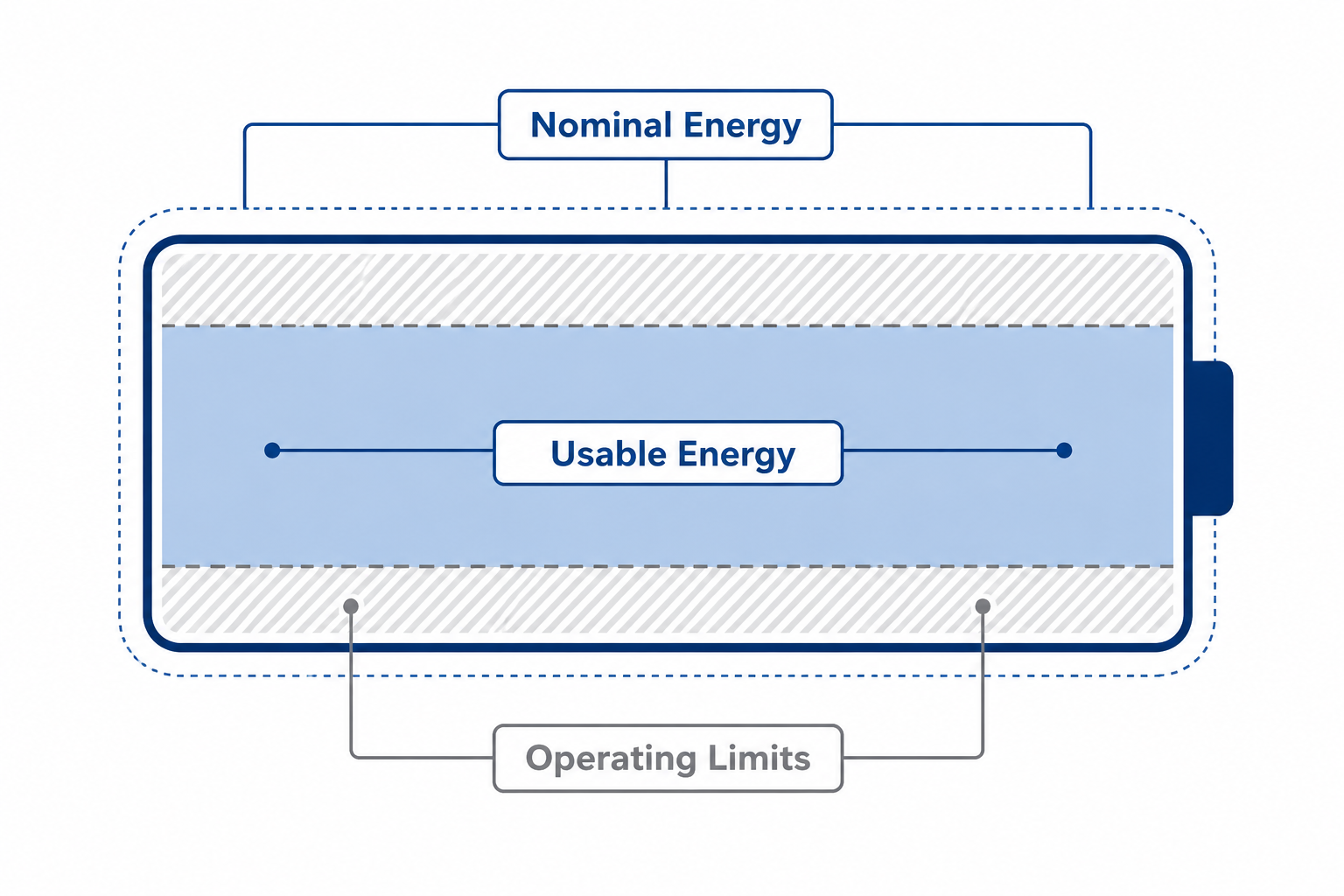
Usable capacity is usually lower because a battery operates within defined charge and discharge limits rather than making its entire nominal energy range available during normal use.
Part of the nominal capacity may remain outside the permitted operating window. This does not necessarily mean the capacity is missing or wasted. The nominal rating and usable energy simply describe the battery at different operating boundaries.
The battery management system (BMS) monitors battery conditions and enforces defined operating limits. Depending on the battery design, it can respond when voltage, current, temperature, or other monitored conditions move outside permitted boundaries.
However, the BMS is not the only reason nominal and usable capacity differ. The usable range is determined by the battery design and manufacturer-defined operating conditions; the BMS helps enforce those conditions.
For buyers, the practical rule is to check the stated usable energy and its operating conditions instead of assuming the full nominal capacity is accessible.
If the manufacturer provides a permitted usable fraction, usable energy can be estimated with a simple formula:
Usable energy (kWh) ≈ Nominal energy (kWh) × Permitted usable fraction
For example, if a battery has 10 kWh nominal energy and 90% of that energy is permitted for use:
10 kWh × 90% = 9 kWh usable energy
If the permitted fraction is expressed as DoD, the same simplified approach may apply when the manufacturer’s definition supports it.
However, this formula should help you understand a specification, not replace one. If a datasheet already states both nominal and usable energy, use the manufacturer's usable-energy value and check the associated DoD, SOC range, and test conditions.
This is particularly important when comparing suppliers because similar percentages do not always represent identical operating or measurement conditions.
Depth of discharge (DoD) describes how much of a battery's capacity is discharged, while the SOC operating window defines the upper and lower state-of-charge limits within which the battery is intended to operate.
A wider permitted SOC window generally makes a larger portion of nominal energy accessible. For example, an operating range from 95% to 15% SOC represents an 80-percentage-point window. This helps explain the available range, but it does not replace the manufacturer's stated usable-energy specification.
No. DoD is a percentage describing discharge depth, while usable capacity is an amount of energy, commonly expressed in kWh.
A manufacturer may use a specified DoD when determining usable energy, so the two are related. However, a higher DoD alone does not prove that one battery provides more usable kWh than another. Nominal energy and the conditions behind the specification also matter.
Check both the upper and lower SOC limits. For example, ThinkVolt lists a 15%–95% operating SOC range for the referenced TVES low-voltage LFP storage batteries. This is a product-specific specification, not a universal SOC range for all LFP batteries.
When comparing products, read nominal energy, usable energy, DoD or SOC limits, and their stated conditions together.
Not necessarily. Battery terminology is not always used identically across manufacturers, so similar labels should not automatically be treated as equivalent specifications.
Datasheet Term | What to Verify |
Nominal capacity | Unit, voltage basis, and definition |
Rated capacity | Rating and test conditions |
Nominal or rated energy | How the kWh value is determined |
Total or nameplate energy | Whether operating limits are excluded |
Usable energy | DoD or SOC conditions associated with it |
A "rated energy" value from one supplier should not automatically be compared with another supplier's "usable energy" as if they describe the same boundary.
The same applies to Ah and kWh. Ah describes charge capacity and must be considered with voltage, while kWh directly describes energy. For energy-storage procurement, kWh is therefore generally more useful for comparing available energy.
The key rule is to compare definitions, units, operating limits, and test conditions—not just specification labels.
Not necessarily. Usable battery energy describes energy available from the battery within its permitted operating range. The energy ultimately delivered to a load may be lower because of downstream conversion and system losses.
The distinction can be viewed as:
Nominal Battery Energy
↓ operating limits
Usable Battery Energy
↓ conversion and system losses
Energy Delivered to the Load
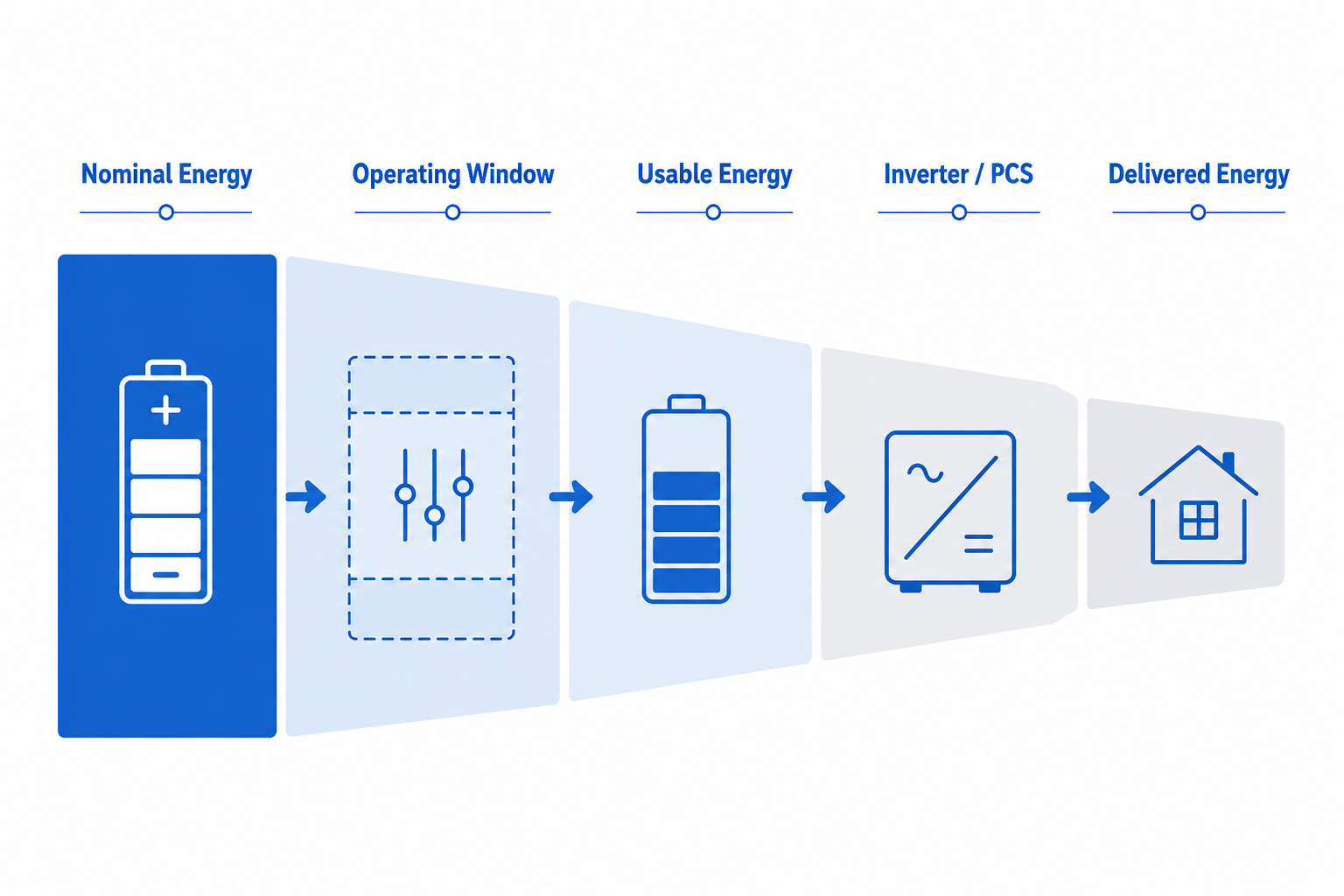
An inverter or power conversion system, for example, converts battery-side DC energy into the form required by the load. This means a stated usable capacity of a certain number of kWh does not automatically mean the same number of kWh will reach an AC load.
It is clearer to treat inverter efficiency as a downstream conversion factor rather than redefining the battery's stated usable capacity.
Battery charge/discharge efficiency, inverter efficiency, and overall system efficiency may describe different measurement boundaries. Keeping them separate prevents buyers from comparing one supplier's battery-side usable kWh with another supplier's system-level delivered energy.
For battery system sizing, use stated usable energy as the battery-side reference rather than nominal kWh alone. Start with the energy required by the loads and work backward toward the battery capacity needed.
A practical sequence is:
Load energy requirement → system losses → required usable battery energy → appropriate nominal battery capacity
No. Nominal kWh does not by itself show how much energy is available within the permitted operating range.
Installers should consider required backup energy, usable battery capacity, applicable conversion efficiency, and any project-specific design margin. Power must also be checked separately: sufficient kWh does not automatically mean the battery and inverter can support the required peak kW.
Actual project sizing also depends on daily energy use, peak load, backup time, inverter configuration, and installation conditions.
A useful rule is: for product comparison, start with usable kWh; for system sizing, work backward from the load.
Two batteries with the same nominal kWh should not be considered equivalent based on nameplate capacity alone. Buyers and installers should compare the usable energy and the conditions behind it.
Specification | What to Ask |
Nominal energy | Are both products using a comparable energy basis? |
Usable energy | How many kWh are available during normal operation? |
DoD / SOC window | Under what operating limits is usable energy specified? |
BMS limits | What operating boundaries are enforced? |
Test conditions | Were the capacity figures measured under comparable conditions? |
Efficiency | Does it refer to the battery, inverter, or complete system? |
Configuration | Does the figure apply to the intended system setup? |
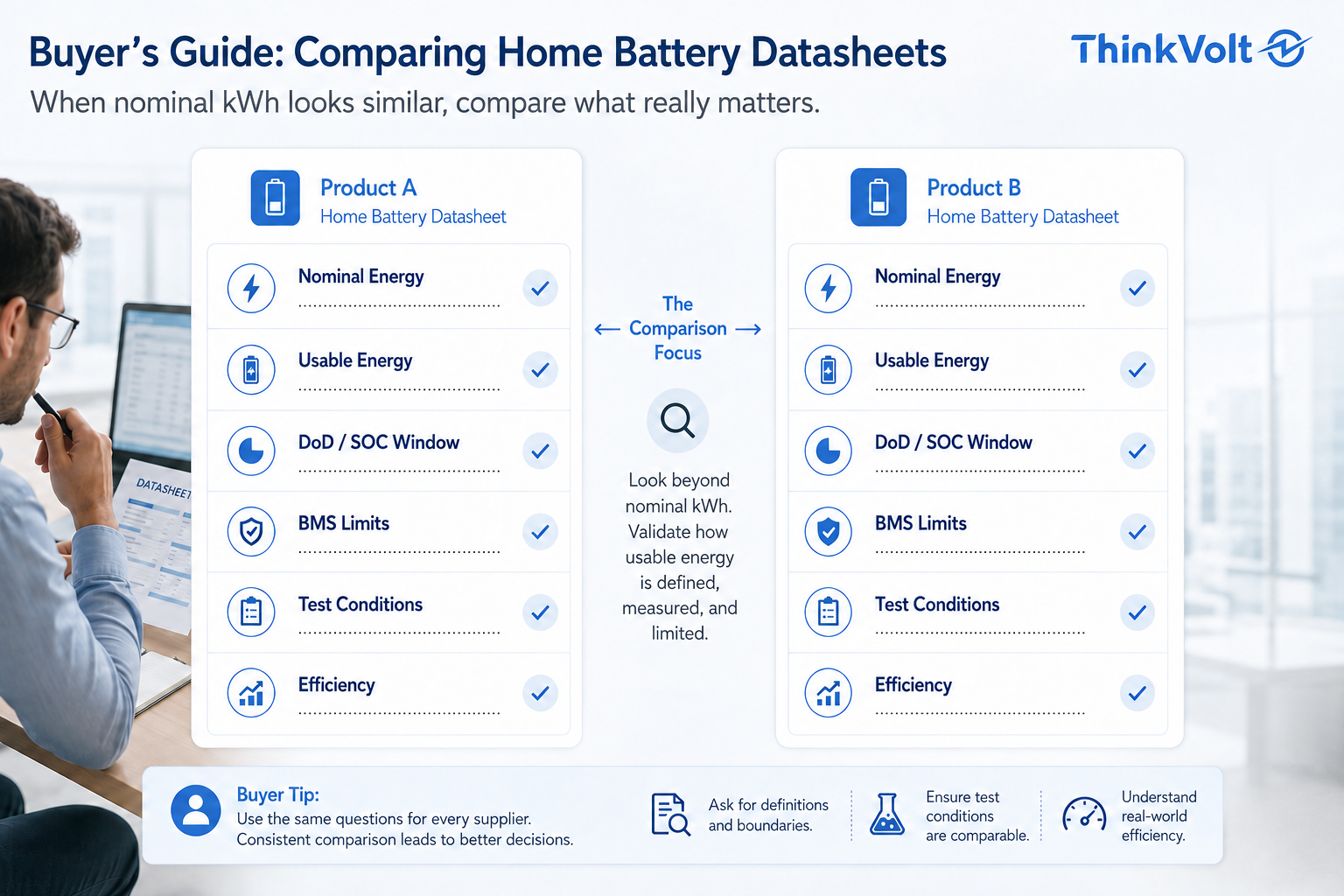
A higher nominal kWh does not automatically mean more usable energy. Likewise, a higher usable-energy figure should be checked against its specified operating and test conditions.
Instead of asking a supplier only, "How many kWh is the battery?" , ask:
"What are the nominal and usable energy values, and under what SOC or DoD limits and test conditions are they specified?"
For systems involving an inverter or multiple batteries, also confirm that the capacity specification applies to the intended configuration and that the exact inverter and communication requirements are supported.
Do not assume that the largest kWh number on a datasheet represents the energy available for normal use. Identify whether the figure is nominal or usable, then check the operating conditions behind it.
A practical sequence is:
Read the definition → check the operating window → confirm usable kWh → account for system losses → size and compare.
When a specification is unclear, ask the supplier how nominal and usable energy are defined and under what conditions they were measured.
A manufacturer may specify 100% usable capacity or 100% DoD, but the figure must be interpreted according to its definition. It does not necessarily mean every internal electrochemical limit is exposed to the user. Check the usable energy, SOC limits, BMS settings, and test conditions for the specific battery.
Yes. Available capacity can decrease as a battery ages. The change depends on the battery, cycling profile, temperature, operating conditions, and other factors, so use model-specific capacity-retention or state-of-health data for long-term planning.
Yes. Available energy and battery performance can vary with temperature, but the effect is product- and condition-dependent. Check the operating and charging temperature specifications for the exact model rather than applying a generic correction.
For energy storage, kWh is generally more useful because it directly describes energy. Ah must be considered together with voltage, so comparing Ah ratings alone can be misleading when batteries have different nominal voltages.
No. Higher permitted DoD can make more nominal capacity accessible, but it does not prove that a battery is better. Also consider usable kWh, operating conditions, power requirements, cycle conditions, and system compatibility.
Because identical nominal energy does not guarantee an identical operating range. Their usable energy, SOC/DoD limits, BMS settings, or specification conditions may differ.
Request nominal energy, usable energy, DoD or SOC operating range, and the conditions behind those values. For an actual project, also confirm voltage, power requirements, inverter compatibility, BMS communication, and intended system configuration.
When comparing nominal vs usable battery capacity, focus on what each figure represents and the operating conditions behind it. Confirm usable energy first, then account for system-level requirements and losses separately.
For a solar, backup, or energy storage project, share your required energy, peak load, backup time, inverter model, installation conditions, and target configuration with ThinkVolt so the relevant battery specifications can be reviewed for your application.