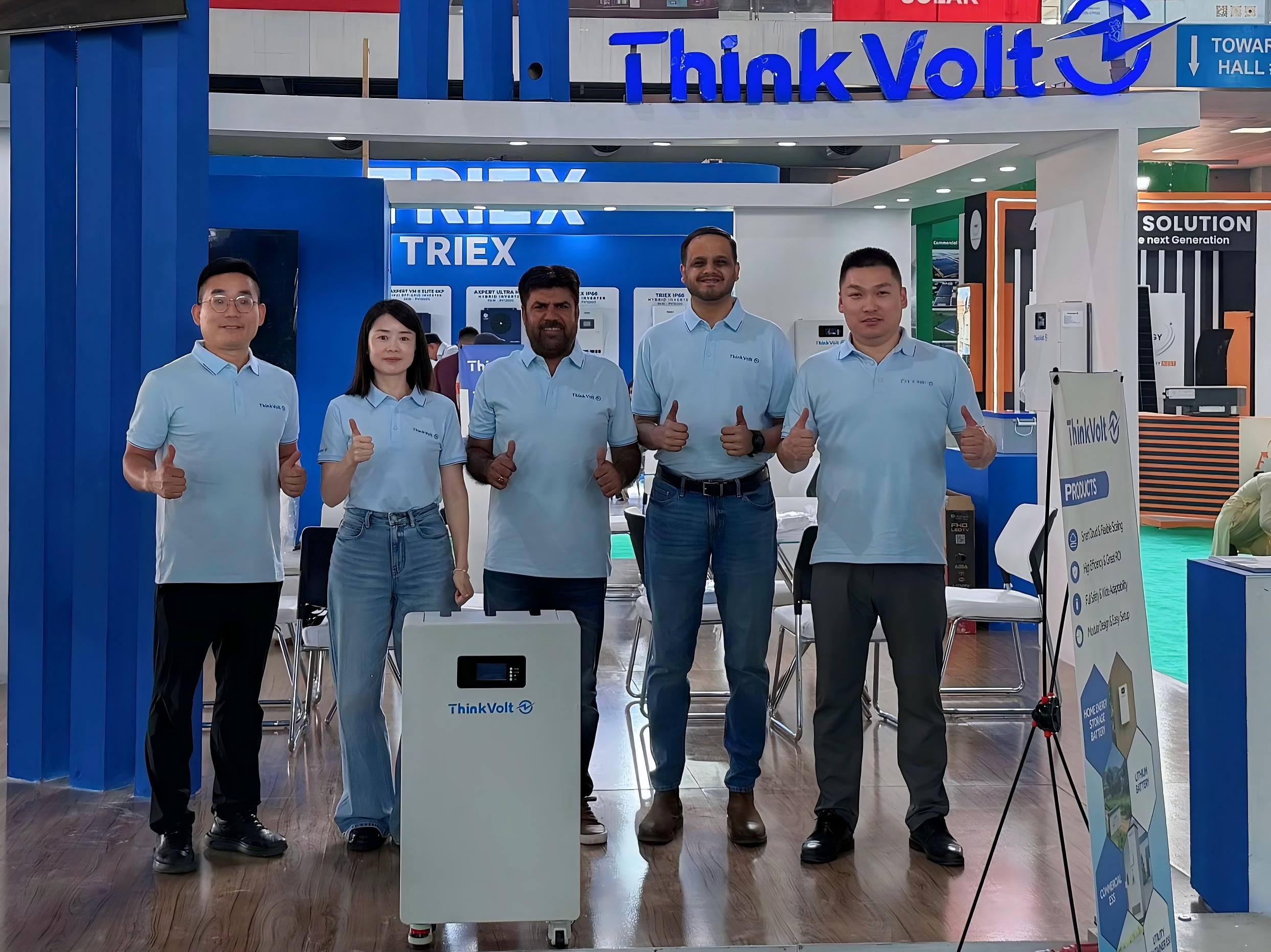
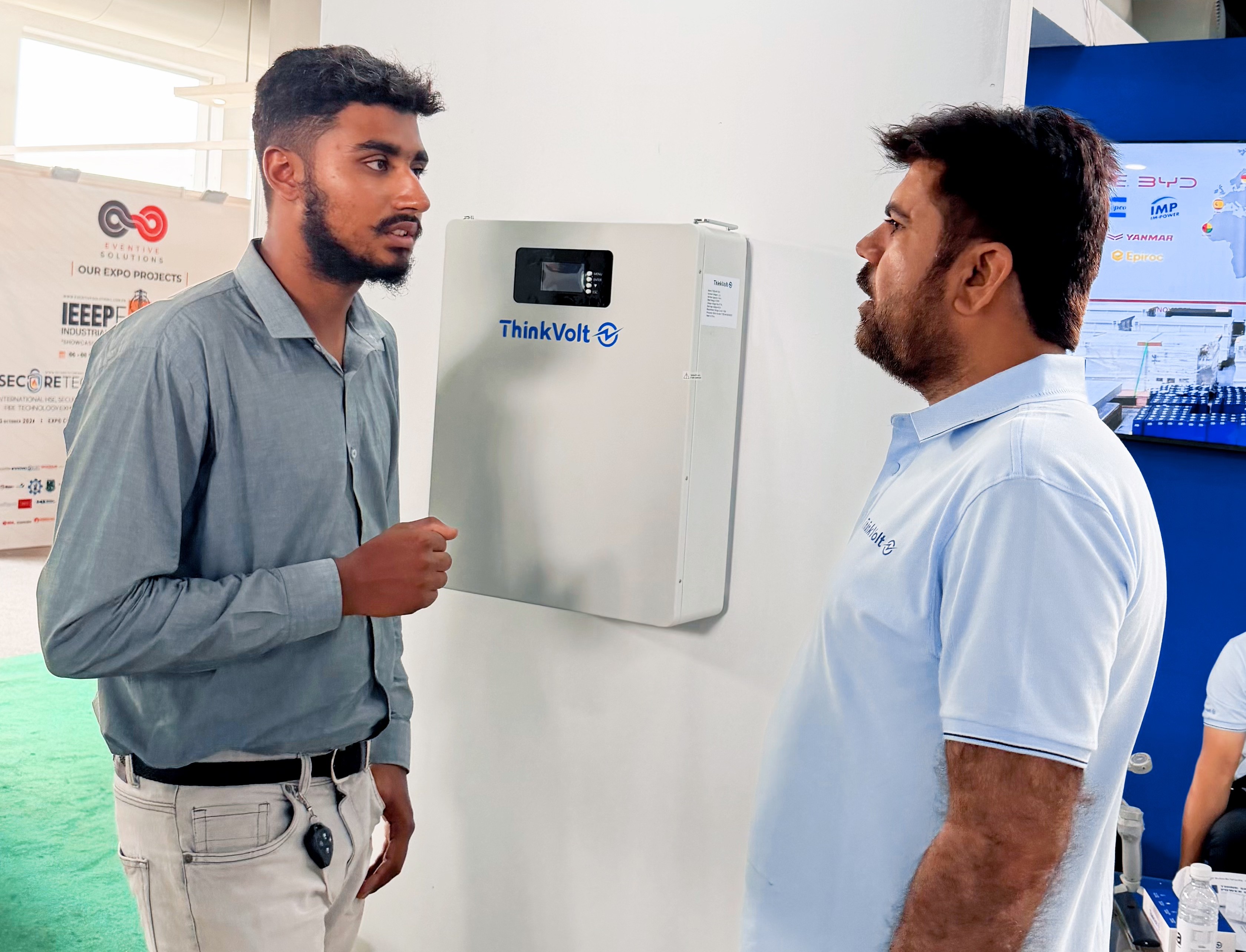
ThinkVolt at Solar & Storage Expo Pakistan 2026: Connecting with Pakistan’s Energy Storage Market
2026-07-23
To determine how many batteries you need for whole-home backup, calculate your home’s electricity consumption during an outage, divide it by the usable energy each battery can deliver, and round up to the nearest whole number. The result depends on your backup loads, required operating time, battery capacity, and system efficiency.
However, battery quantity is only part of the decision. Your system must also provide enough power to operate household appliances and meet the technical requirements of your inverter.
This guide explains how to calculate the number of batteries needed, compare different battery capacities, and verify whether your planned configuration is suitable for your home.
Whole-home backup is designed to supply your home’s electrical circuits during a power outage, while essential-load backup powers only selected circuits. The difference matters because supporting more appliances generally requires greater battery capacity and output power.
A whole-home backup system may support lighting, refrigerators, internet equipment, air conditioning, kitchen appliances, and other household loads.
However, backing up an entire home does not mean every appliance can operate simultaneously without restrictions. The available power still depends on the battery and inverter system.
Essential-load backup focuses on selected equipment, such as refrigerators, lights, routers, and critical outlets. Excluding high-demand appliances can significantly reduce the required battery capacity.
Before calculating the number of batteries, decide which circuits must remain powered during an outage and which appliances you expect to operate.
This decision establishes the starting point for an accurate battery quantity calculation.
To estimate your backup energy needs, identify the appliances you want to power, determine their electricity consumption, and calculate how long they will operate during an outage.
The total energy requirement, measured in kilowatt-hours (kWh), is the starting point for calculating battery quantity.
Your electricity bill provides a useful reference for household energy consumption.
Divide the electricity used during a billing period by the number of days to estimate average daily consumption.
For example, a home consuming 900 kWh over 30 days uses an average of 30 kWh per day.
However, your backup energy requirement may be different. Some appliances may remain switched off during an outage, while heating, cooling, and other loads can vary considerably.
For whole-home backup, use the electricity bill as a starting point rather than assuming that average daily consumption precisely represents your outage demand.
For a more accurate calculation, list the appliances you plan to operate and estimate their energy consumption.
Energy Consumption (kWh) = Power (W) × Operating Hours ÷ 1,000
Consider the following example of selected household loads during a 24-hour outage.
Appliance | Power | Operating Time | Energy Use |
Refrigerator | 120 W | 10 h | 1.20 kWh |
LED lighting | 60 W | 6 h | 0.36 kWh |
Wi-Fi router | 15 W | 24 h | 0.36 kWh |
Fans | 100 W | 12 h | 1.20 kWh |
Air conditioner | 1,000 W | 6 h | 6.00 kWh |
Total | 9.12 kWh |
In this example, the selected appliances require 9.12 kWh of AC energy over 24 hours.
This is a selected-load example, not a complete whole-home consumption estimate. A full whole-home calculation must include any additional loads you intend to support.
Where possible, use actual appliance measurements or monitoring data instead of relying on generic power ratings.
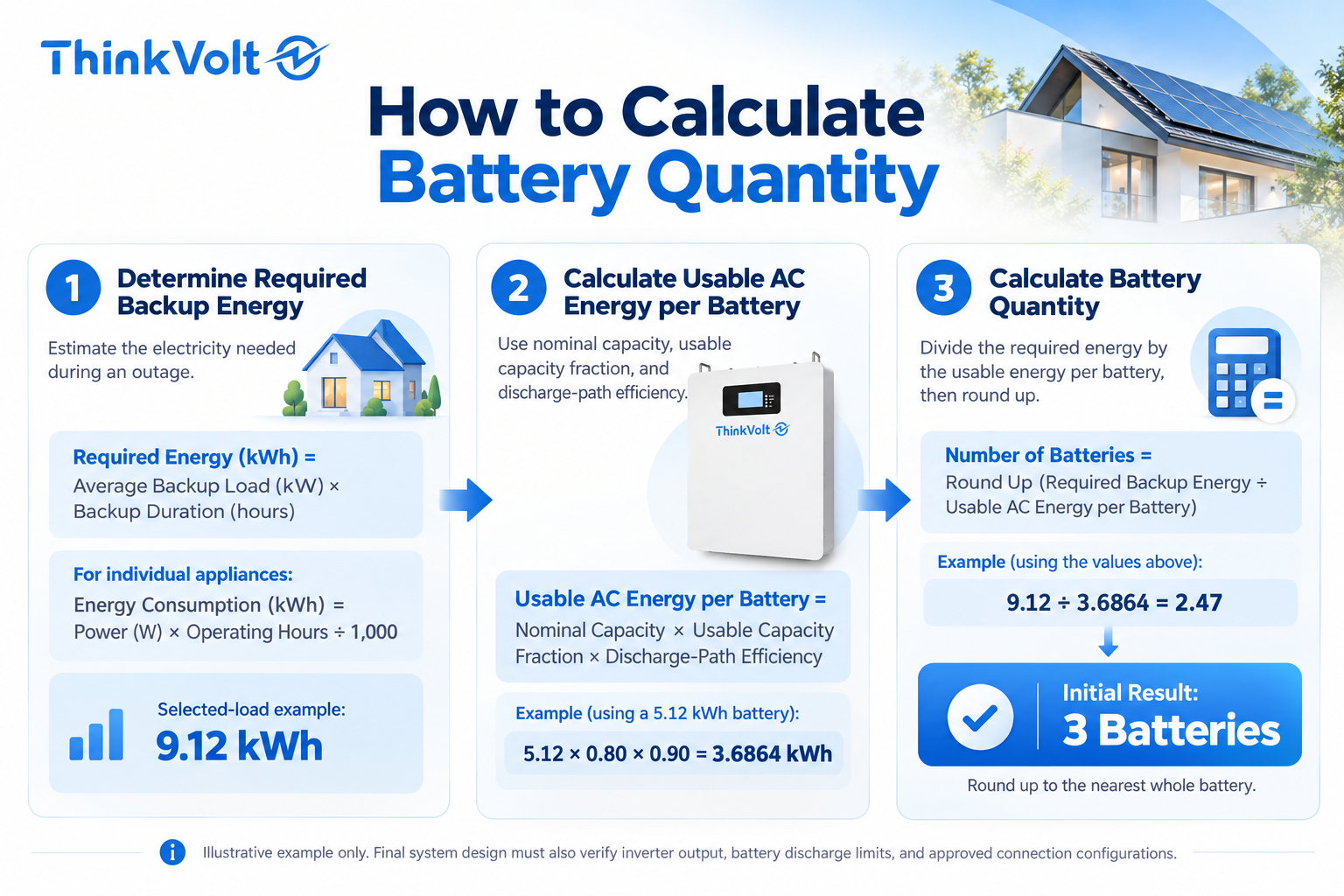
To calculate the number of batteries needed for whole-home backup, divide the total required AC energy by the usable AC energy available from each battery, then round up to the nearest whole number.
The calculation involves three steps.
First, calculate the electricity your household needs during the planned outage.
Required Energy (kWh) = Average Backup Load (kW) × Backup Duration (hours)
For example, a home with an average backup load of 1 kW requires 12 kWh of AC energy for 12 hours.
If electricity consumption changes throughout the day, calculate individual appliance energy use and add the results together.
A battery’s nominal capacity does not necessarily represent all the electricity available to household appliances.
Two factors need to be considered:
• Usable capacity fraction: The portion of nominal battery energy available between the starting state of charge (SOC) and the minimum permitted SOC.
• Discharge-path efficiency: The proportion of battery energy delivered to AC loads after applicable conversion and operating losses.
The formula is:
Usable AC Energy per Battery = Nominal Capacity × Usable Capacity Fraction × Discharge-Path Efficiency
Consider a hypothetical 5.12 kWh battery with:
• Nominal capacity: 5.12 kWh
• Usable capacity fraction: 80%
• Discharge-path efficiency: 90%
Its estimated usable AC energy is:
5.12 × 0.80 × 0.90 = 3.6864 kWh
The 80% usable fraction could represent a battery starting at 95% SOC with a planned minimum of 15% SOC. These are illustrative conditions, not universal battery specifications.
For actual projects, use the selected battery’s operating limits and your expected starting SOC.
If the manufacturer already specifies usable energy for the relevant operating conditions, do not automatically apply another depth-of-discharge adjustment. Likewise, avoid counting the same conversion losses twice.
For a more detailed explanation, see Nominal vs. Usable Battery Capacity.
Once you know the usable energy per battery, calculate the quantity:
Number of Batteries = Round Up (Required Backup Energy ÷ Usable AC Energy per Battery)
Using the 9.12 kWh selected-load example from the previous section:
9.12 ÷ 3.6864 = 2.47
Rounding up gives:
3 batteries
Therefore, three 5.12 kWh batteries would provide sufficient calculated energy for this specific selected-load example under the stated assumptions.
This is an initial capacity estimate. The actual configuration must also satisfy the battery system’s discharge capabilities, inverter power requirements, and permitted connection arrangements.
If additional capacity is needed for uncertain future loads or a defined planning margin, include that requirement before finalizing the battery quantity.
Yes, solar panels can reduce the battery capacity needed for whole-home backup if the system can continue generating electricity and charging batteries during an outage.
However, solar panels alone do not guarantee backup power. Standard grid-connected solar systems generally shut down during grid outages unless they have suitable equipment and controls for backup operation.
Without solar recharging, your batteries must supply all the electricity required during the planned outage.
With a properly configured solar-plus-storage system, daytime solar generation can power household appliances and recharge batteries. This may reduce the required battery capacity or extend backup duration.
However, solar output depends on weather, sunlight, shading, and seasonal conditions. Your batteries must still support nighttime electricity consumption and periods of insufficient solar generation.
For practical sizing, compare two scenarios:
• Without solar: Calculate the full backup energy requirement without relying on additional charging.
• With solar: Estimate the energy that can realistically be supplied by solar generation during the outage, accounting for household demand and relevant system losses.
Do not assume that the solar array’s rated output will be available throughout an outage.
Before reducing the planned number of batteries, confirm that your inverter and solar system support the required backup and charging functions.
The number of batteries required increases with backup duration when the average household load remains the same and no additional charging is available.
For a consistent comparison, consider a hypothetical home with an average backup load of 1 kW.
The following assumptions will be used:
• Average backup load: 1 kW
• Nominal battery capacity: 5.12 kWh
• Usable capacity fraction: 80%
• Discharge-path efficiency: 90%
• Solar or grid recharging: None
Under these conditions, each battery provides approximately 3.69 kWh of usable AC energy.
Backup Duration | Required AC Energy | Number of 5.12 kWh Batteries |
8 hours | 8 kWh | 3 |
12 hours | 12 kWh | 4 |
24 hours | 24 kWh | 7 |
48 hours | 48 kWh | 14 |
For example, maintaining an average load of 1 kW for 24 hours requires 24 kWh of AC energy.
24 ÷ 3.6864 = 6.51
You would therefore need seven batteries under these assumptions.
Remember that the 1 kW average load is used only to demonstrate the calculation. It does not represent the electricity consumption of every household or guarantee that all household appliances can operate together.
Actual consumption may increase significantly when air conditioning, electric heating, cooking equipment, or other high-demand appliances are used.
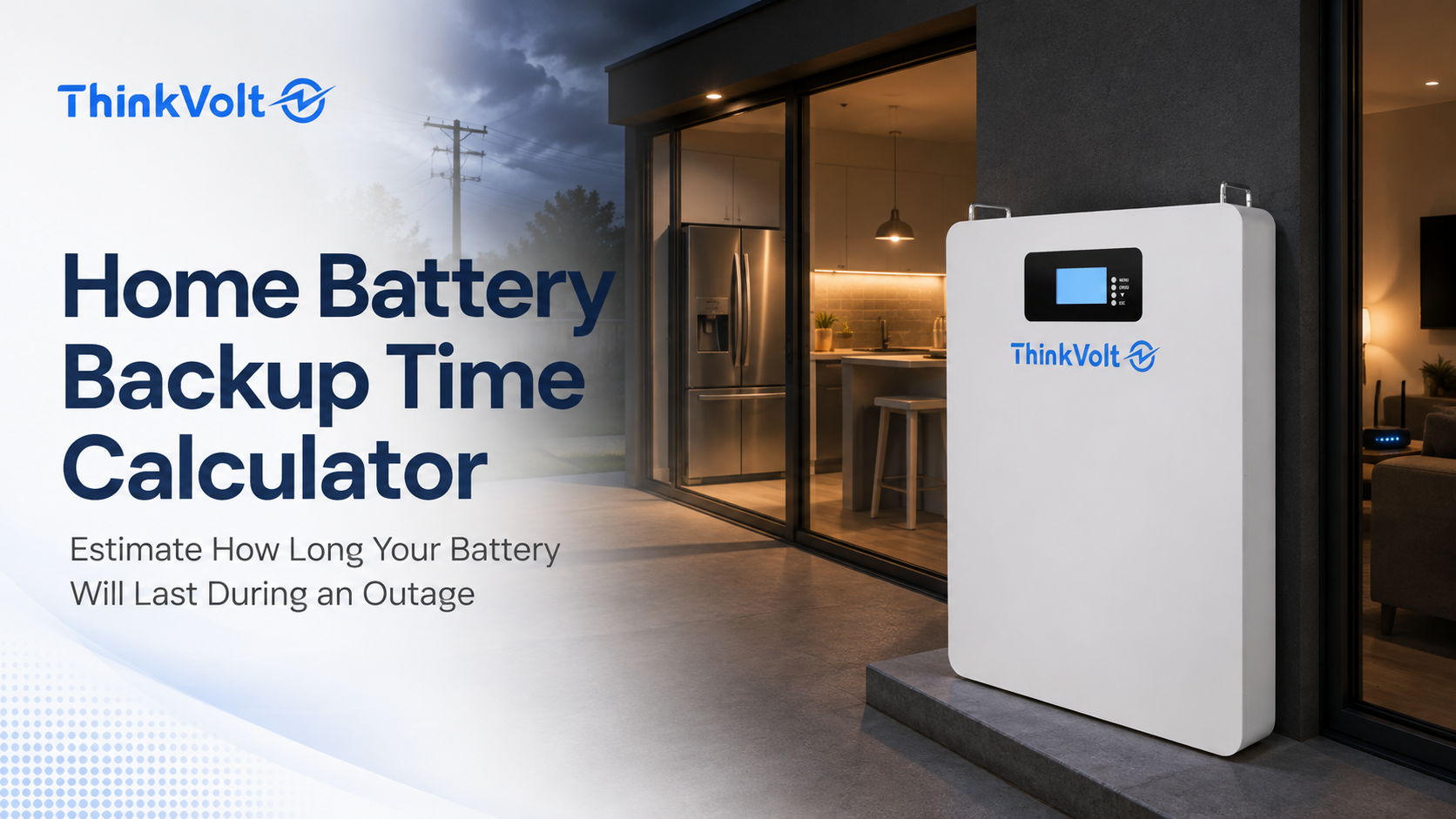
For more information on calculating backup duration from an existing battery capacity, see Home Battery Backup Time Calculator.
Larger-capacity batteries generally reduce the number of units needed to meet the same backup energy requirement. However, the actual quantity depends on usable energy per battery, not simply its nominal capacity.
Using the same illustrative 1 kW average backup load, 80% usable capacity fraction, and 90% discharge-path efficiency, we can compare different battery capacities.
Backup Duration | Required Energy | 5.12 kWh Batteries | 10.24 kWh Batteries | 15 kWh Batteries |
8 hours | 8 kWh | 3 | 2 | 1 |
12 hours | 12 kWh | 4 | 2 | 2 |
24 hours | 24 kWh | 7 | 4 | 3 |
48 hours | 48 kWh | 14 | 7 | 5 |
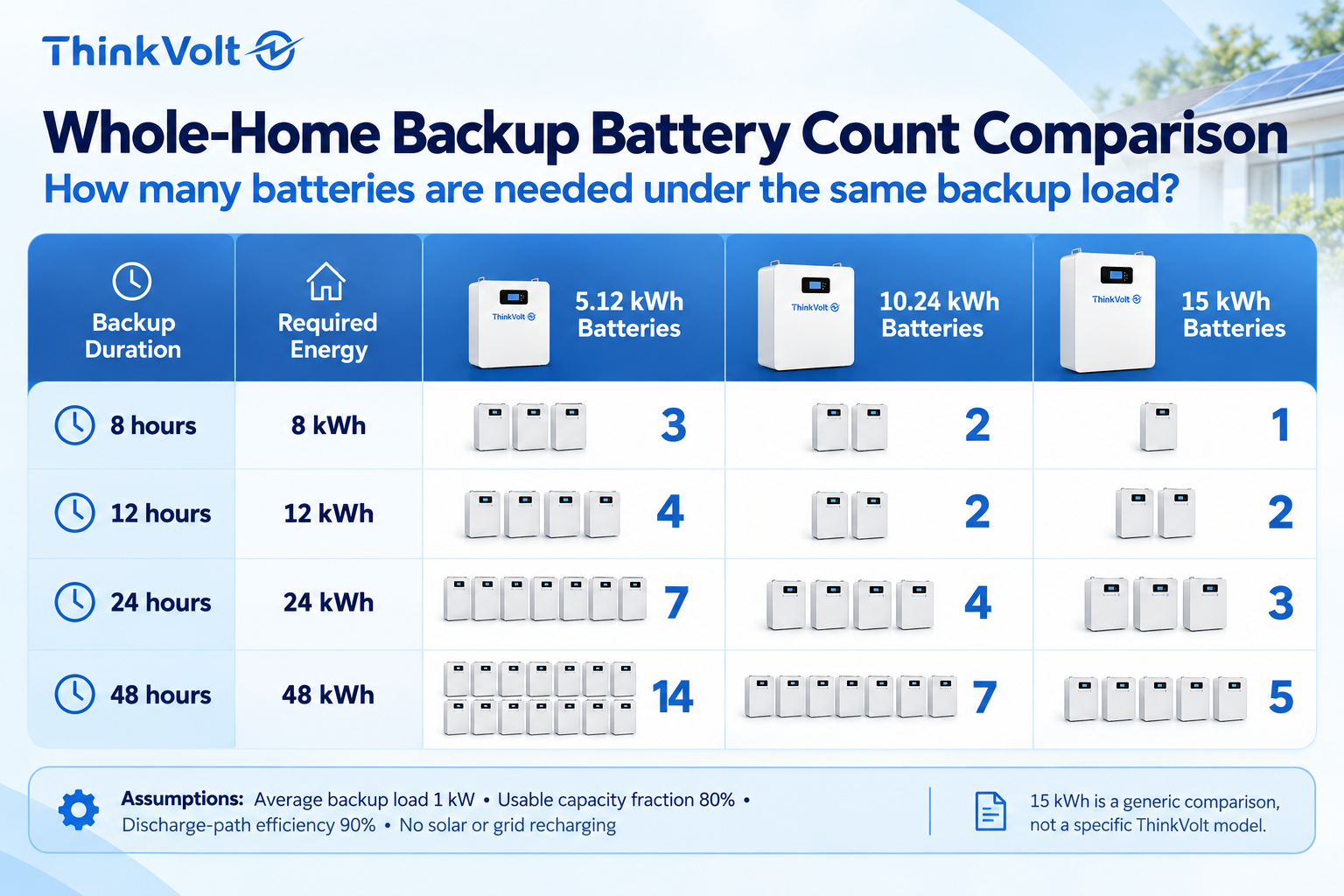
For a 24-hour backup requirement of 24 kWh:
• Seven 5.12 kWh batteries provide approximately 25.80 kWh of calculated usable AC energy.
• Four 10.24 kWh batteries provide approximately 29.49 kWh.
• Three 15 kWh batteries provide approximately 32.40 kWh.
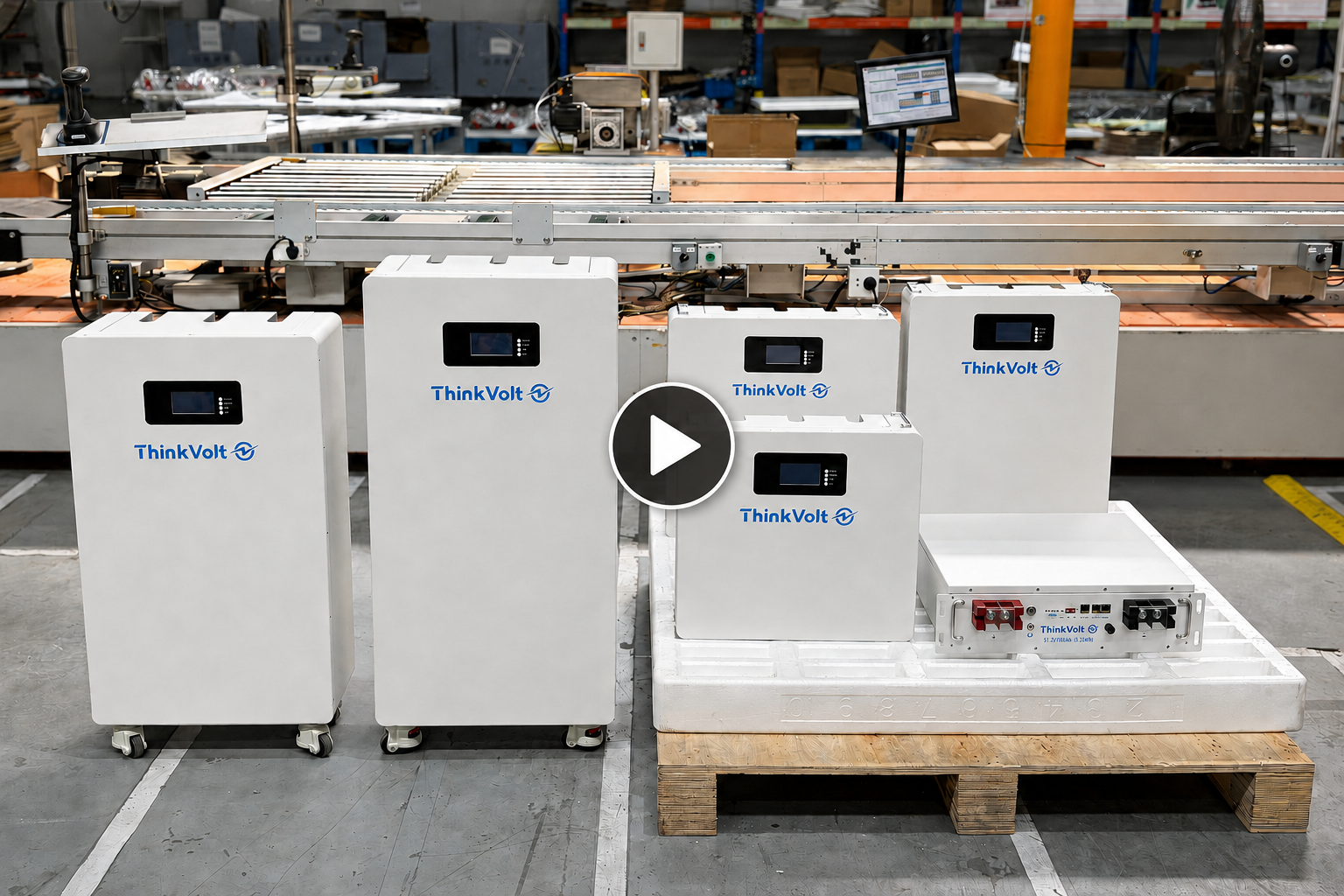
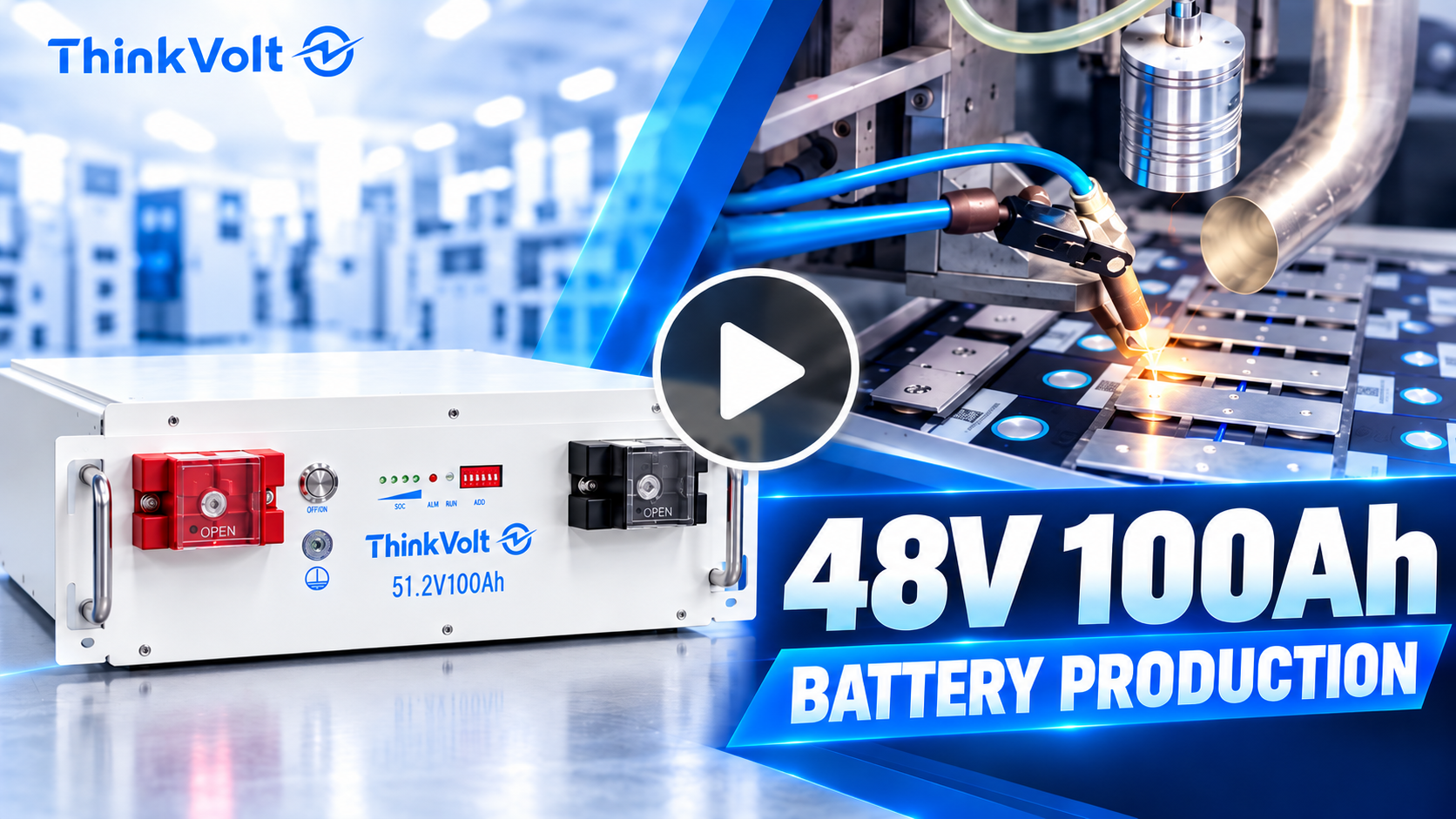
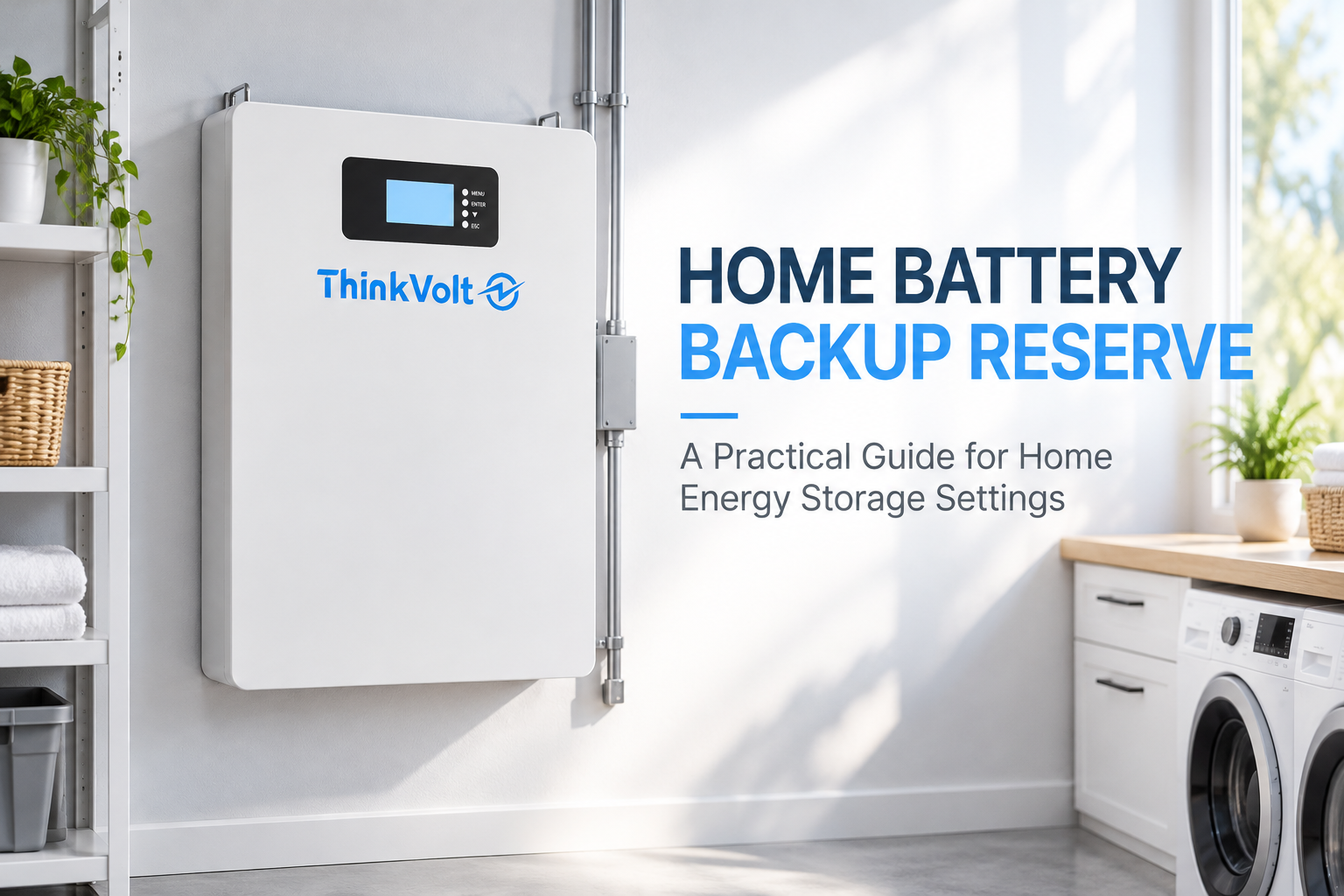
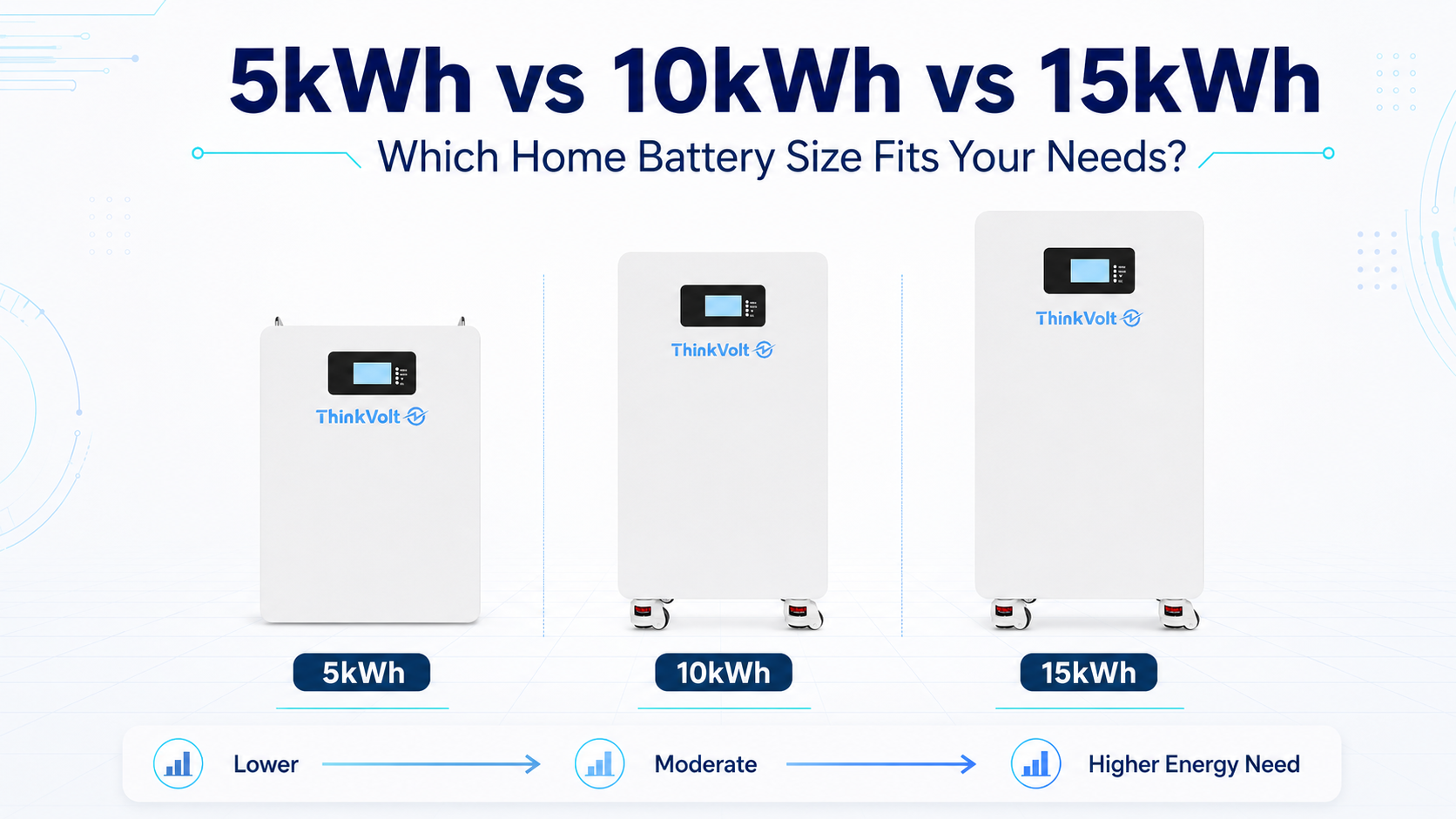
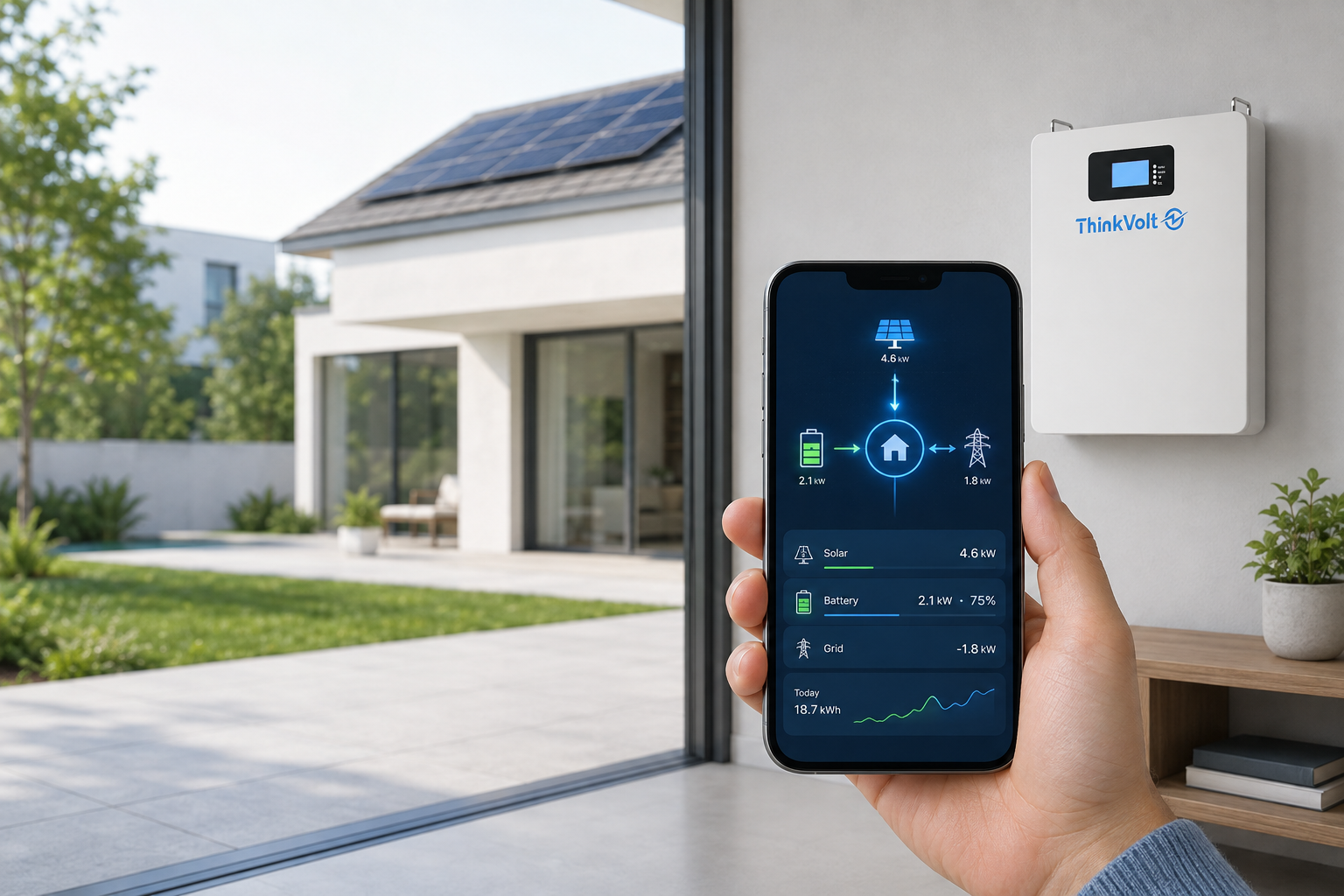
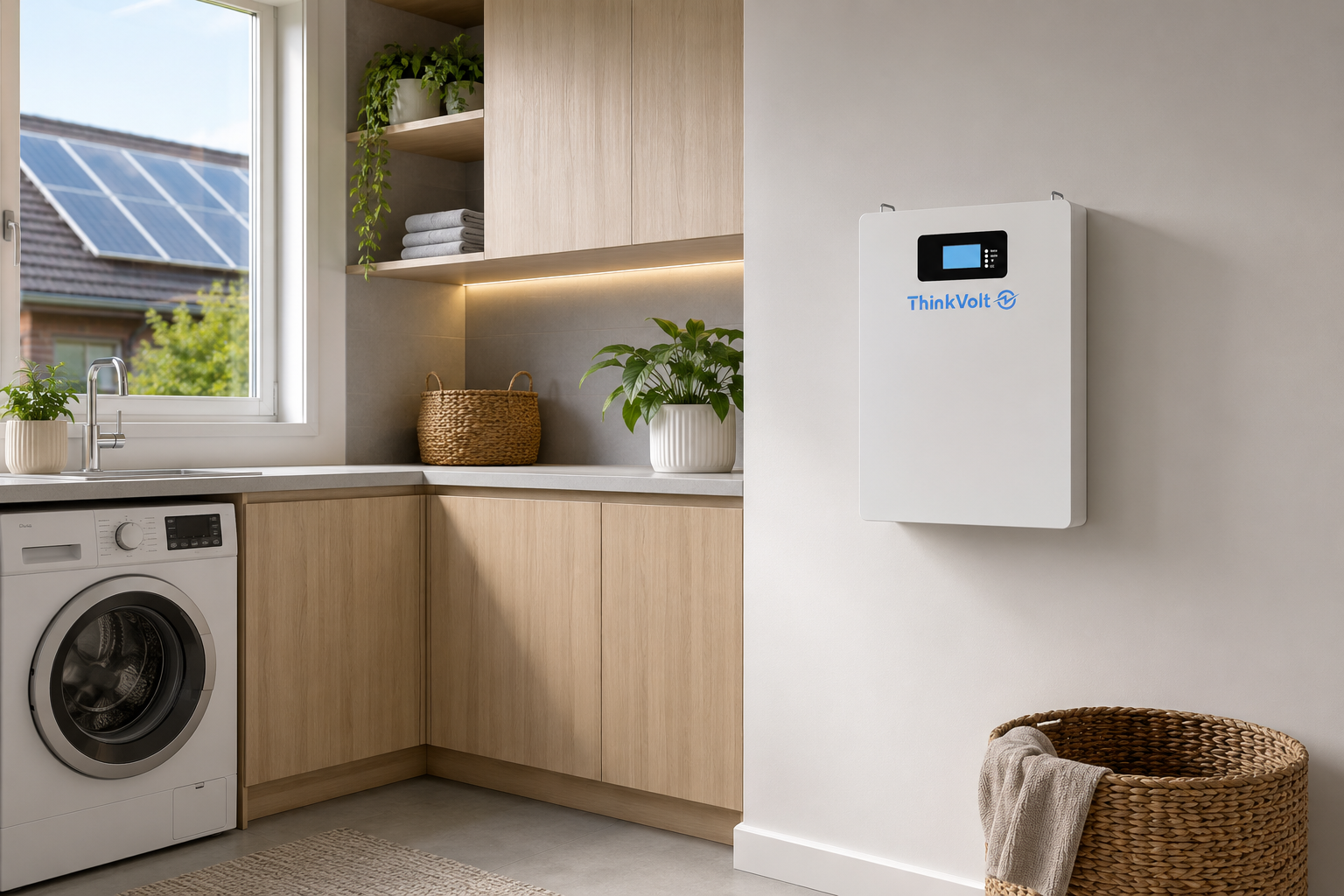
ThinkVolt offers 51.2V 100Ah LiFePO4 batteries with 5.12 kWh of nominal energy in wall-mounted and rack-mounted formats, along with a 51.2V 200Ah floor-standing battery rated at 10.24 kWh.
These provide different module-capacity options for residential backup projects. The 15 kWh capacity shown above is a generic comparison, not a specific ThinkVolt model.
For a broader comparison of capacity options, see 5kWh vs. 10kWh vs. 15kWh Home Battery.
Yes, one battery can be enough if its usable energy meets your backup requirement and the complete system can deliver the necessary power.
For example, the table shows that one nominal 15 kWh battery could satisfy the calculated energy requirement for eight hours at an average 1 kW load under the stated assumptions.
However, actual suitability depends on the battery’s discharge capability, the inverter’s output ratings, and the household’s operating conditions.
For installers, fewer batteries do not automatically mean a better configuration. Installation space, approved system architecture, maintenance access, and future expansion requirements should also influence the final selection.
Both kW and kWh matter because they describe different capabilities of a home battery system.
Kilowatt-hours (kWh) measure stored energy, while kilowatts (kW) measure the rate at which the system can deliver power.
Battery capacity mainly affects how long your home can operate during an outage. Output power determines which appliances can run simultaneously.
For example, consider a battery system with 20 kWh of storage connected to a 3 kW inverter.
Even if the batteries contain enough energy for several hours of backup, the inverter cannot continuously supply household appliances requiring a combined 5 kW.
The batteries also have discharge limits that must be considered alongside the inverter rating.
When evaluating a configuration, check two separate requirements:
• Energy capacity (kWh): Is sufficient usable energy available for the required backup duration?
• Power output (kW): Can the complete system supply the expected simultaneous loads?
Both conditions must be satisfied. Adding more stored energy will not necessarily solve an insufficient inverter output rating.
Yes, a properly designed home battery system can power air conditioners, water pumps, and other high-demand appliances during an outage.
However, these appliances may require substantially more power when starting than during normal operation.
Some appliances contain motors or compressors that draw additional current during startup.
For example, a central air conditioner may operate within an inverter’s continuous power rating but exceed its short-term surge capability when the compressor starts.
Startup requirements vary by equipment design, particularly for variable-speed systems.
Before finalizing the battery configuration, check:
• Running power: The combined power consumption of appliances operating simultaneously.
• Starting surge: The short-duration additional power required when motors or compressors start.
• System output limits: The inverter’s continuous and surge ratings, together with the battery system’s discharge capability.
In some installations, compatible soft starters or load-management strategies may help reduce startup demands.
Do not estimate startup requirements using a single universal multiplier. Actual equipment specifications and manufacturer documentation provide a more reliable basis.
For high-demand loads, installers should verify the complete electrical requirements before selecting the final system configuration.
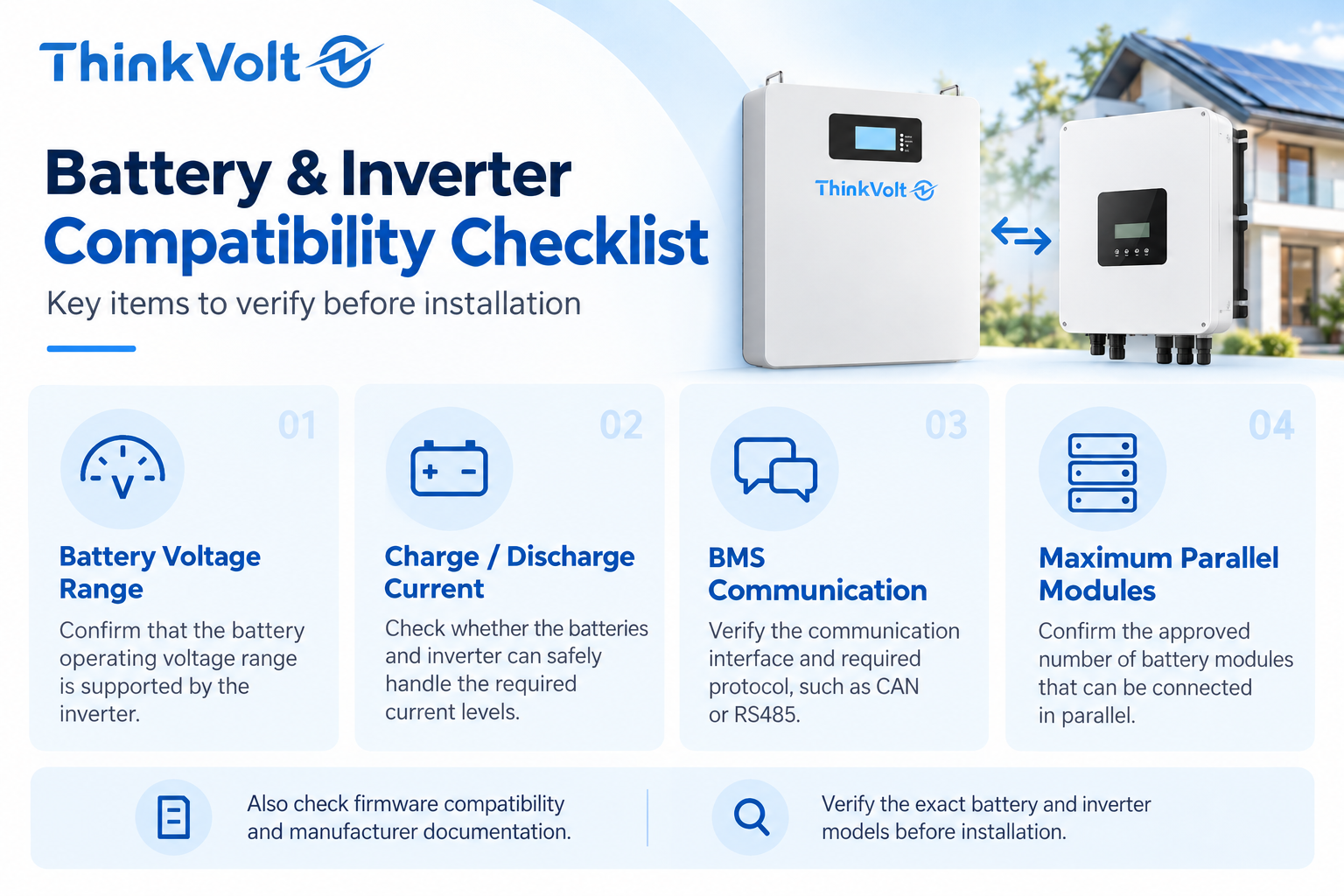
Before connecting batteries to an inverter, confirm that the exact models are compatible. Matching nominal voltage alone is not sufficient.
Battery operating voltage, charging and discharging limits, BMS communication, and approved configurations all affect whether the system can operate correctly.
Start with the following specifications:
• Operating voltage: Confirm that the battery’s operating voltage range is supported by the inverter.
• Charge and discharge current: Check the current limits of both the batteries and inverter under the intended operating conditions.
• BMS communication: Verify the supported communication interface, such as CAN or RS485, together with the required communication protocol.
• Firmware compatibility: Confirm whether specific firmware versions or configuration settings are required.
For example, a nominal 51.2V LiFePO4 battery should not automatically be considered compatible with every inverter advertised as 48V.
The exact battery and inverter models must be checked against the relevant technical documentation.
Connecting multiple batteries in parallel can increase total energy storage, but the permitted number of modules depends on the equipment.
Before installation, verify the manufacturer’s maximum supported parallel quantity, required protection devices, cabling arrangements, communication settings, and commissioning procedures.
The number of batteries calculated from energy demand must fit within an approved system configuration.
For installers and system integrators, the latest battery datasheet, inverter compatibility documentation, and installation manual should be checked before confirming a project design.
Before selecting your final battery quantity, verify that the system meets your energy requirements, electrical load demands, and installation conditions.
A theoretical battery count should be treated as a starting point, not a complete installation plan.
Item to Verify | Key Question |
Backup energy requirements | Have you included the appliances and operating hours needed during an outage? |
Usable battery capacity | Have you accounted for the actual SOC window and relevant losses? |
Continuous and surge power | Can the system support simultaneous loads and equipment startup? |
Battery and inverter compatibility | Are voltage, current, communication, and firmware requirements satisfied? |
Parallel configuration | Is the planned battery quantity supported by the manufacturer? |
Outage operation | Can the system safely operate during a grid outage? |
Installation conditions | Are space, protection, environmental limits, and local electrical requirements addressed? |
Future expansion | Can additional capacity be installed if your needs increase? |
For installers and distributors, these checks help turn a calculated battery quantity into a practical configuration proposal.
The final design should follow the applicable manufacturer documentation and local electrical requirements.
Yes, multiple 48V-class batteries can be connected in parallel when the manufacturer supports that configuration.
Parallel connections increase total storage capacity while maintaining the same nominal system voltage. However, the batteries must meet requirements for voltage, BMS operation, communication, current sharing, protection, and maximum parallel quantity.
Always follow the manufacturer’s approved installation procedures rather than assuming that any two 48V batteries can be connected together.
Mixing batteries of different capacities, ages, or models is generally not recommended unless the manufacturer explicitly supports the combination.
Differences in internal resistance, available capacity, and operating characteristics can affect current sharing and battery performance.
For reliable operation, installers should check manufacturer-approved expansion guidelines before combining new and existing modules. Batteries with similar nominal voltages are not necessarily suitable for use together.
A whole-home battery backup system requires appropriate equipment to isolate the home from the utility grid during an outage and supply power safely.
Depending on the system design, this function may be integrated into the inverter or require a separate transfer switch, backup gateway, or other approved equipment.
Your installer should confirm the necessary components based on the inverter model, system architecture, and applicable local electrical regulations.
Yes, low temperatures can reduce the available energy and power performance of lithium batteries.
Charging may also be restricted at low temperatures, depending on the battery chemistry, BMS settings, and thermal management system.
For LiFePO4 home batteries, check the manufacturer’s charging and discharging temperature limits before installation. Suitable placement and temperature management are particularly important in regions with cold winters.
Yes, allowing for realistic future electricity demand can help prevent your backup system from becoming undersized.
Additional air conditioning, electric appliances, or longer backup requirements may increase the energy needed during an outage.
However, there is no fixed capacity margin suitable for every household. Base your decision on expected load changes and consider whether the selected battery system supports future expansion.
Installers should provide the inverter manufacturer, exact model, firmware version, supported battery voltage range, and communication requirements.
Continuous output power, surge capability, charging and discharging limits, and applicable electrical supply specifications may also be necessary.
These details help battery suppliers evaluate whether the proposed battery configuration is suitable and identify any additional technical requirements before installation.
To request a suitable home battery configuration, provide your estimated electricity consumption, required backup duration, major household loads, and existing inverter model, if available.
Installers and distributors should also specify the installation country, solar system details, preferred battery format, expansion requirements, and estimated purchase quantity.
Providing accurate project information helps suppliers recommend appropriate battery quantities and prepare a more relevant quotation.
The right number of batteries for whole-home backup depends on your actual electricity consumption, required backup duration, and usable energy per battery. A practical configuration must also satisfy your household’s power requirements and the technical limits of the complete system.
Need Help Choosing the Right Home Battery Configuration?
ThinkVolt offers LiFePO4 battery solutions for residential energy storage and backup applications, including wall-mounted, rack-mounted, and floor-standing options.
Whether you are an installer, distributor, or system integrator, share your backup load requirements, target operating time, inverter model, installation country, and estimated project quantity with our team.
We can discuss suitable battery capacity options and help you evaluate the required battery configuration for your project.