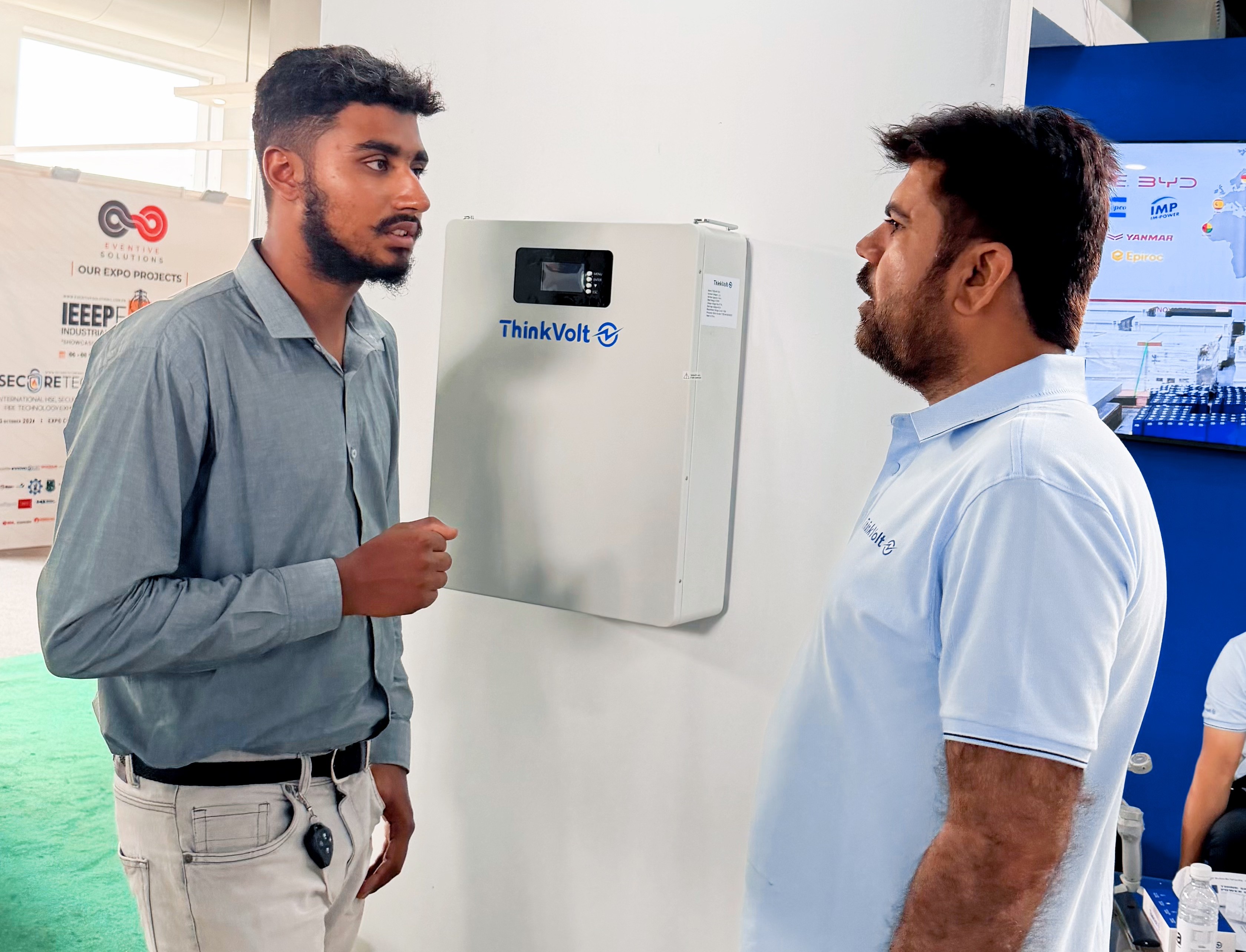
ThinkVolt at Solar & Storage Expo Pakistan 2026: Connecting with Pakistan’s Energy Storage Market
2026-07-23
A lithium forklift battery is more than a group of cells inside a metal case. It is an integrated system of battery cells, electrical connections, sensing wires, monitoring electronics, insulation, and structural components. How these parts are assembled can influence the consistency and reliability of the finished battery.
For forklift manufacturers, equipment distributors, and industrial battery buyers, technical specifications are only part of the purchasing decision. Voltage, capacity, and dimensions tell you whether a battery may fit your application. The manufacturing process helps you understand how that battery is built and checked before delivery.
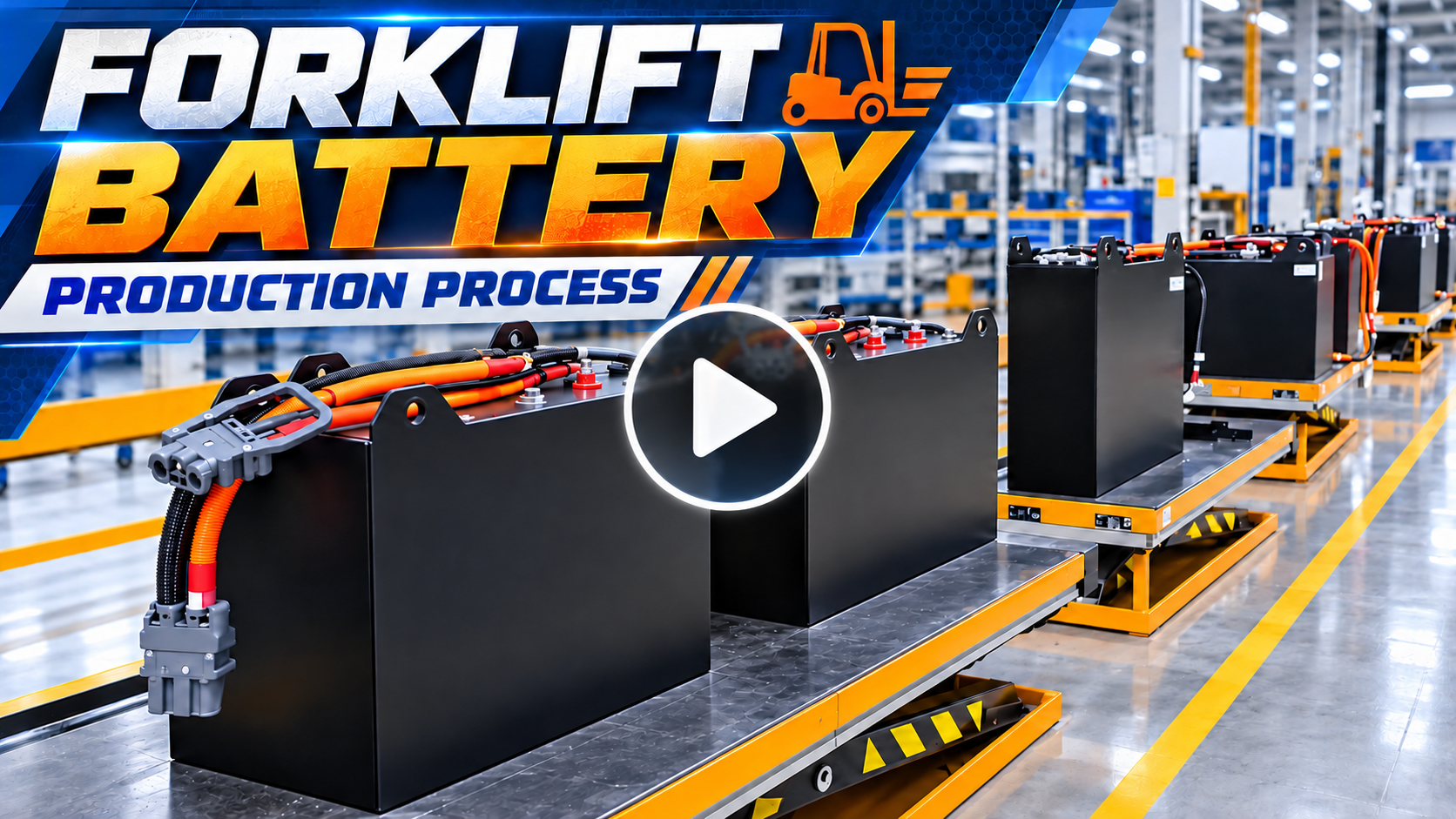
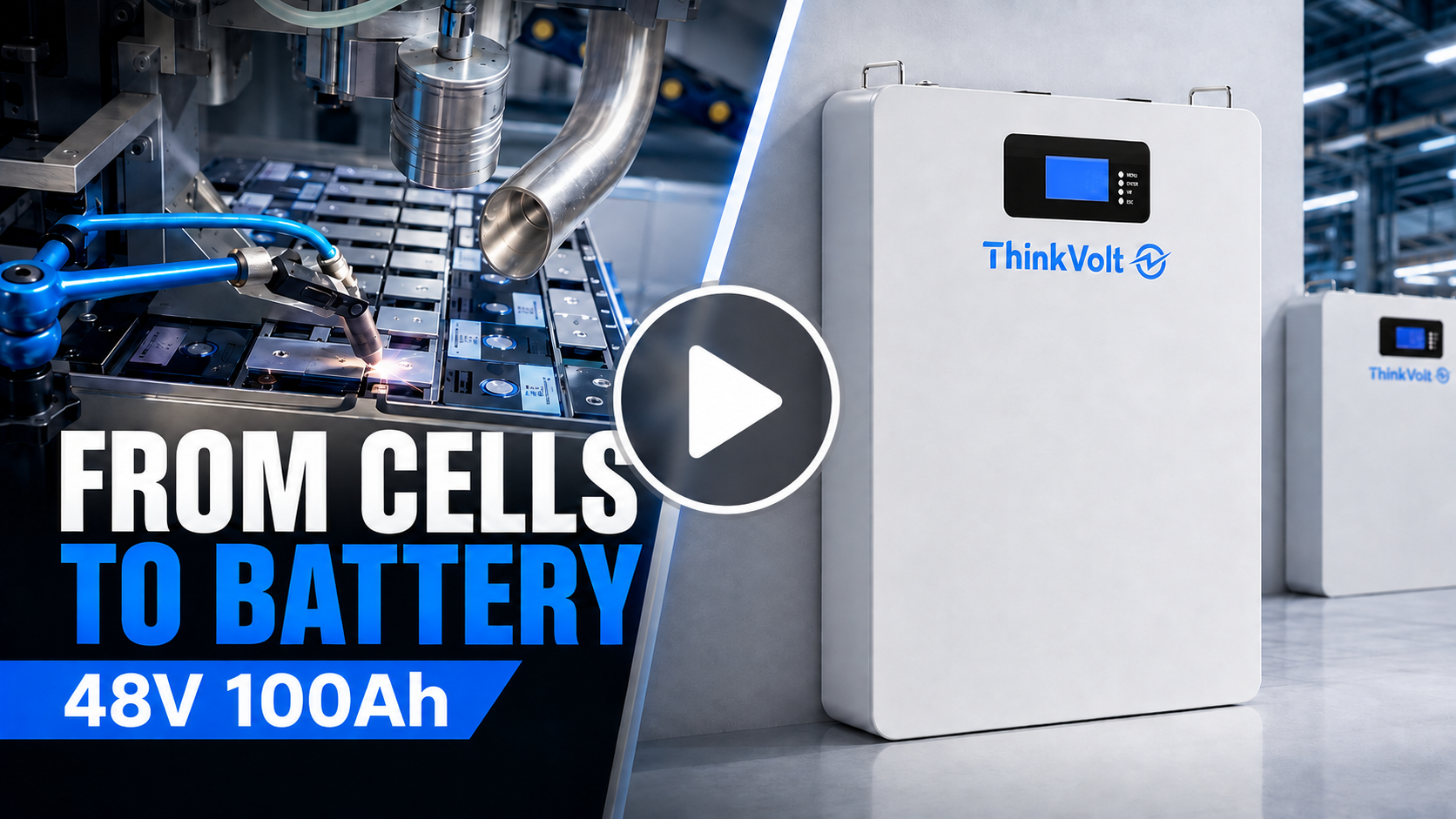
In this article, we take you through ThinkVolt's lithium forklift battery manufacturing process, following the operations shown in our production video: cell inspection, module assembly, aluminum plate positioning, laser welding, sensing wire installation, pack integration, and charge/discharge testing. We also explain why these steps matter and what buyers should ask when evaluating a supplier.
A lithium forklift battery is manufactured by checking individual cells, securing them into a module, creating electrical connections, installing sensing and protection components, integrating the module into an enclosure, and testing the assembled system. The exact process depends on battery design, but every stage should have a defined purpose and appropriate checks.
The production sequence below is based on ThinkVolt's actual forklift battery assembly video. It illustrates the work behind a finished battery rather than suggesting that any single operation guarantees performance or safety.
Manufacturing begins before the cells are assembled. At ThinkVolt, workers measure the voltage of individual cells one by one and record the readings on a computer. The cells are checked before moving to module assembly.
Why it matters: Cells connected into a battery pack must operate together. An unusual voltage reading can be an early warning that a cell needs further assessment. Recording the readings also creates production information that can help with subsequent investigation or quality review.
This inspection is useful, but its scope should be understood correctly. Cell voltage alone cannot establish cell capacity, internal resistance, long-term durability, or complete matching. Those require other measurements and test methods. A buyer evaluating a battery supplier can ask which incoming cell characteristics are inspected and what acceptance limits are applied.
Starting with inspection rather than immediately assembling the cells reduces the chance that an obvious cell-level issue will be discovered only after substantial assembly work has been completed.
After inspection, workers assemble the cells into a structured module. As shown in the video, aluminum and plastic plates are used to position the cell group, and screws secure the assembly.
A forklift battery must remain mechanically stable while installed in equipment that starts, stops, turns, and travels over industrial floors. The internal module therefore needs appropriate support and restraint. Controlled positioning also helps prepare the cells for the next operations, especially connection plate installation and welding.
The choice of plate materials and fastening arrangement should be compatible with the battery design. During manufacturing, technicians must avoid misplaced parts, damaged insulation, and uneven assembly.
For buyers, mechanical construction deserves attention because it is largely hidden once the battery enclosure is closed. Production footage and inspection procedures can provide useful evidence of how the internal module is assembled, although formal vibration or durability claims require separate test results.
The next stage involves placing aluminum connection plates on the cell terminals. In the ThinkVolt video, the plates have positioning holes that help workers align them with the intended locations before welding.
Alignment is important because a welding machine must create connections at the correct points. A shifted plate can make the operation less consistent and potentially affect the resulting joint. Using a repeatable placement method helps reduce unnecessary variation between modules.
This stage highlights a principle of manufacturing quality: the accuracy of the finished connection begins with the preparation before welding. A precise welding machine cannot compensate for every positioning or assembly error.
Buyers can ask how the manufacturer checks connection plate placement and what happens when a part does not fit or align as expected. Such questions reveal more about production discipline than the equipment list alone.
Once the connection plates are positioned, the module moves to laser welding. The production video shows ThinkVolt using laser welding equipment to connect the aluminum plates to the cells.
Laser welding allows the welding path and operating parameters to be controlled. When properly configured and maintained, automated or equipment-assisted welding can improve the repeatability of connection work and reduce dependence on manual technique.
The goal is not simply to make a visible joint. Electrical connections must support the intended current flow and remain suitable for the battery's operating conditions. Joint quality can be affected by positioning, surface condition, welding settings, and subsequent handling.
Important distinction: Having a laser welding machine does not, by itself, prove weld quality. Manufacturers should establish suitable process settings and verification procedures. Depending on the design, a buyer may ask about visual inspection, connection resistance measurements, or other applicable checks.
For an OEM or distributor ordering repeated batches, the ability to reproduce a controlled connection process is particularly valuable. Consistency across production is often as important as the appearance of a single sample.
After welding, workers install the sensing wires that connect relevant points of the battery module to its monitoring electronics. In the video, the wires are secured to the aluminum plates with screws.
The assembly sequence is specific: workers first connect the wires, then use cable ties to bundle and organize the harness. Next, insulating glue is applied to the screw connections. Finally, a plastic dust cover is fitted above the cells.
These are small operations with practical purposes. Secure wiring helps prevent unnecessary movement and stress on connections. Organized routing reduces clutter inside the enclosure and makes the arrangement easier to inspect. Insulating material adds a protective layer around exposed connection points, while the cover helps shield internal components.
Sensing wires are important because the battery's monitoring system depends on reliable electrical measurement connections. However, cable installation by itself does not demonstrate the accuracy or effectiveness of the complete battery management system; those functions require relevant verification.
For industrial buyers, this is a useful stage to examine closely. Once the battery is closed, harness routing and protective details may no longer be visible.
The completed cell module is then positioned inside the battery enclosure and secured. ThinkVolt's video shows workers using a torque-controlled electric screwdriver, with indicator lights displaying tightening results.
Fasteners that are too loose may allow components to move. Excessive tightening can damage threads or the parts being secured. A controlled fastening tool helps make repeated assembly operations more consistent and gives the operator feedback during work.
This does not mean that every screw uses the same torque setting. Appropriate tightening values depend on the joint, fastener, and component design. What matters is that the operation is carried out according to the relevant assembly requirements.
When assessing a supplier, ask whether critical fastening points have defined settings, whether tools are maintained or calibrated as appropriate, and how unsuccessful tightening results are handled.
A visually neat battery may look complete, but manufacturing control is demonstrated by the methods used to secure the parts inside it.
After the battery module is secured, workers install the pre-assembled circuit board inside the enclosure. The video then shows metal support strips being added to prepare for the upper cover.
This stage brings the cell module and electrical control components together as a complete pack assembly. Each component needs an appropriate location, mounting method, and connection arrangement. The layout must also allow workers to complete wiring without creating unnecessary cable stress or interference.
The monitoring electronics play an important role in battery operation, but buyers should avoid assuming that a particular protection function is present solely from seeing a circuit board installed. For any project, request documentation confirming the specific battery management features, communication interfaces, and protections included in the offered model.
This is particularly relevant to forklift conversions and OEM integration, where the battery, charger, and vehicle electrical system must be compatible.
Next, a soft waterproof pad is attached to the upper metal support strips as part of the enclosure's sealing arrangement. Workers then connect cables from the internal circuit board to the corresponding points on the top panel and tighten the connections with screws.
Correct connection and routing are important at this stage because the upper panel forms part of the battery's final physical and electrical assembly. Workers must ensure the required connections are made before closing the enclosure.
The sealing pad is a visible protective feature, but it should not be treated as proof of a specific ingress protection rating. An IP rating requires testing under the applicable standard. Buyers who need equipment for wet, dusty, or outdoor environments should request the actual enclosure rating and supporting evidence for the model being supplied.
The video demonstrates the installation sequence; additional product-specific documentation establishes the environmental limits of the finished battery.
Before final closure, the assembled battery is connected to charge and discharge testing equipment. This is a key moment in the production sequence because individual components are now being checked as an integrated battery system.
What does charge/discharge testing verify? Depending on the test procedure, it can help confirm that the pack accepts charging, supplies power during discharge, and operates as expected under the selected test conditions. It may reveal issues that are not obvious from visual inspection alone.
However, not all battery tests answer the same question. A functional charge/discharge check is different from a formal capacity test, cycle-life evaluation, high-temperature test, vibration test, or safety certification. Specific claims about capacity, cycle life, and operating limits require defined methods and records.
For procurement teams, useful questions include: What are the test conditions? Which measurements are recorded? What are the pass/fail criteria? Can test reports be supplied for the relevant order or model?
ThinkVolt's video shows testing before the final top cover is secured, allowing functional verification while the assembly is still accessible.
After the testing stage, workers position the top panel and fasten it to the battery enclosure. The result is a completed forklift battery whose internal assembly is no longer visible.
From the outside, the product may appear straightforward. Internally, it reflects a sequence of cell inspection, mechanical fixing, precise positioning, welding, organized wiring, component installation, controlled fastening, and functional testing.
That sequence is the value of a factory production video. It allows buyers to see practical operations that a product photo or short specification sheet cannot show.
Final appearance is only one part of delivery readiness. Packaging, labeling, applicable documentation, and any additional outgoing inspections should be confirmed according to the actual order requirements.
A credible manufacturing process is built around identifiable checkpoints, not broad promises such as "premium quality" or "100% reliability." The ThinkVolt video provides concrete examples of production practices that customers can examine:
Before assembly: Individual cell voltages are checked and recorded.
Before welding: Connection plates are positioned using defined locations.
During electrical assembly: Sensing wires are secured, bundled, insulated, and protected.
During mechanical assembly: A torque-controlled tool provides tightening feedback.
Before final closure: The assembled pack undergoes charge/discharge testing.
These steps help make the manufacturing process more understandable and reviewable. They do not replace documented acceptance criteria, quality records, or third-party reports where those are required.
For a professional customer, the strongest evidence combines visible factory operations with model-specific technical documentation. A supplier should be able to explain not only what is done, but also why, how it is checked, and which records are available.
If you are comparing suppliers for forklift electrification, replacement batteries, or OEM projects, use the following questions during technical discussions:
Cell inspection: Which characteristics are measured before assembly, and how are out-of-range cells handled?
Electrical connections: What joining method is used, and how is connection quality checked?
Wiring and insulation: How are sensing wires secured and protected from damage?
Mechanical assembly: Are there defined procedures for critical fasteners and component positioning?
Testing: What does the final battery test include, and what counts as a pass?
Application fit: Are battery dimensions, voltage, capacity, connector, charger, and communication requirements compatible with the forklift?
Documentation: Which relevant specifications, test reports, warranty terms, and compliance documents can be provided?
Questions about the target vehicle are especially important. Two forklift batteries with similar nominal voltage and energy may still differ in physical dimensions, connections, charging requirements, communication, or operating limits.
Price matters, but the lowest initial quote may not offer the best fit if installation changes, charging incompatibility, or unclear documentation create extra work later.
The process typically includes cell inspection, module construction, electrical connection formation, sensing and control wiring, enclosure integration, pack testing, and final assembly. ThinkVolt's production video shows these steps in an actual forklift battery build.
Sensing wires connect selected points in the battery pack to its monitoring electronics. Proper attachment, routing, and protection matter because the monitoring system depends on reliable measurement connections.
Laser welding can offer more repeatable positioning and controlled processing when correctly configured. However, weld quality depends on appropriate settings and inspection, not simply on which equipment is used.
No. A production charge/discharge test checks performance under defined test conditions. Long-term cycle life and durability require additional testing and appropriate supporting data.
ThinkVolt welcomes OEM/ODM project discussions. Feasibility depends on the required voltage, capacity, physical dimensions, electrical interfaces, charging conditions, and other application details. Share your forklift specifications so the team can review the project.
Reliable industrial batteries begin with careful component handling and well-organized production work. In our forklift battery manufacturing video, customers can see the practical steps behind the product—from voltage inspection and laser welding to wiring protection and charge/discharge testing.
If you are a forklift manufacturer, equipment dealer, industrial battery distributor, or OEM buyer, ThinkVolt can discuss lithium forklift battery requirements for your application. Please share your forklift model, system voltage, target capacity, battery compartment dimensions, charger details, and estimated quantity.
Email: sales@cnthinkvolt.com
Website: https://www.cnthinkvolt.com/
Manufacturing information: https://www.cnthinkvolt.com/whythinkvolt/manufacture
Contact ThinkVolt to discuss your next lithium forklift battery project.