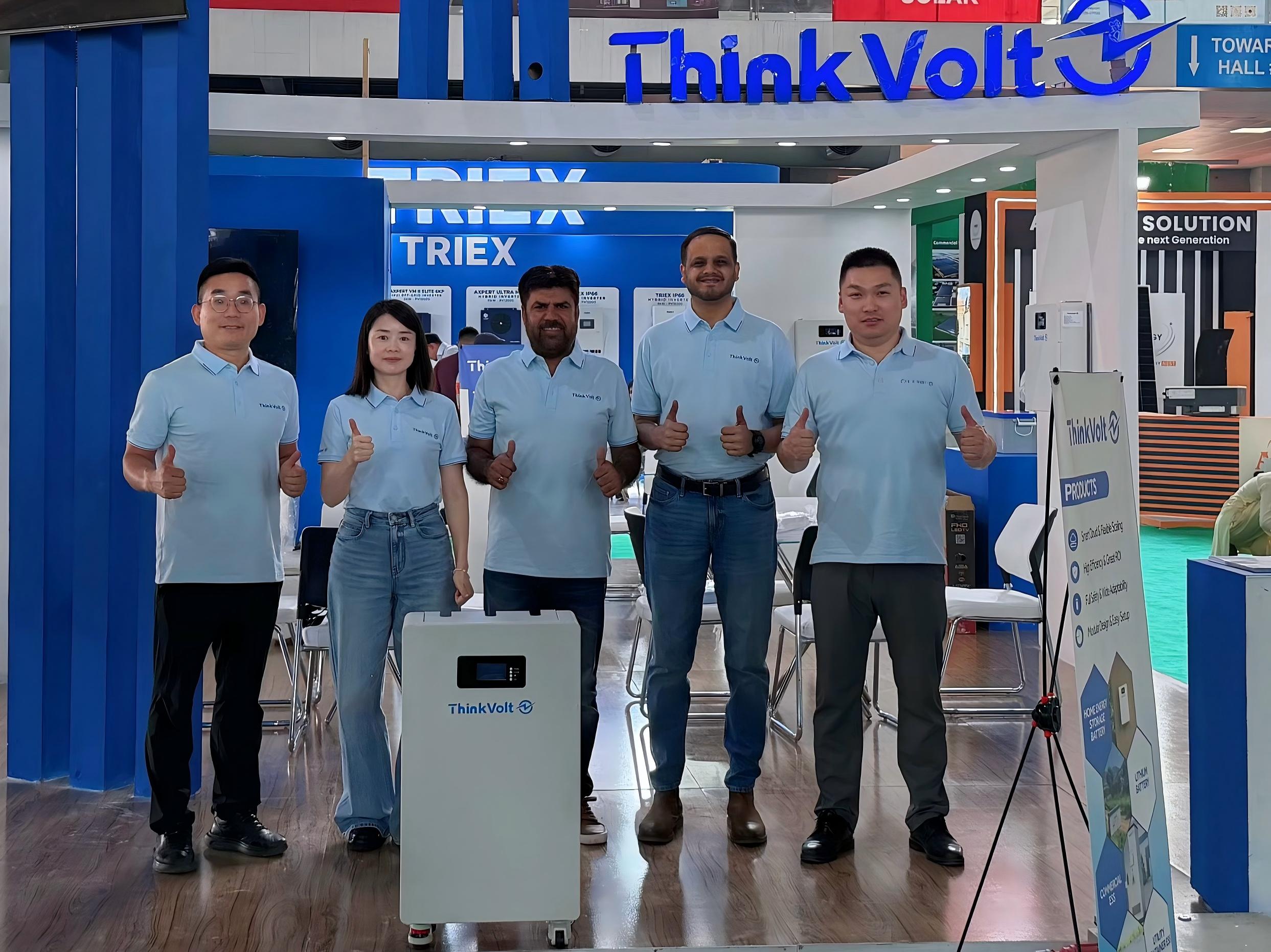
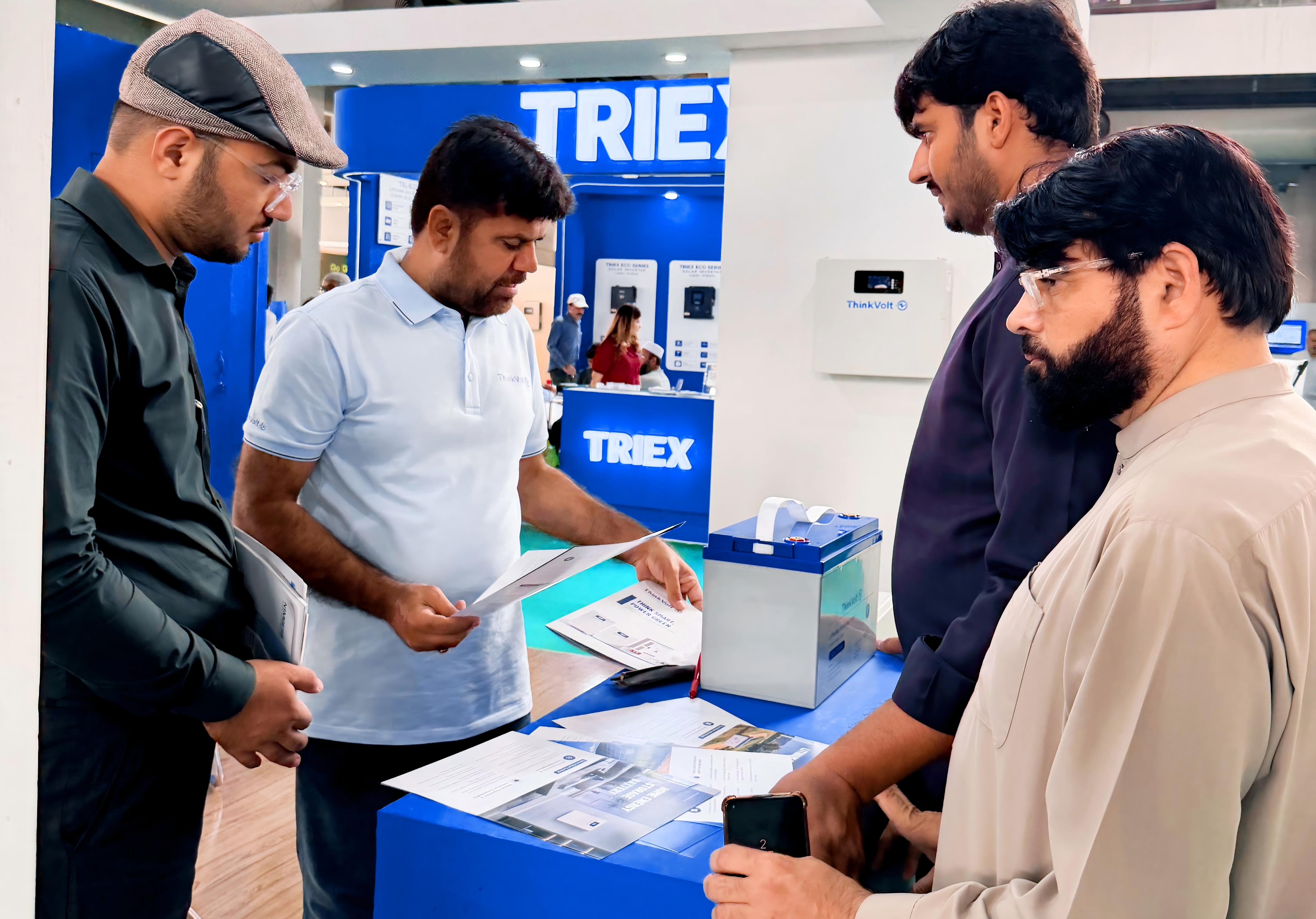
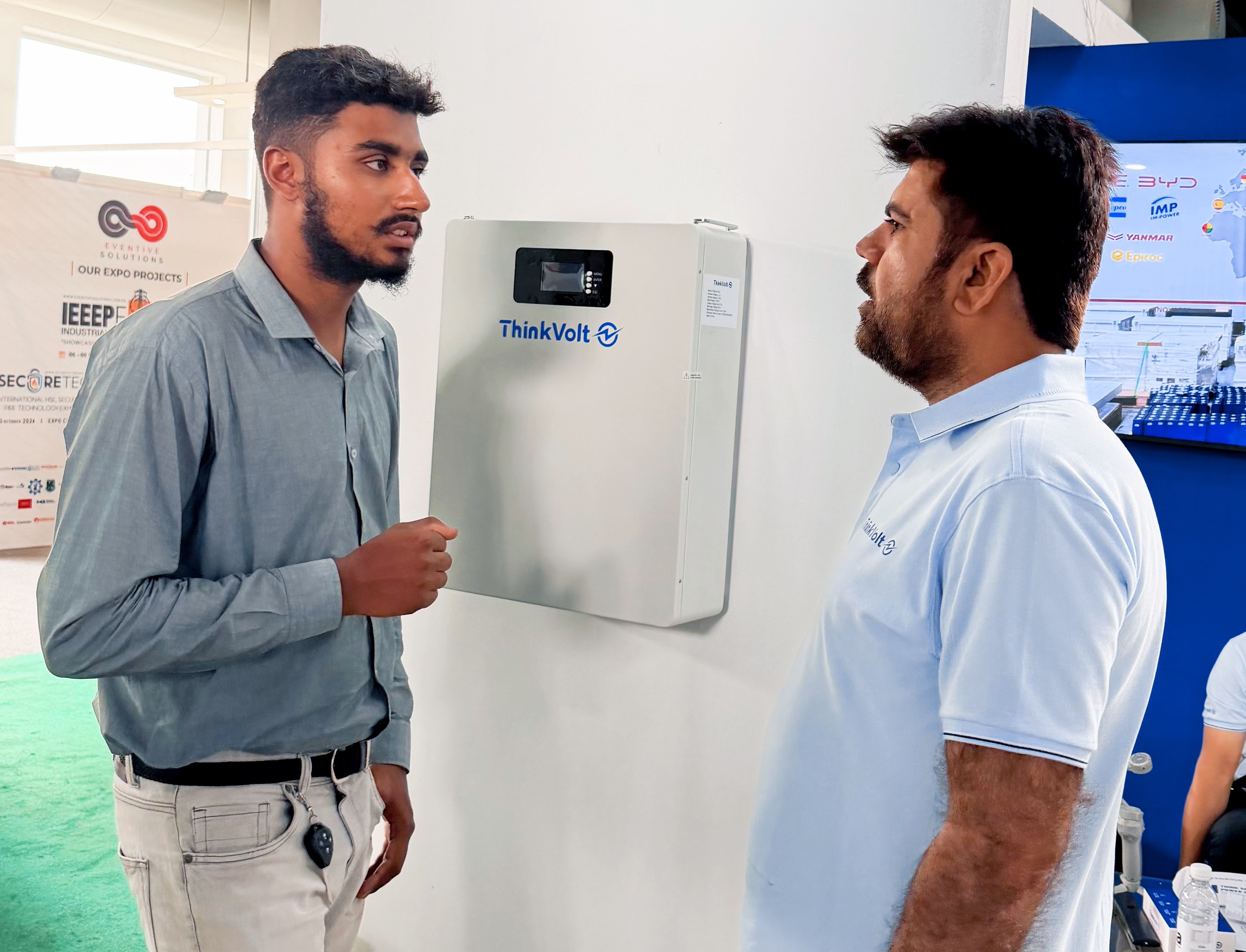
ThinkVolt at Solar & Storage Expo Pakistan 2026: Connecting with Pakistan’s Energy Storage Market
2026-07-23
No, battery size does not need to match your solar array in a fixed ratio. A 5kWp solar system, for example, can be paired with different battery capacities depending on solar generation, household electricity use, and backup power requirements.
The question of battery size vs solar system size is really about balancing electricity generation, energy storage, and actual consumption. To choose the right battery, you need to consider available solar surplus, nighttime electricity demand, usable battery capacity, and inverter compatibility.
This guide explains how to calculate battery capacity, compare different configurations, and avoid common sizing mistakes.
There is no universal rule that a 5kWp solar array must be paired with a 5kWh battery. Solar panels generate electricity, while batteries store energy for later use. Their numerical ratings describe different functions and cannot be matched directly.
A household that consumes most of its electricity during daylight hours may need relatively little battery storage. Another household with the same solar array but higher nighttime consumption may benefit from a larger battery.
Backup requirements can change the decision further. A homeowner who wants to operate essential appliances during extended outages may need additional storage capacity, even if the solar array cannot fully recharge it every day.
Similarly, a larger solar array does not automatically require a larger battery. If most generated electricity is consumed immediately or exported to the grid, additional storage may provide limited value.
The right battery size depends on how electricity is generated, stored, and consumed—not on a fixed relationship between solar kWp and battery kWh.
Solar array size (kWp) measures rated peak electrical power under standard test conditions, while battery capacity (kWh) measures stored energy. These are different measurements, so matching their numerical values does not guarantee a suitable system.
Measurement | What It Means | Why It Matters |
kWp | Rated peak power of a solar array under standard test conditions | Describes installed solar capacity, not daily energy production |
kW | Power generated or consumed at a particular moment | Helps determine inverter and load requirements |
kWh | Energy generated, consumed, or stored over time | Helps calculate electricity demand and battery capacity |
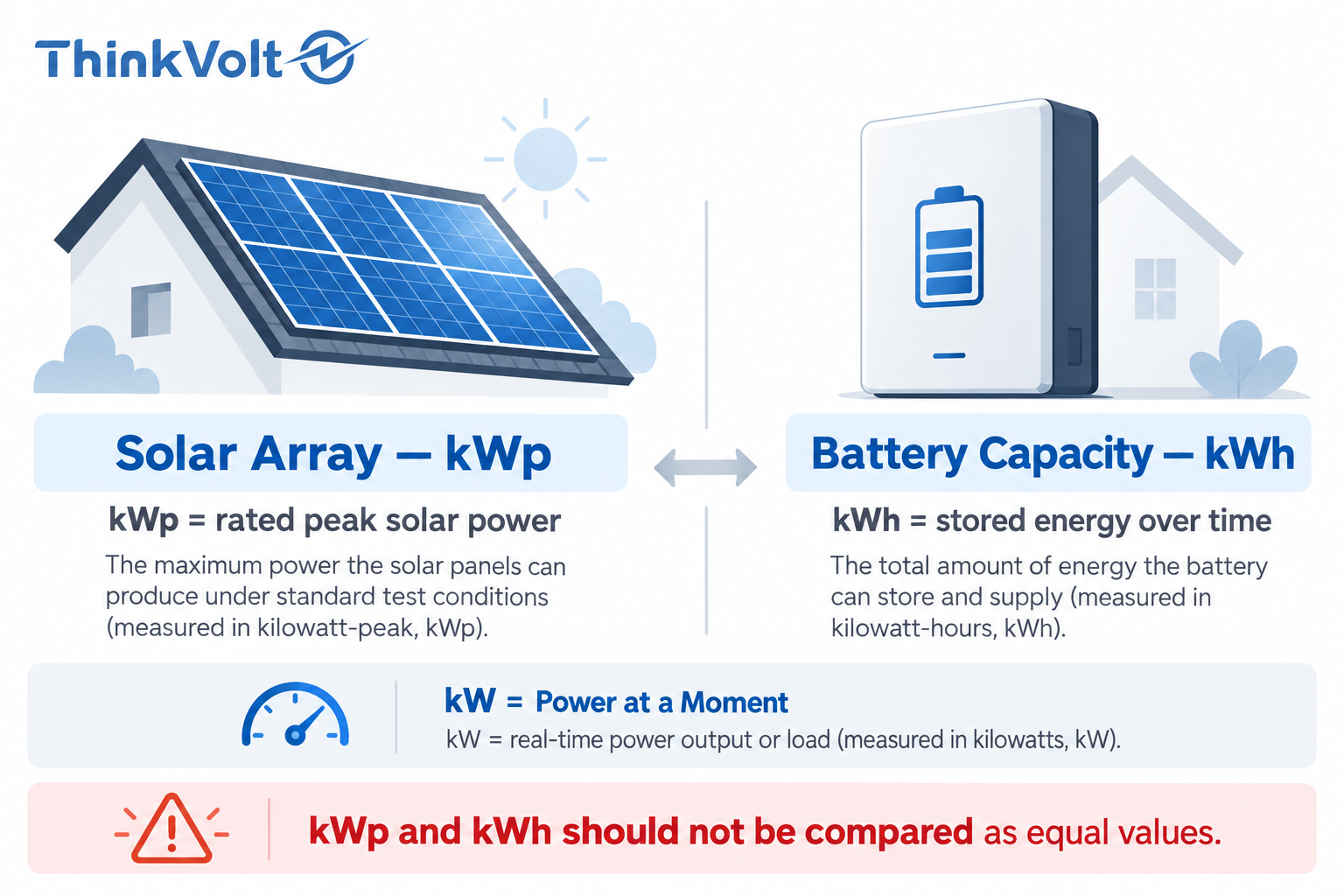
For example, a 5kWp solar array does not necessarily generate 5kWh per day. Actual production depends on sunlight, weather, panel orientation, shading, and system losses.
Similarly, a 10kWh battery cannot necessarily supply 10kW of power. Its maximum output depends on the battery's discharge limits, BMS, and inverter ratings.
Understanding these differences allows you to evaluate solar generation, battery energy capacity, and power requirements separately.
The right battery capacity depends on your household's electricity consumption, available solar surplus, and storage goals. Solar array size alone cannot determine how much battery storage you need.
Consider these six factors before selecting a battery:
1. Nighttime electricity consumption: Measure how much energy your home uses after sunset. Evening and overnight demand often determines storage requirements for daily solar self-consumption.
2. Available solar surplus: Estimate how much solar energy remains after daytime household consumption. This affects how much electricity is available to charge the battery.
3. Storage purpose: Solar self-consumption, emergency backup, and off-grid operation have different capacity requirements.
4. Backup duration: Identify essential appliances and determine how long they must operate during an outage.
5. Usable battery capacity: Consider the permitted state-of-charge (SOC) range, conversion losses, and battery operating limits rather than relying only on rated kWh.
6. Future expansion: Account for potential increases in electricity demand and whether the inverter and battery system can support additional storage.
For installers, actual electricity consumption patterns, solar production records, and inverter specifications provide a more reliable basis for battery sizing than a fixed solar-to-battery ratio.
The solar energy available for battery charging depends on how much electricity your panels generate beyond your home's simultaneous consumption. Solar array size alone cannot determine this amount.
For preliminary planning, daily solar production can be estimated using:
Daily PV Energy (kWh) = Array Size (kWp) × Peak Sun Hours × System Performance Ratio
For example, consider a 5kWp solar array receiving four peak sun hours per day, with an assumed AC-side system performance ratio of 80%.
5 × 4 × 0.80 = 16kWh per day
This is an illustrative estimate, not guaranteed daily production. The performance ratio represents assumed PV system losses up to the AC generation measurement point.
Actual generation depends on location, season, weather, orientation, shading, and equipment performance.
Not all solar generation is available for storage. Household appliances consume electricity directly while the solar panels are producing power.
To estimate solar surplus, compare PV generation and household consumption over the same time intervals.
Consider the following simplified hypothetical profile:
Period | Solar Generation | Household Use | Potential Solar Surplus |
Morning | 4kWh | 1kWh | 3kWh |
Midday | 9kWh | 3kWh | 6kWh |
Late afternoon | 3kWh | 4kWh | 0kWh |
Total | 16kWh | 8kWh | 9kWh |
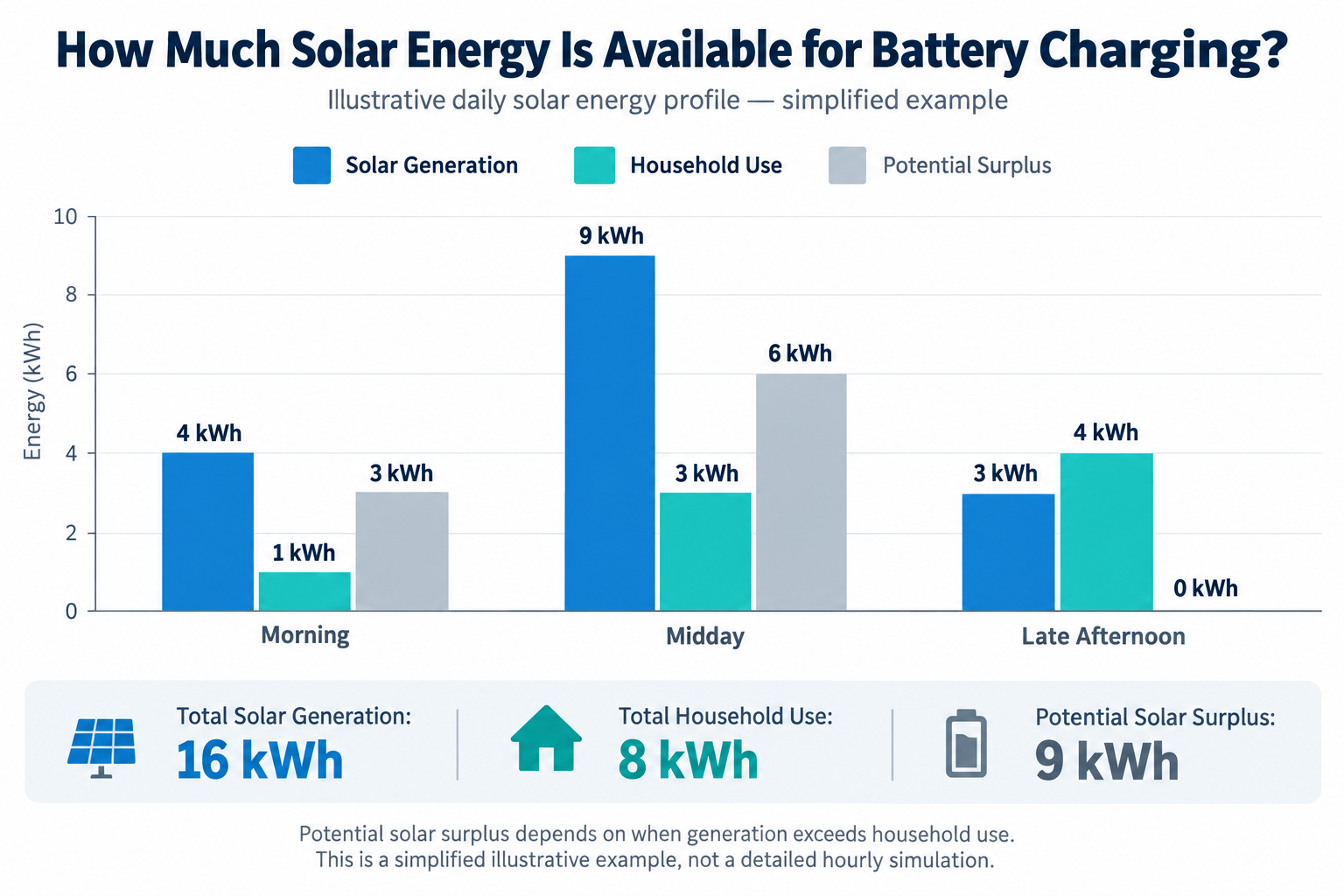
Under the assumed profile, potential solar surplus is 9kWh, rather than simply subtracting total consumption from total generation.
The calculation counts only intervals when generation exceeds household consumption. The late-afternoon period contributes no surplus because consumption is higher than generation.
Important: This example assumes generation and consumption are sufficiently consistent within each time block. Actual production and loads fluctuate, so broad time intervals may overestimate available surplus.
Installers should use hourly or finer-resolution data, preferably from actual system monitoring, for more reliable estimates.
The 9kWh also represents potential AC-side surplus before battery charging losses. Actual energy stored depends on charging efficiency, available charging time, battery SOC, and inverter or BMS charging limits.
To calculate battery capacity, first estimate the electricity required during the target operating period. Then account for the battery's usable DC energy and discharge conversion losses to determine the required rated capacity.
Start with your nighttime electricity consumption or the essential appliances you want to support during an outage.
For individual appliances:
Energy Consumption (kWh) = Power (kW) × Operating Hours (h)
Add the energy requirements of the relevant appliances to calculate total electricity demand.
For example, if a household consumes an average of 0.5kW over 12 nighttime hours:
0.5 × 12 = 6kWh
The battery system must therefore deliver approximately 6kWh of AC electricity to cover this demand.
A battery's rated energy capacity is not necessarily the amount available to household appliances.
Two important factors are:
· Usable capacity fraction: The proportion of rated DC battery energy available within the selected SOC operating range, including any reserve requirement.
· Discharge conversion efficiency: The assumed efficiency of converting usable DC battery energy into AC electricity supplied to household loads.
A simplified sizing formula is:
Required Rated Battery Capacity (kWh) = Required AC Energy ÷ (Usable Capacity Fraction × DC-to-AC Discharge Efficiency)
Consider these hypothetical conditions:
Parameter | Assumed Value |
Required nighttime AC energy | 6kWh |
Usable DC capacity fraction | 80% |
DC-to-AC discharge efficiency | 90% |
The calculation becomes:
6 ÷ (0.80 × 0.90) = 8.33kWh
Under these assumptions, the household requires at least 8.33kWh of rated battery capacity.
The 80% usable fraction and 90% discharge efficiency are separate illustrative assumptions, not verified ThinkVolt product specifications. If a manufacturer already provides usable AC energy under defined conditions, do not deduct the same losses again.
Final sizing should also account for power requirements, temperature-related limits, reserve settings, and the latest battery and inverter specifications.
Battery sizing depends on how stored electricity will be used. Solar self-consumption, emergency backup, and off-grid operation require different design priorities, even when the solar array and household electricity consumption are identical.
For solar self-consumption, the main goal is to store excess daytime generation for use when solar production is low.
Battery capacity should reflect both nighttime demand and the solar surplus available for charging.
A battery that is much larger than the available daily surplus may remain partially charged during normal operation, while a battery that is too small may leave valuable solar energy unused.
For backup power, sizing focuses on essential appliances and the required operating time during an outage.
The calculation must consider available reserve energy, usable capacity, inverter output power, and appliance startup requirements.
Off-grid systems face additional constraints because regular grid electricity is unavailable. Storage capacity must account for daily consumption, low-generation periods, and the desired autonomy. Solar array capacity and alternative charging sources must also support the energy balance.
Application | Primary Sizing Priority | Key Consideration |
Solar self-consumption | Nighttime electricity demand | Available solar surplus |
Backup power | Essential loads and backup duration | Reserve energy and discharge power |
Off-grid operation | Daily demand and autonomy | Low-generation periods and charging reliability |
A battery suitable for daily self-consumption may not provide enough energy for extended outages. The configuration should therefore reflect the intended operating conditions rather than a fixed solar-to-battery ratio.
A 5kW solar system, commonly referring to a 5kWp PV array, does not require a specific battery capacity. The right choice depends on available solar surplus, nighttime consumption, and the intended storage application.
Consider a hypothetical household with the following conditions:
Parameter | Assumed Value |
Solar array capacity | 5kWp |
Daily AC solar generation | 16kWh |
Potential AC solar surplus | 9kWh |
Nighttime AC electricity demand | 6kWh |
Usable DC battery capacity fraction | 80% |
DC-to-AC discharge efficiency | 90% |
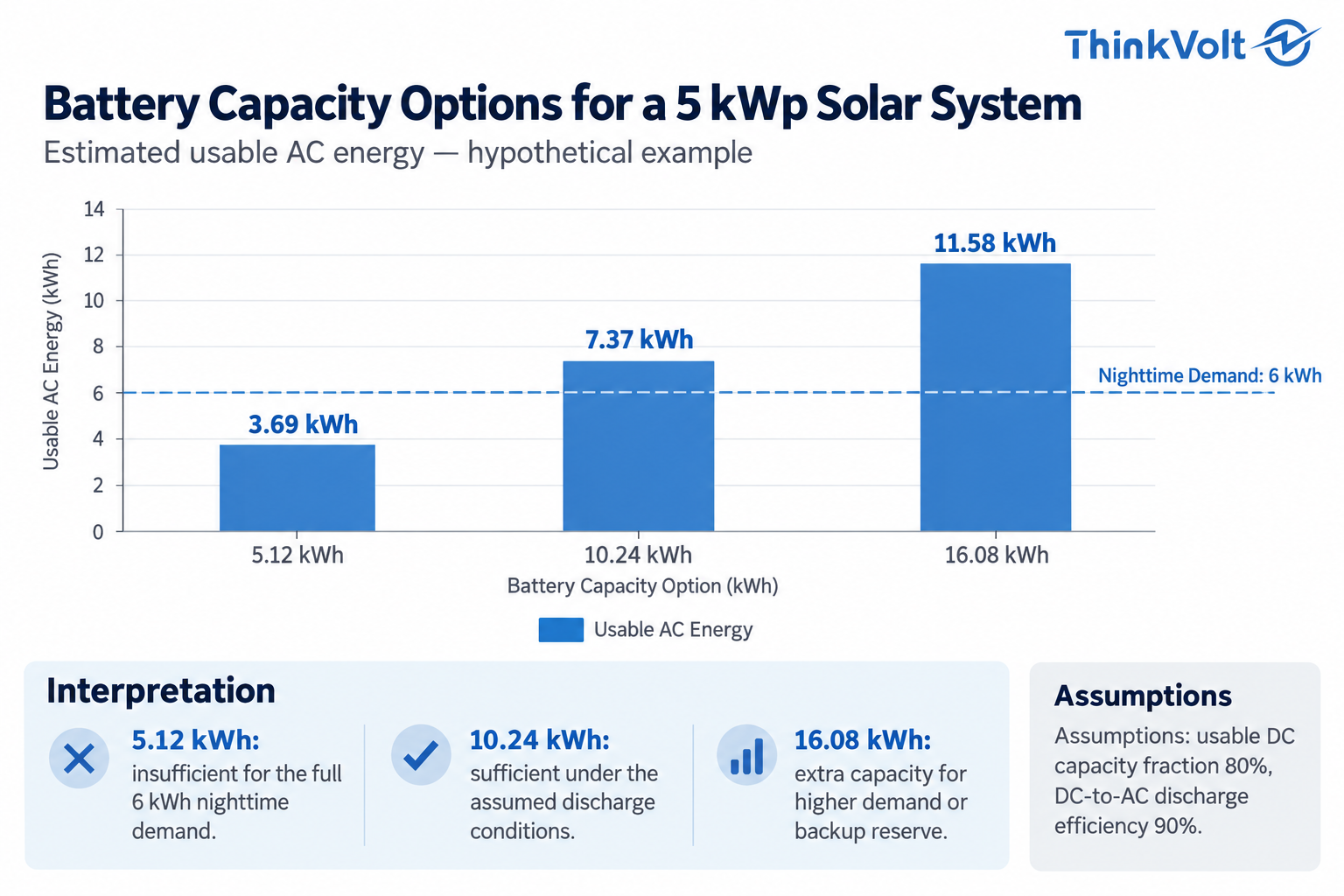
As calculated earlier, the household requires at least 8.33kWh of rated battery capacity to deliver 6kWh of nighttime AC energy under these assumptions.
However, this is an energy-capacity estimate, not a complete system design.
The following table compares three capacity options using the same usable-capacity and discharge-efficiency assumptions.
Rated Battery Capacity | Estimated Usable AC Energy | Assessment |
5.12kWh | 3.69kWh | Insufficient for the full 6kWh nighttime demand |
10.24kWh | 7.37kWh | Sufficient under the assumed discharge conditions |
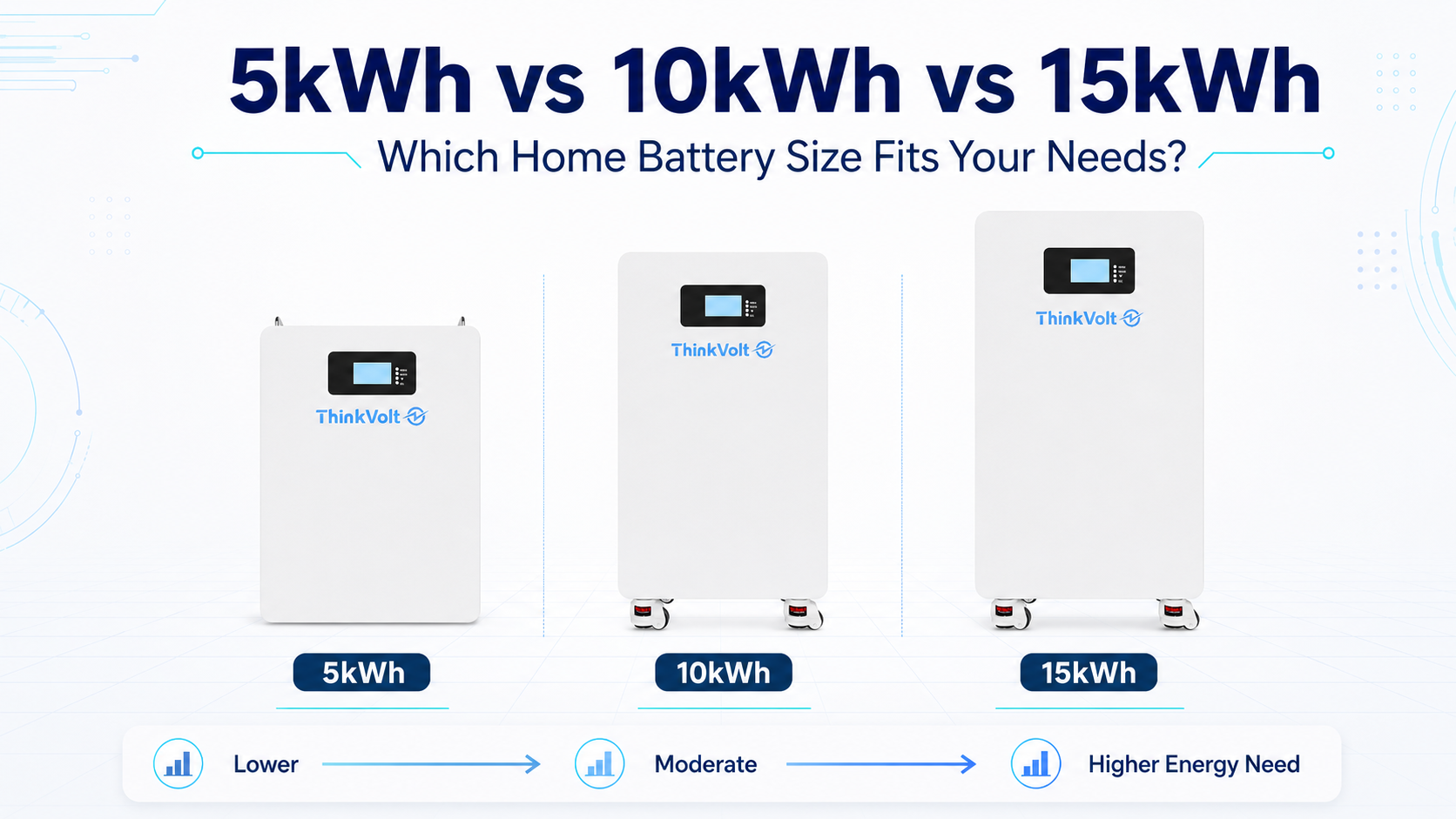
16.08kWh | 11.58kWh | Additional potential for backup or higher energy demand |
A 10.24kWh battery is a reasonable preliminary capacity candidate for this particular example, but it is not automatically the best final configuration.
The charging side must also be evaluated.
For illustration, assume the 9kWh potential AC solar surplus passes through a battery charging path with 90% AC-to-DC efficiency:
9 × 0.90 = 8.1kWh of potential stored DC energy
Meanwhile, delivering 6kWh of AC electricity at 90% discharge efficiency requires approximately:
6 ÷ 0.90 = 6.67kWh of DC energy
Under these assumptions, the available daily solar surplus could theoretically replace the energy needed for nighttime consumption.
Actual results still depend on when surplus generation occurs, charging power, battery SOC, temperature, and system settings. Seasonal variations may further reduce charging opportunities.
ThinkVolt offers residential LiFePO4 battery options in these capacity ranges. Final selection requires verification of the exact battery model, inverter compatibility, charge/discharge limits, and installation conditions.
Yes. A solar array can be paired with relatively large or small battery storage, but the numerical values of kWp and kWh cannot be compared directly.
The appropriate configuration depends on how much energy the battery can receive, store, and deliver for its intended use.
A larger battery may be suitable when a household has higher nighttime consumption, requires extended backup power, or expects future electricity demand to increase.
Additional capacity may also be useful when grid charging is supported and permitted.
However, limited solar surplus can prevent a larger battery from charging fully during normal daily operation. Additional capacity also increases upfront investment.
A smaller battery may be appropriate when nighttime consumption is modest, backup requirements are limited, or the main objective is to store part of the available solar surplus.
It generally requires less initial investment but provides shorter backup duration and may leave some excess solar generation unused.
Situation | Capacity Strategy | Main Consideration |
High nighttime consumption | Consider larger storage | Required usable energy |
Extended outage protection | Consider additional capacity | Critical loads and backup duration |
Limited solar surplus | Evaluate smaller storage | Daily charging opportunity |
Low evening consumption | Smaller capacity may be sufficient | Actual stored energy usage |
Future demand growth | Plan for expansion | Inverter and battery compatibility |
For installers, the best choice is not necessarily the largest battery. It is the configuration that balances actual energy demand, available charging sources, system limits, and total investment.
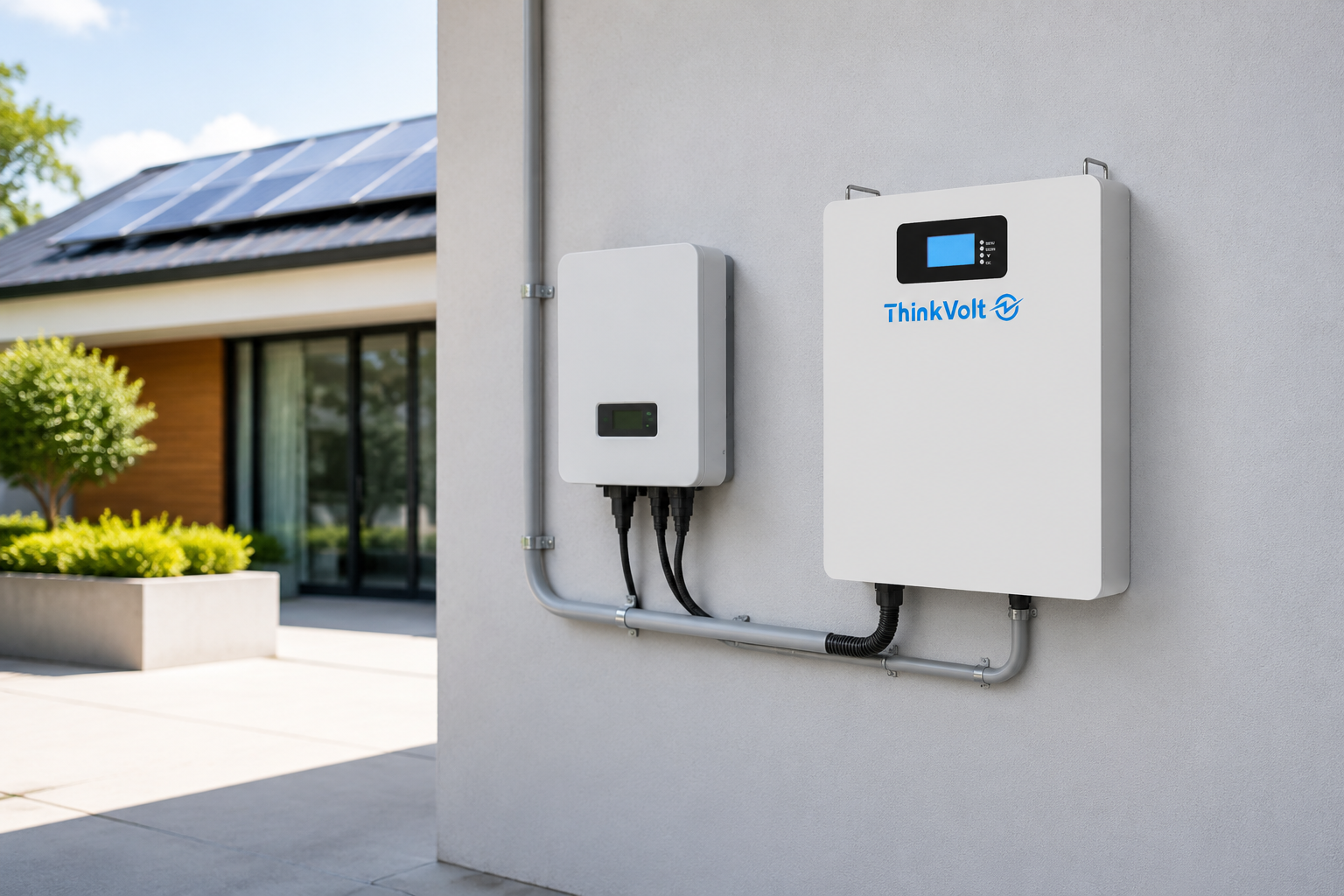
Even when calculated battery capacity meets your energy requirements, the system must also satisfy the inverter's electrical and communication limits.
Battery capacity in kWh alone does not guarantee compatibility or sufficient power output.
First, verify that the battery's operating voltage range falls within the inverter's supported battery voltage range.
Next, check the maximum charging current and power supported by both devices.
A solar array may generate enough surplus energy, but the battery cannot necessarily absorb it at any charging rate.
Actual charging performance also depends on battery SOC, temperature, and BMS restrictions.
Battery capacity determines stored energy, while discharge power determines how much electricity the system can supply at a given moment.
Check whether the battery's discharge capability and inverter's continuous and surge ratings can support household loads, including appliance startup requirements.
Installers should verify the following specifications:
Parameter | What to Verify |
Battery voltage | Compatible DC operating voltage range |
Charging limits | Maximum charging current and power |
Discharge limits | Continuous and peak discharge capability |
Inverter output | Continuous AC power and surge capacity |
BMS communication | Supported protocol, inverter model, and firmware |
System protection | Approved protective devices and installation requirements |
For LiFePO4 battery systems, confirm the exact inverter and battery models using current technical documentation.
Compatibility with one inverter model does not guarantee compatibility with every model from the same manufacturer. Final system configuration should follow approved installation instructions and applicable local requirements.
Yes, many existing solar systems can accommodate additional battery storage, but expansion is not always plug-and-play.
Available options depend on the inverter architecture, existing battery specifications, and manufacturer-approved configurations.
Start by identifying whether the system uses a hybrid inverter, a standard grid-tied solar inverter, or a separate battery inverter.
A compatible hybrid inverter may support battery storage within specified voltage, power, and communication limits.
A solar-only inverter may require a separate battery inverter or other approved retrofit equipment.
If batteries are already installed, check the manufacturer's expansion requirements before adding modules.
Installers should verify:
· Parallel connection limits: Maximum supported module quantity and total capacity.
· Battery compatibility: Approved models, voltage ranges, and BMS communication protocols.
· Module consistency: Restrictions on mixing batteries of different ages, capacities, or revisions.
· System protection: Firmware requirements, charging settings, cables, and protective devices.
Adding more battery capacity does not automatically increase the system's maximum output power.
Before expanding storage, document the existing inverter model, battery configuration, and additional energy requirements. Verify the proposed expansion against the manufacturers' latest technical documentation.
Provide your solar array capacity (kWp), daily electricity consumption, nighttime demand, and intended battery application.
Installers should also collect the inverter model, backup duration, installation location, and future expansion requirements. Historical solar production and load data improve sizing accuracy. These details help determine suitable battery capacity and identify potential compatibility issues before equipment selection.
Yes, some home battery systems support grid charging when the inverter and energy management settings allow it.
Grid charging can help maintain backup reserves or supplement insufficient solar production. However, availability depends on the inverter model, system configuration, local regulations, and electricity tariffs. The feature should be verified before including grid charging in the sizing strategy.
Not necessarily. Parallel connection of batteries with different capacities, ages, or specifications should only be considered when explicitly supported by the manufacturer.
Differences in electrical behavior and BMS operation can affect performance and safety. Installers must confirm approved battery combinations, communication settings, protection requirements, and commissioning instructions before expansion.
No. Delivered AC energy can vary depending on inverter efficiency, SOC settings, and other operating restrictions.
For accurate comparisons, distinguish rated battery capacity, usable DC energy, and AC energy available to household appliances. Use the manufacturer's definitions and the intended operating conditions rather than assuming that the same rated kWh always produces identical usable energy.
Check the battery's continuous discharge capability, the inverter's AC output rating, and appliance startup requirements.
A battery may contain sufficient energy for several hours of use but still be unable to supply high-power appliances simultaneously. Installers should review peak demand, surge capability, inverter settings, and BMS limits before modifying the system configuration.
Review the approved operating temperature range, thermal management design, and temperature-related charging or discharging restrictions.
High temperatures can affect battery performance and long-term durability. Installation location, ventilation, direct sunlight exposure, and enclosure protection also matter. Confirm environmental suitability using the exact battery model's technical documentation.
Request the latest battery datasheet, installation manual, inverter compatibility information, and applicable certification documents for the destination market.
Distributors should also verify warranty terms, communication protocols, supported expansion configurations, and technical support arrangements. Product suitability and documentation should be confirmed for the intended project before procurement decisions are finalized.
Battery size does not need to match solar array size in a fixed ratio. The right configuration depends on available solar generation, actual electricity demand, storage objectives, and compatibility between the battery and inverter.
Need Help Sizing a Battery for Your Solar Project?
ThinkVolt offers residential LiFePO4 battery solutions for solar energy storage and backup applications.
Share your solar array capacity, electricity consumption, inverter model, backup requirements, and project location with our team. We can help evaluate suitable battery capacity options and identify the technical specifications that need to be verified for your project.