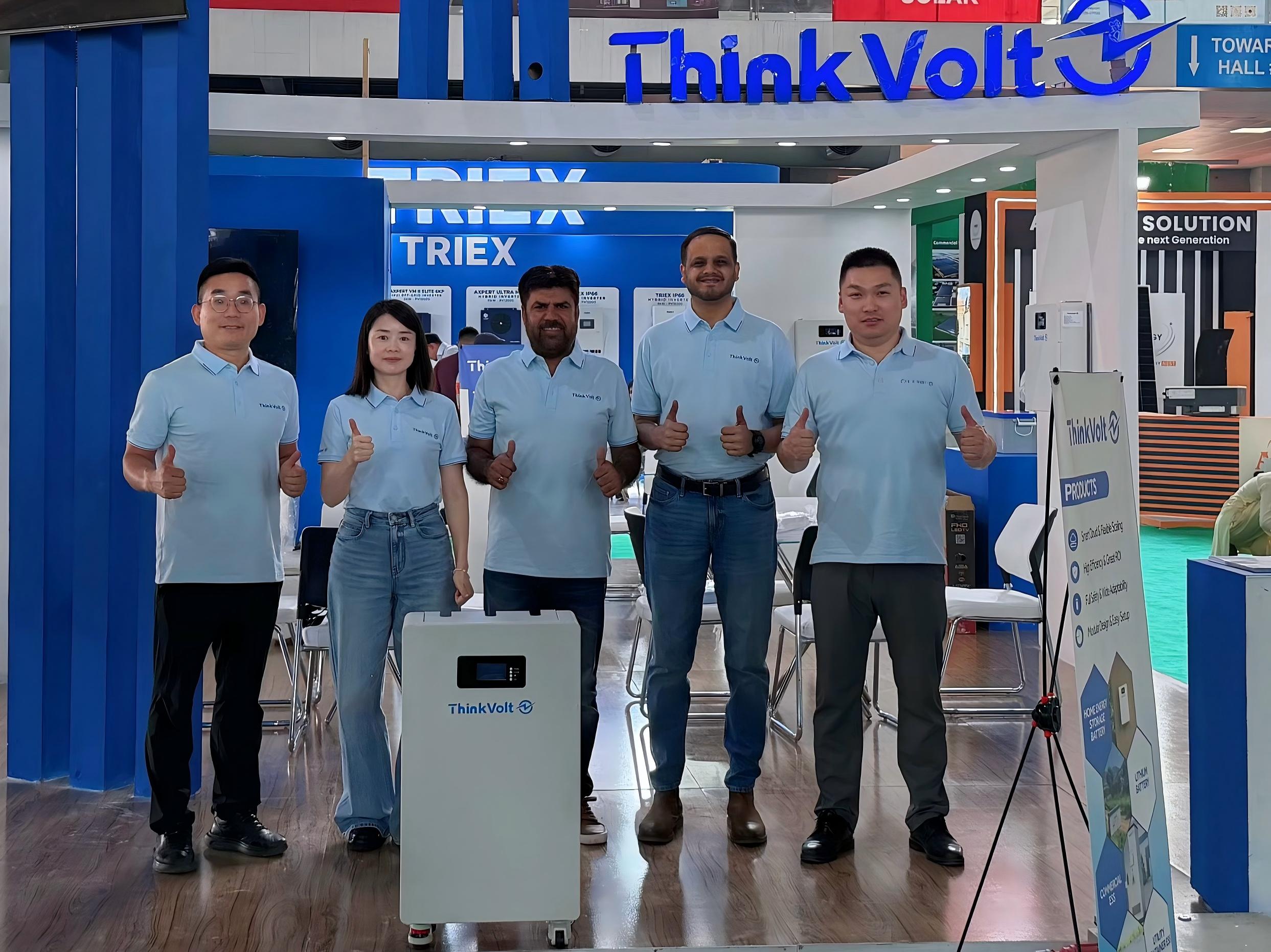
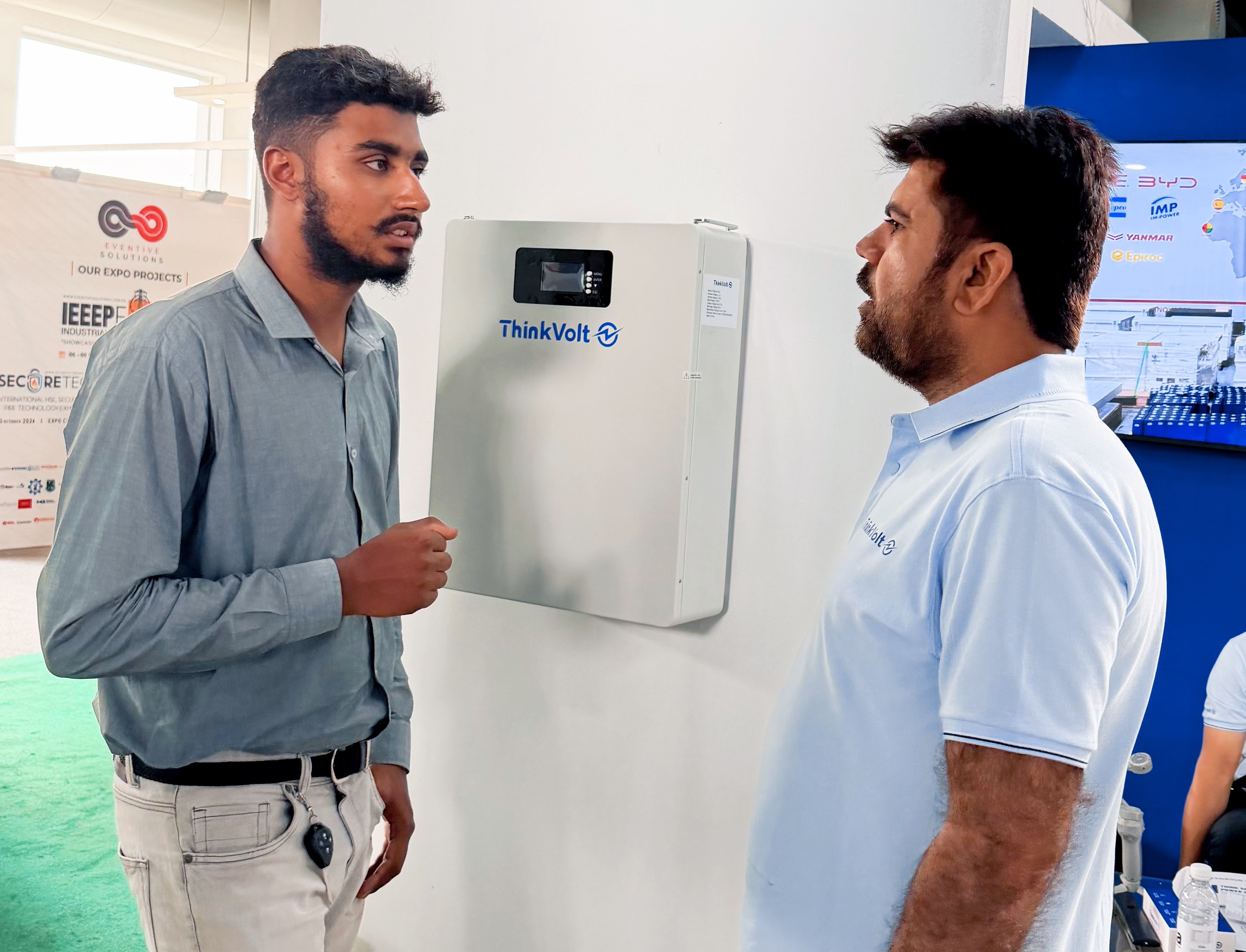
ThinkVolt at Solar & Storage Expo Pakistan 2026: Connecting with Pakistan’s Energy Storage Market
2026-07-23
To pair a home battery with a heat pump, calculate the heat pump's real electrical consumption, choose enough usable battery energy for the desired hours, and verify that the inverter can handle continuous demand, compressor startup, and any auxiliary heating. Battery capacity in kWh and power in kW must both pass the test.
Begin with the actual equipment, not a generic battery-size recommendation. Record the heat pump make and model, electrical nameplate, compressor type, indoor air handler, auxiliary heater arrangement, supply voltage and phase. Also identify whether the system is air-to-air, air-to-water, ground-source or a heat-pump water heater. These arrangements can have very different operating profiles.
Ask the homeowner what success means: lower evening electricity imports, shifting solar energy into the night, a few hours of heating during an outage, or full overnight winter backup. A grid-connected self-consumption design can still import power during high demand. A true outage-backup system needs equipment specifically capable of forming an islanded AC supply.
Use measured consumption wherever possible. Energy monitor data from a cold day can reveal compressor modulation, circulation pumps, fan loads, defrost events and electric resistance heat that may not be visible in headline marketing specifications. Obtain the installation manual and electrical schedule if monitoring is not available.
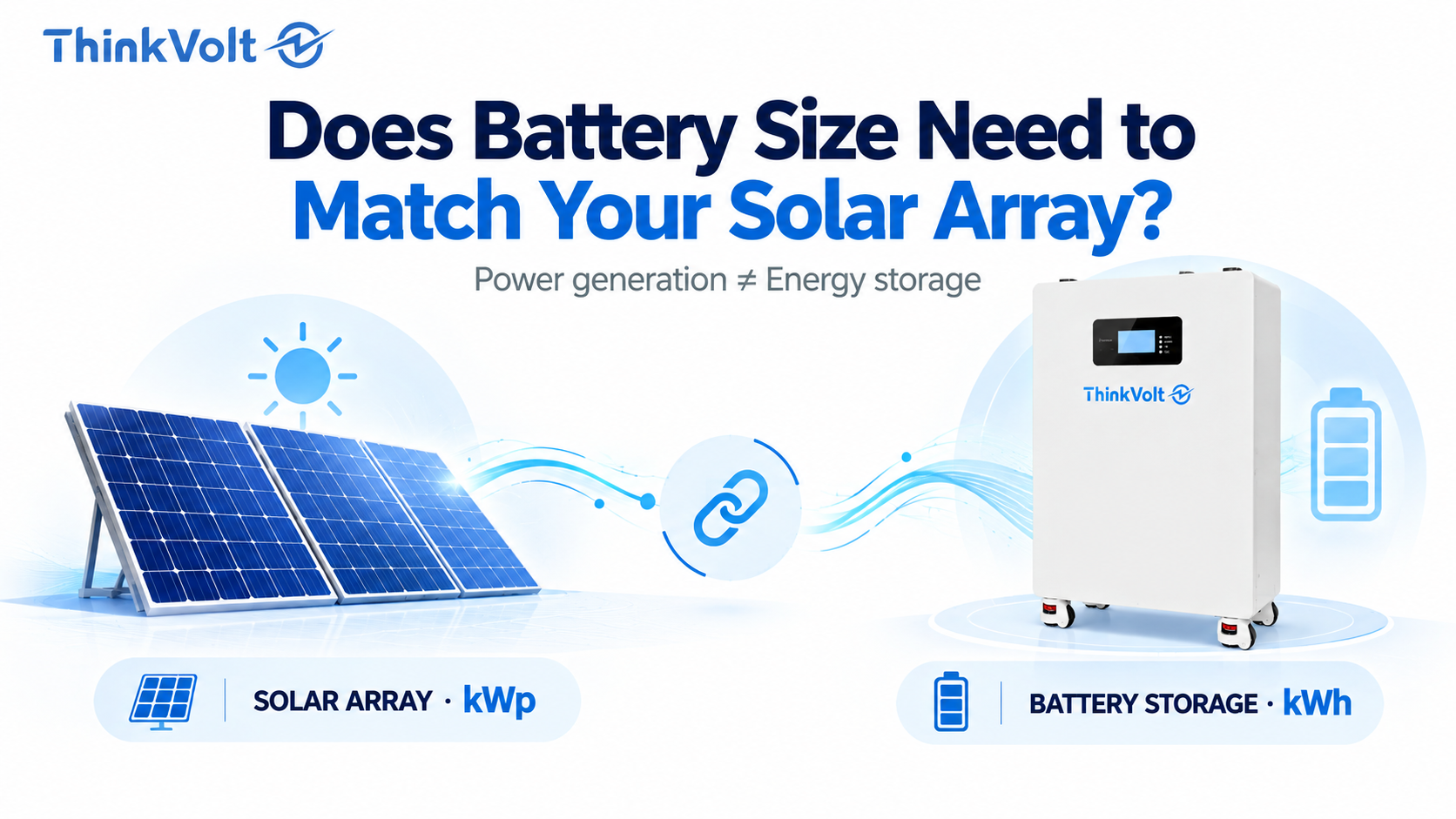
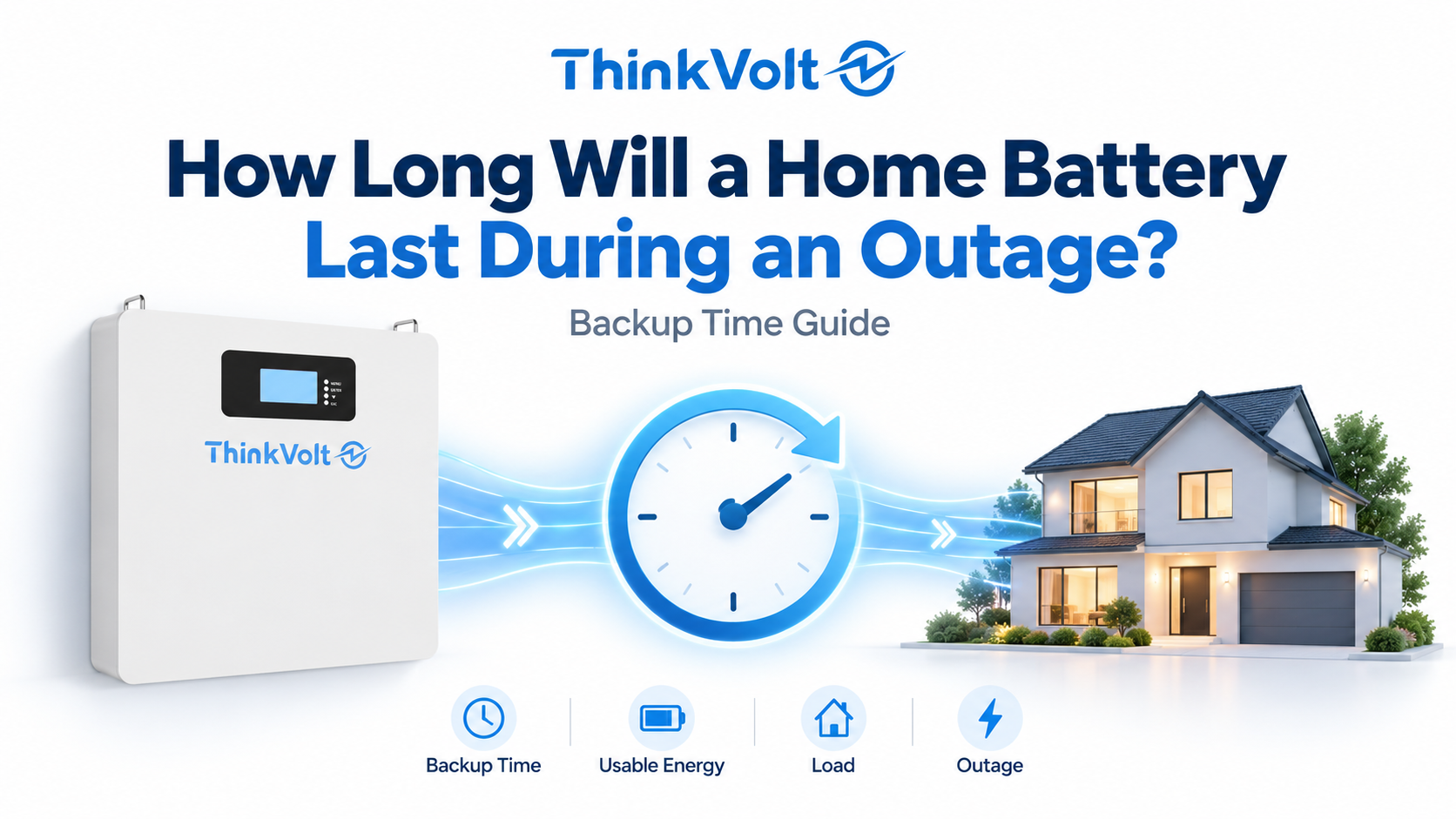
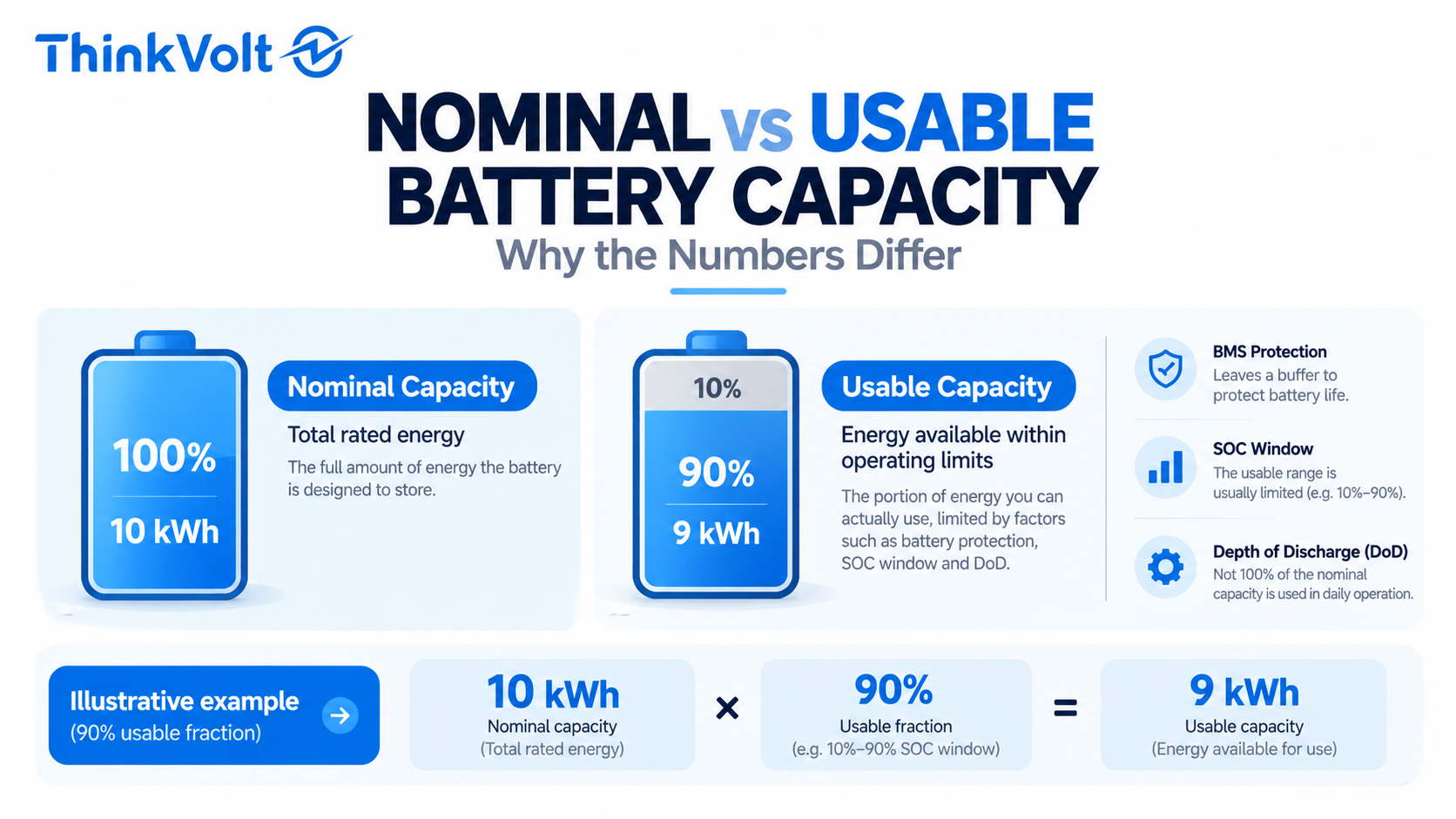
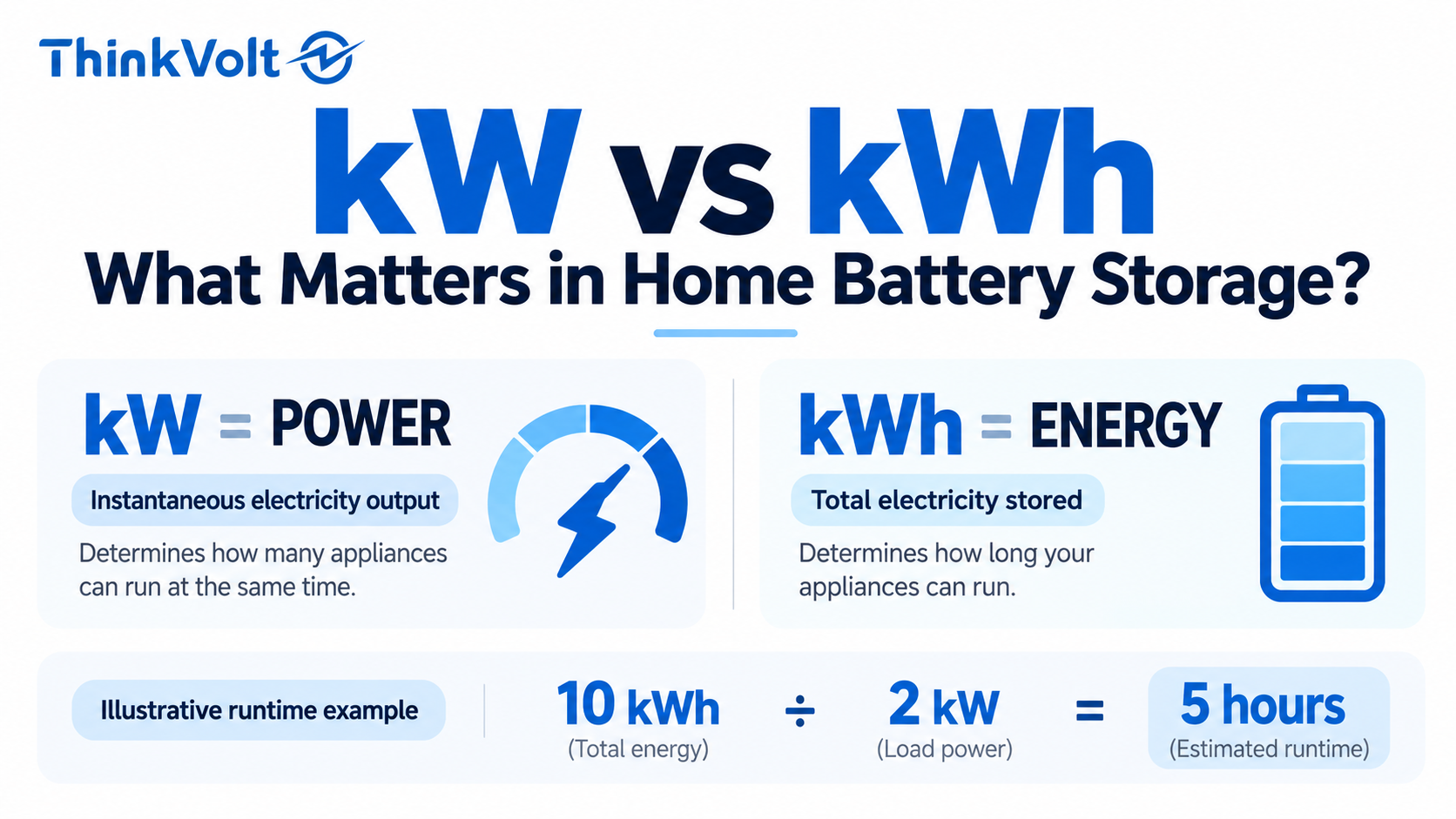
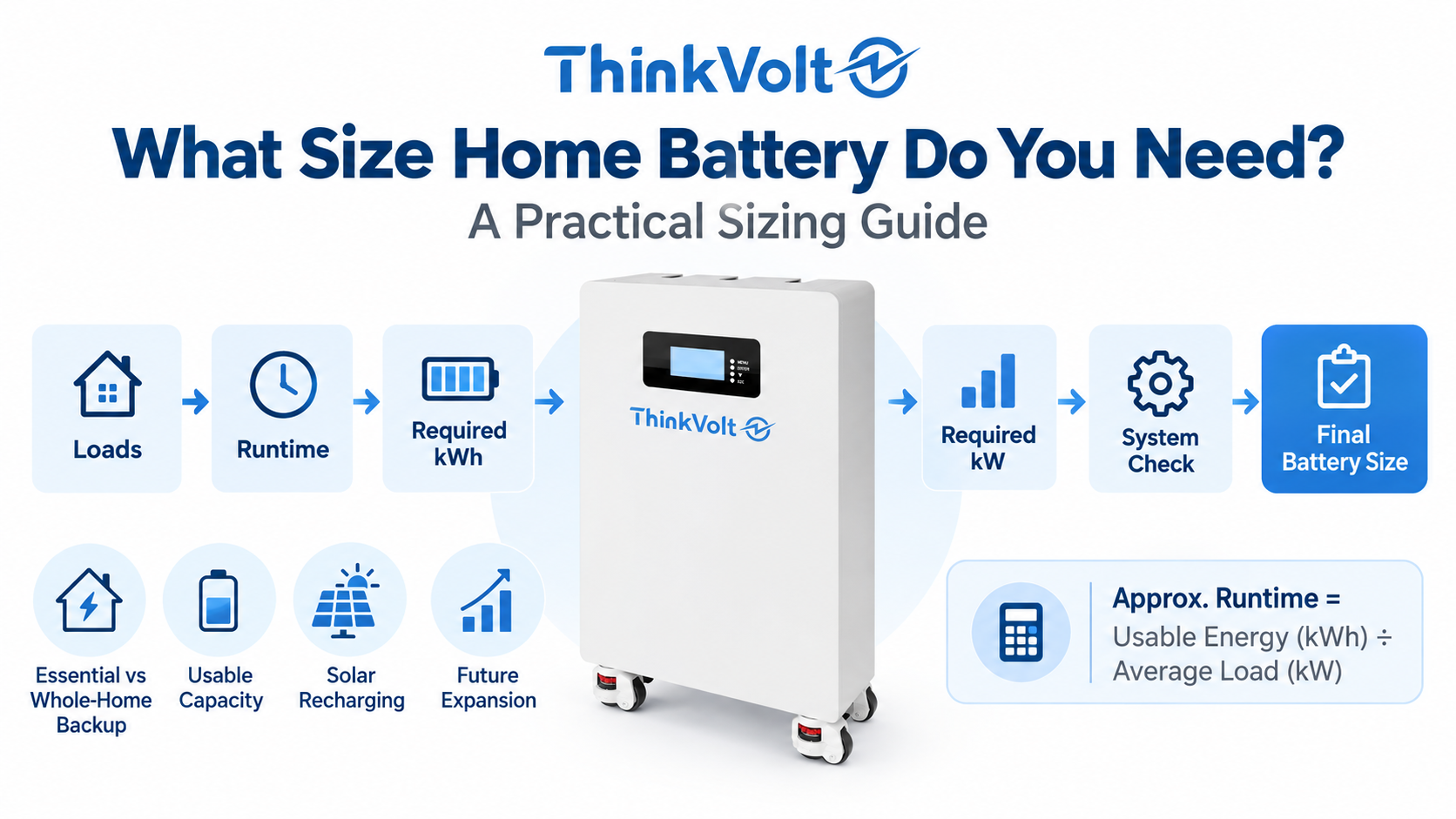
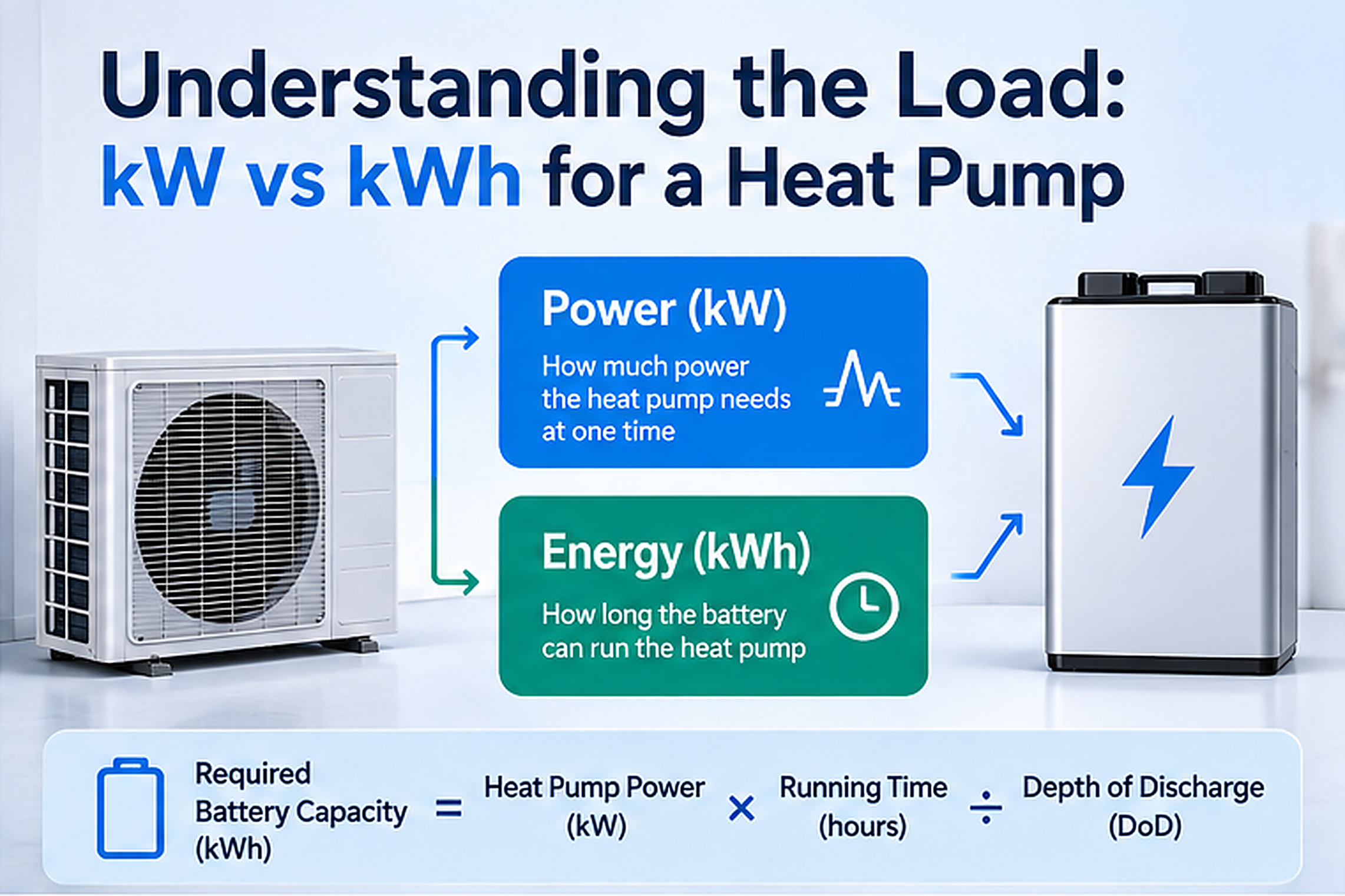
Kilowatts describe instantaneous electrical power; kilowatt-hours describe energy consumed over time. A 2 kW average electrical load running for four hours needs approximately 8 kWh at the AC load, before accounting for battery discharge limits and conversion losses. A battery with 10 kWh printed on its case cannot automatically provide 10 kWh of usable AC electricity.
Inverter output and battery discharge capability impose separate power limits. Even a large battery can fail to start a compressor if the inverter surge specification is insufficient. Conversely, a powerful inverter paired with a small battery may run the system correctly but for only a short period.
Check continuous inverter output, short-duration surge capability and overload duration, supported output voltage/frequency, battery maximum continuous discharge and the inverter-to-battery control interface. Where a site uses split-phase or three-phase equipment, confirm that the backup output actually serves the relevant circuit configuration.
Use electrical input, not heat output, for battery sizing. A heat pump rated at 8 kW of heating capacity does not necessarily draw 8 kW from the electrical supply. Its input depends on the operating coefficient of performance (COP) and conditions. As an illustration, 8 kW of delivered heat at COP 3 implies about 2.67 kW electrical input, before any separately counted accessories or backup elements.
For a basic estimate, multiply average electrical input in kW by expected running hours, adjusted for cycling or modulation. If the compressor averages 1.8 kW for five equivalent full-load hours, it uses 9 kWh. Add indoor fan, pump, controls and other backed-up loads that are outside that measured total. Avoid adding the same equipment twice.
Daily averages may hide critical winter peaks. A heat pump's efficiency and heating capacity can change as outdoor temperature falls, and a defrost cycle may alter its power profile. Plan with colder-weather measurements or approved manufacturer performance tables, not only a pleasant-day reading. ENERGY STAR describes cold-climate heat pumps as a distinct application requiring attention to low-temperature performance.
| Input | Example only | Source to verify |
Heat pump average electric draw | 1.8 kW | Meter or technical data |
Effective runtime | 6 hours | Backup target and duty cycle |
Other essential loads | 0.4 kW average | Circuit-level measurements |
Energy at AC loads | 13.2 kWh | (1.8 + 0.4) × 6 |
Illustrative AC delivery factor | 0.90 | System-specific assumption |
Illustrative usable SOC fraction | 0.80 | Battery/system settings |
These are illustrative inputs, not typical ratings for all heat pumps, and should not be treated as a quotation. If the 13.2 kWh must reach the AC loads, with 90% discharge-path efficiency and 80% of nominal capacity available across the planned SOC window, the screening estimate is 13.2 ÷ (0.90 × 0.80) ≈ 18.3 kWh nominal. The actual manufacturer's usable AC capacity may already include some losses or limits, so do not apply a factor twice.
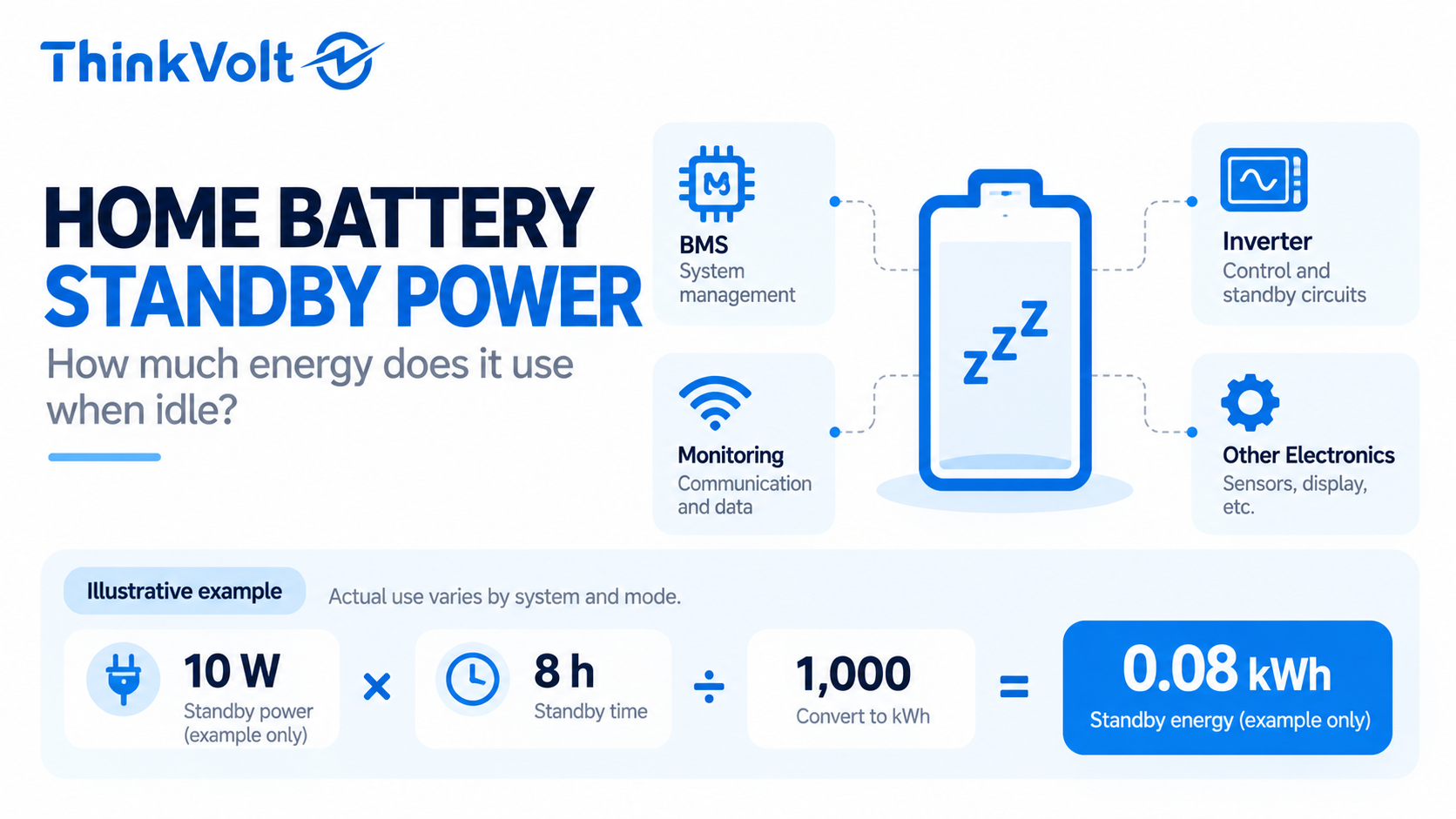
Start with the outage duration and the conditions in which backup matters. A four-hour evening reserve is a different project from twenty-four hours of heating through freezing weather. Choose which circuits remain live: heat pump, indoor unit, circulators, refrigerator, lights, internet and any critical medical equipment. Include standby power and realistically concurrent loads.
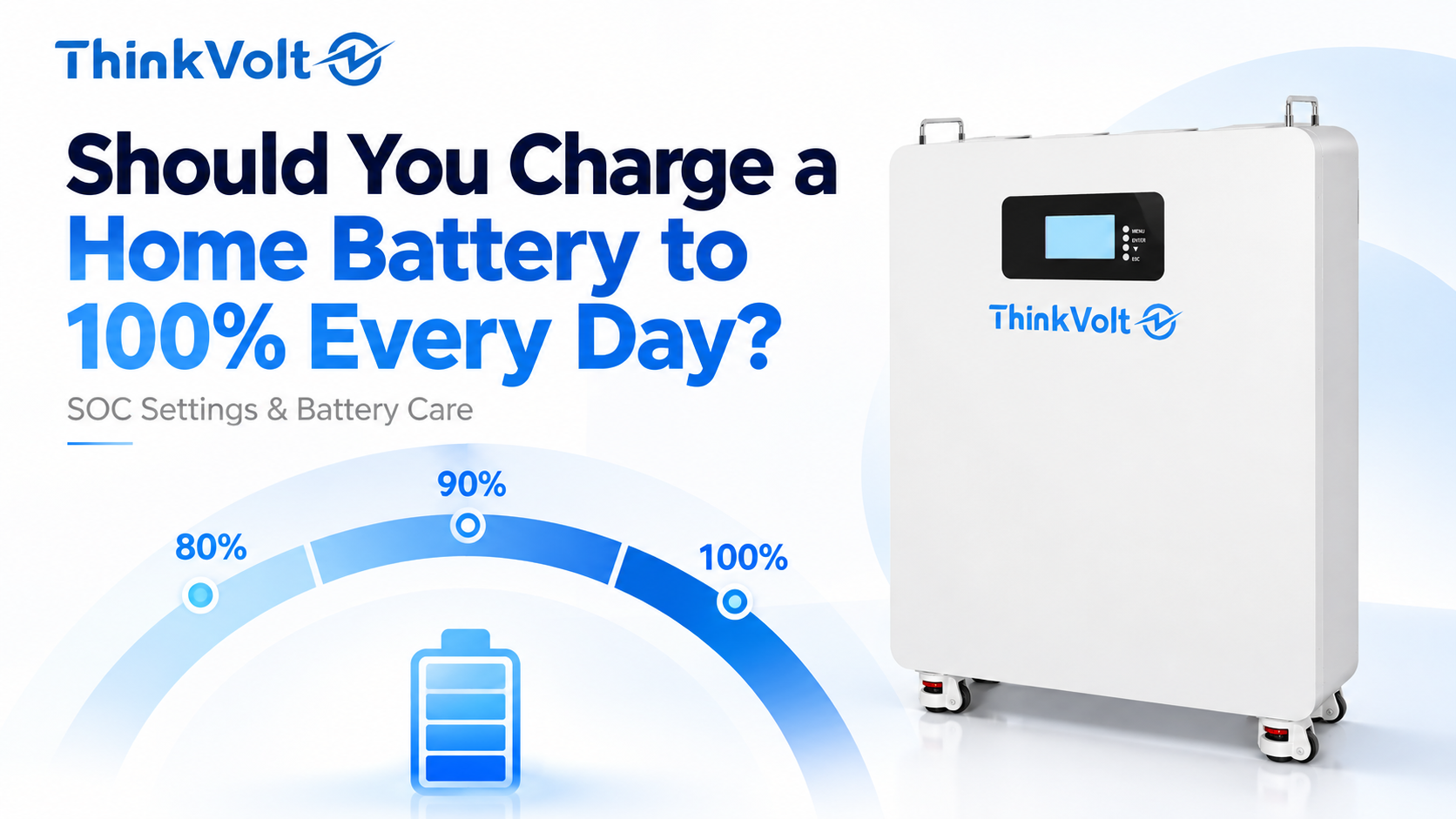
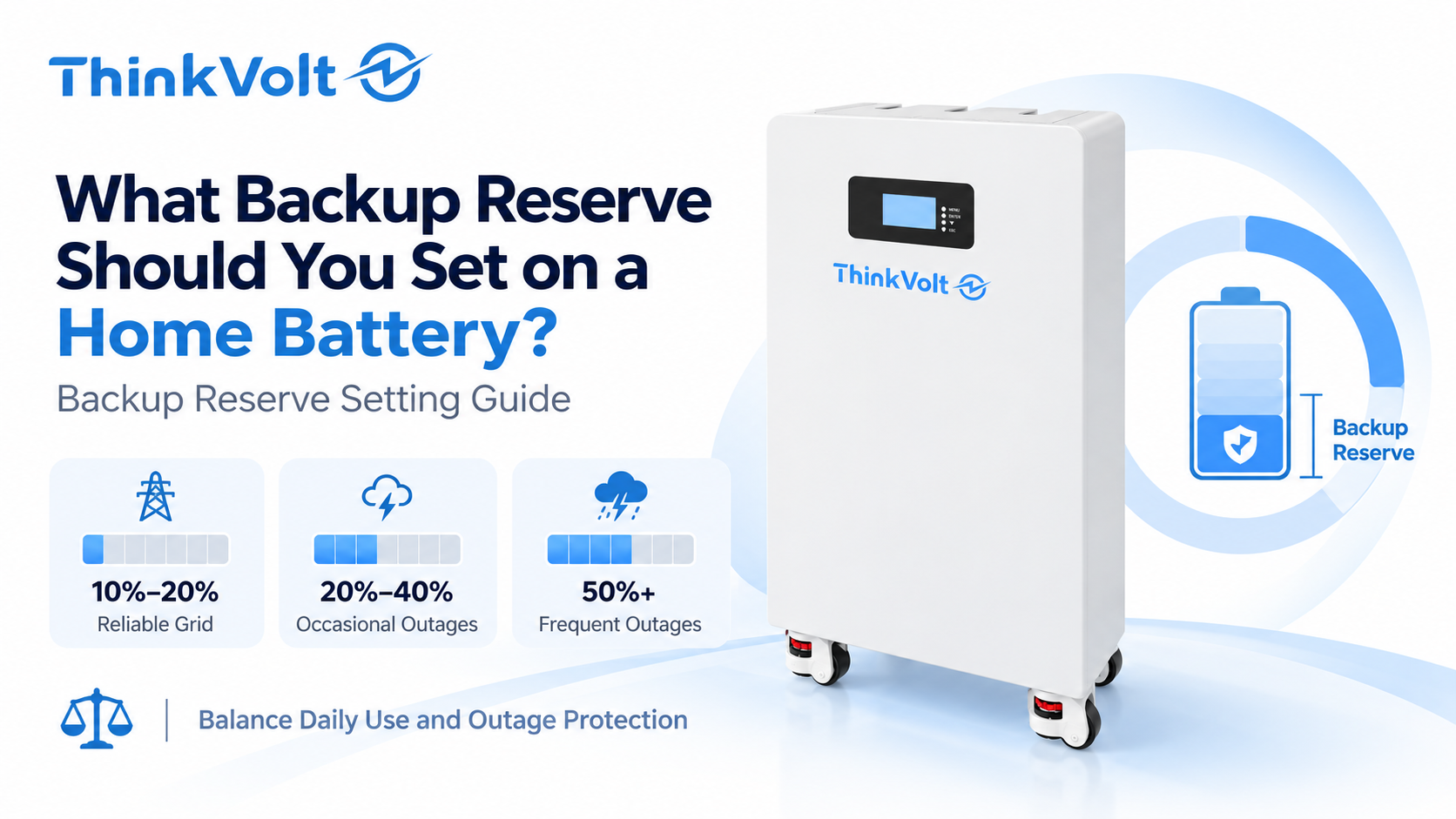
The core screening relationship is: nominal battery kWh ≈ required AC load kWh ÷ (usable battery fraction × discharge-path efficiency). Use manufacturer-stated usable AC output instead if directly available, and include any minimum state-of-charge reserve you intend to preserve. A battery that is not fully charged at outage onset cannot supply its full nominal capacity.
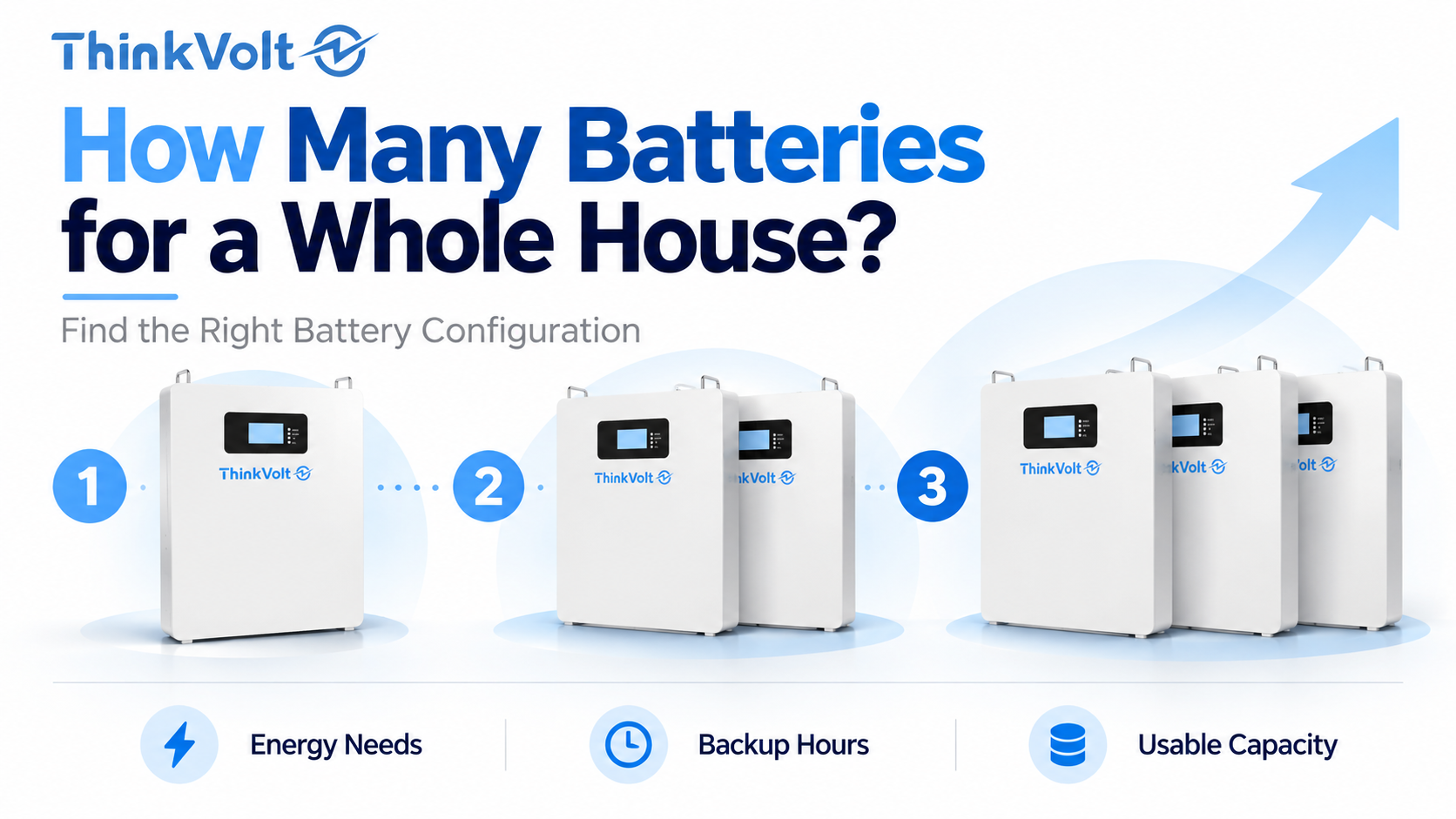
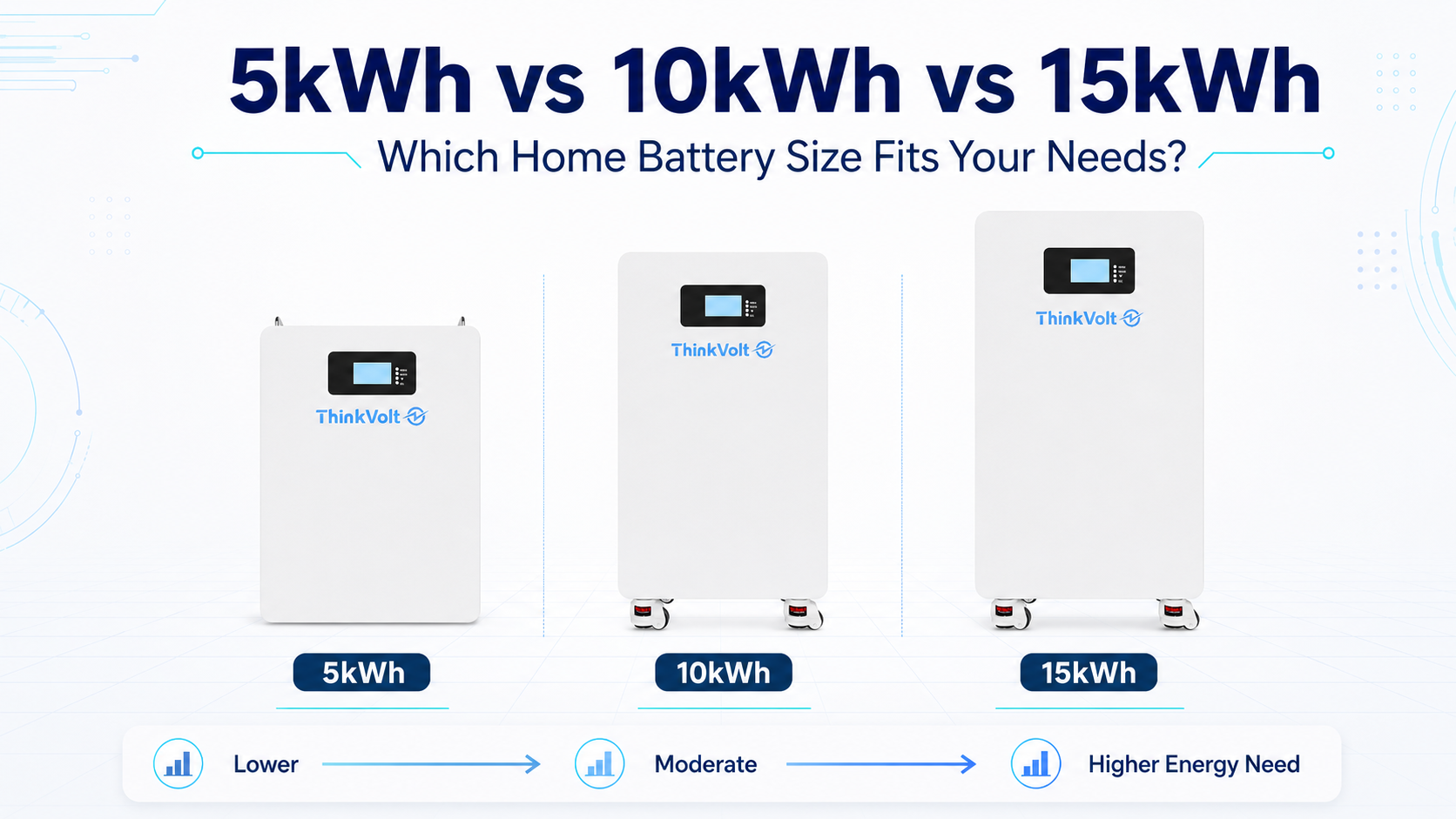
If an installer recommends a 5 kWh, 10 kWh or 20 kWh system without an outage-duration assumption, request the load calculation. Modularity can help with future expansion, but some parallel battery arrangements increase energy without increasing inverter power. Expansion must be permitted by both battery and inverter documentation.
For longer outages, solar recharge can extend runtime but cannot be assumed at night, in storms or when rooftop modules are snow-covered. Model a no-solar case as the baseline and a solar-recharge case as an additional scenario. Research on solar-plus-storage backup finds that climate, building efficiency and electrified heating can substantially change storage requirements.
Verify three limits before accepting a heat pump for battery backup: continuous running power, compressor-start transient and all simultaneously operating loads. The start behavior varies across fixed-speed, variable-speed and inverter-driven compressors; an advertised soft-start feature is not a guarantee that a particular inverter will work.
Ask for actual starting-current or locked-rotor information where applicable, compressor controls, the inverter's overload curve and any required soft-start device approval. Check that the heat pump manufacturer permits the proposed supply topology and that voltage stability remains within its limits. The installer should test a real start, including other essential loads already energized.
For example, a 3 kW compressor operating together with 1 kW of other loads needs at least 4 kW continuous AC output. Its startup transient must be evaluated separately rather than assuming a generic multiplier. Also verify the battery/BMS current limit, as a low-voltage pack may limit inverter output during a high-power event.
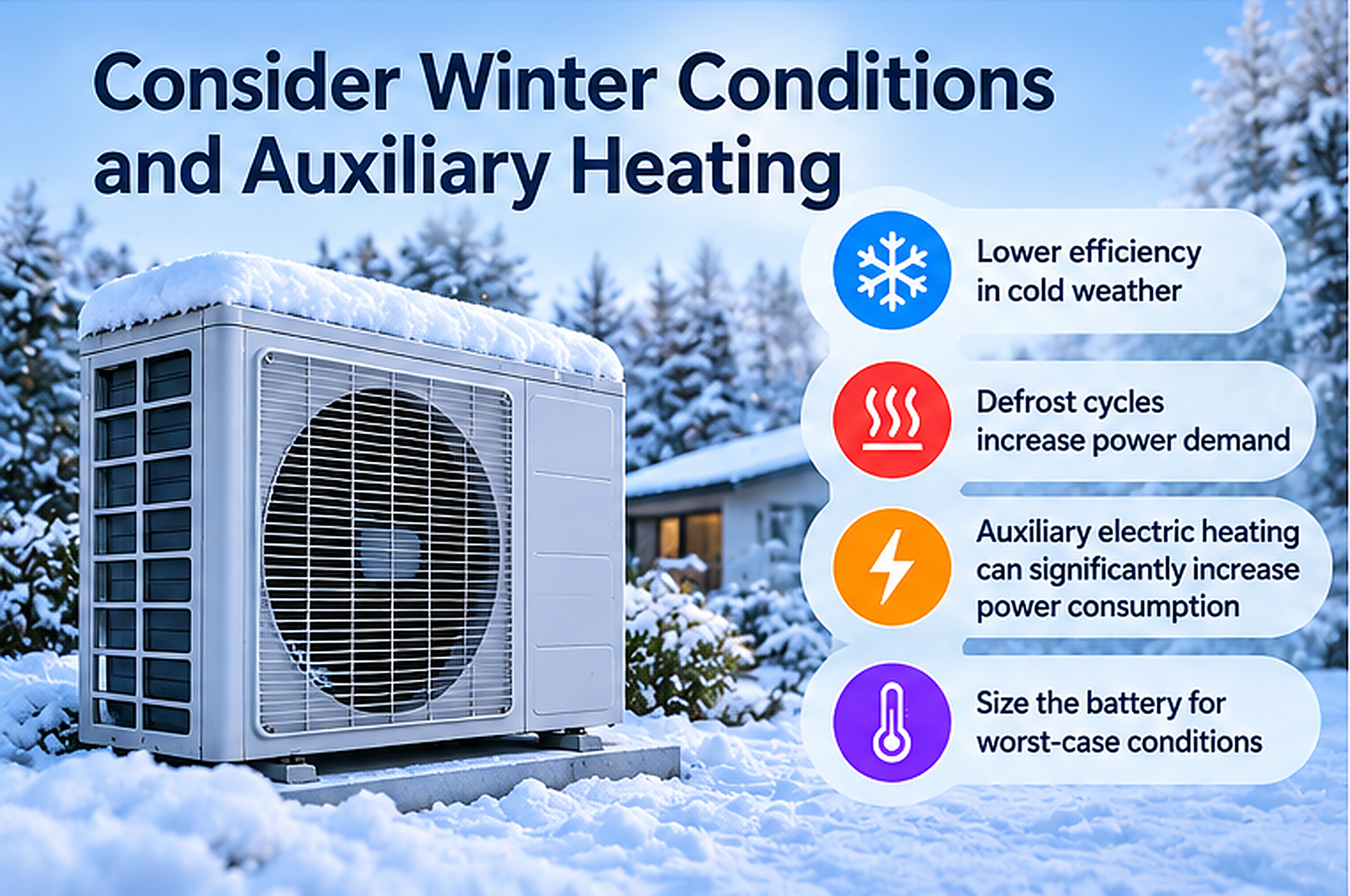
Winter is often the hardest backup case. As ambient temperature drops, some heat pumps use more electrical energy for the same indoor comfort, while their heating output and efficiency can fall. Defrost operation can briefly change compressor and fan operation. Systems with electric auxiliary heat may introduce a major additional electrical load.
Electric resistance heat is particularly important. EPRI notes that residential auxiliary heating elements can be sized at several kilowatts, sometimes far above the compressor’s normal input. A system able to run the compressor may not support compressor plus heat strips. Verify whether the thermostat can restrict auxiliary heat during outage mode, and whether doing so preserves adequate indoor temperature and manufacturer-approved operation.
Do not simply switch off emergency heating in a freezing climate without a safe alternative. Consider outdoor design temperature, insulation, vulnerable occupants, minimum indoor temperatures and freeze protection. A professional should establish operational priorities and suitable controls. For air-to-water systems also identify immersion heaters, buffer-tank controls and circulation pumps.
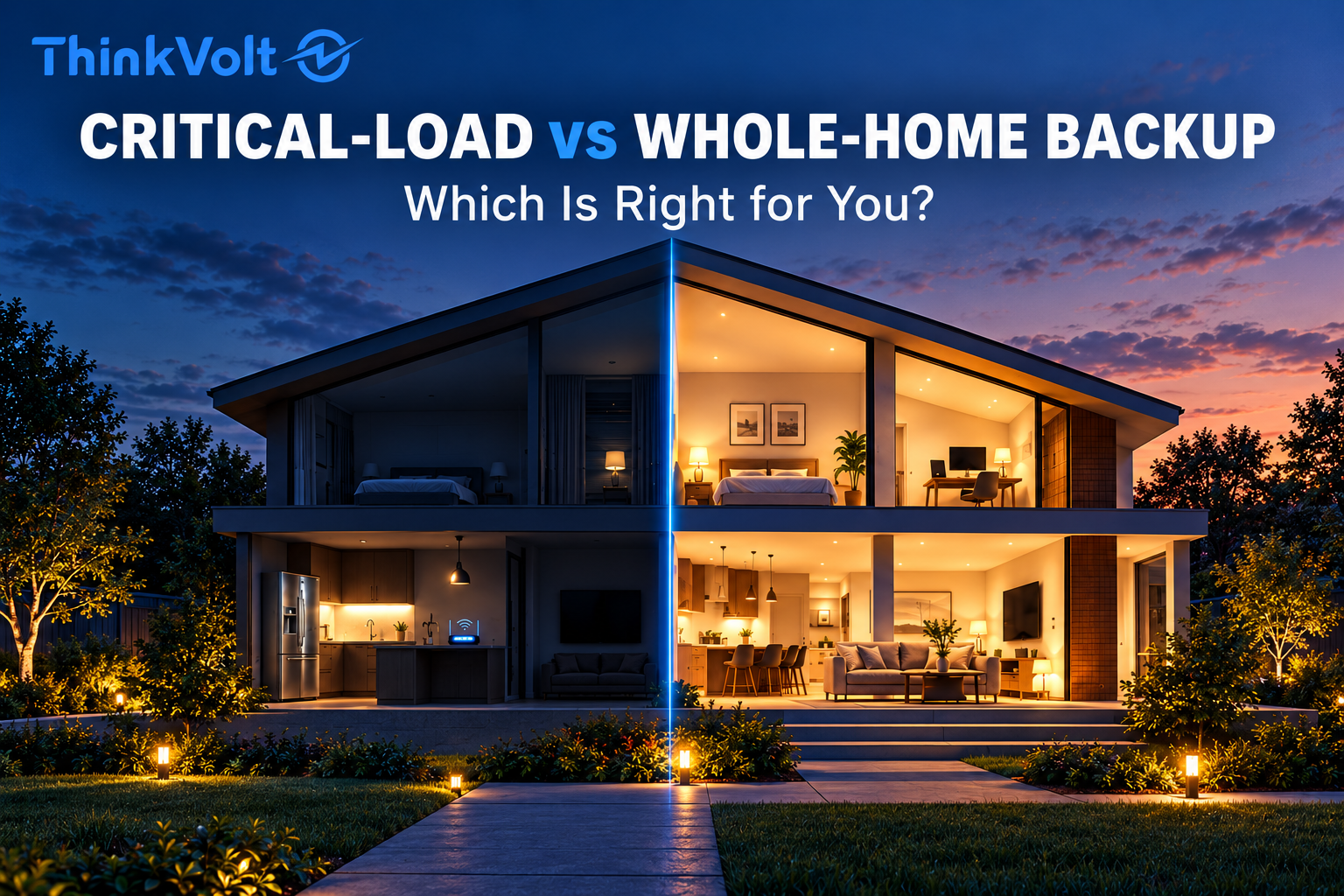
A critical-load arrangement usually gives more predictable runtime because heavy appliances can remain disconnected. It may protect the heat pump and a short list of essentials, provided the protected distribution arrangement, electrical phase and circuit ratings are appropriate. Whole-home backup can offer more convenience but requires more inverter output and a larger energy budget.
A smart-load or contactor strategy can shed an EV charger, electric oven or auxiliary heat when the grid fails, but it must be compatible with local electrical rules and with the appliances' requirements. If heating is essential, prioritize its compressor and indoor controls over nonessential loads while preserving required protection functions.
Installers should map circuits before selecting the transfer equipment. Confirm anti-islanding, approved transfer switching, neutral/ground treatment, grid interconnection rules and the system’s black-start behavior. Not every grid-tied solar inverter continues to operate in an outage simply because a battery is nearby.
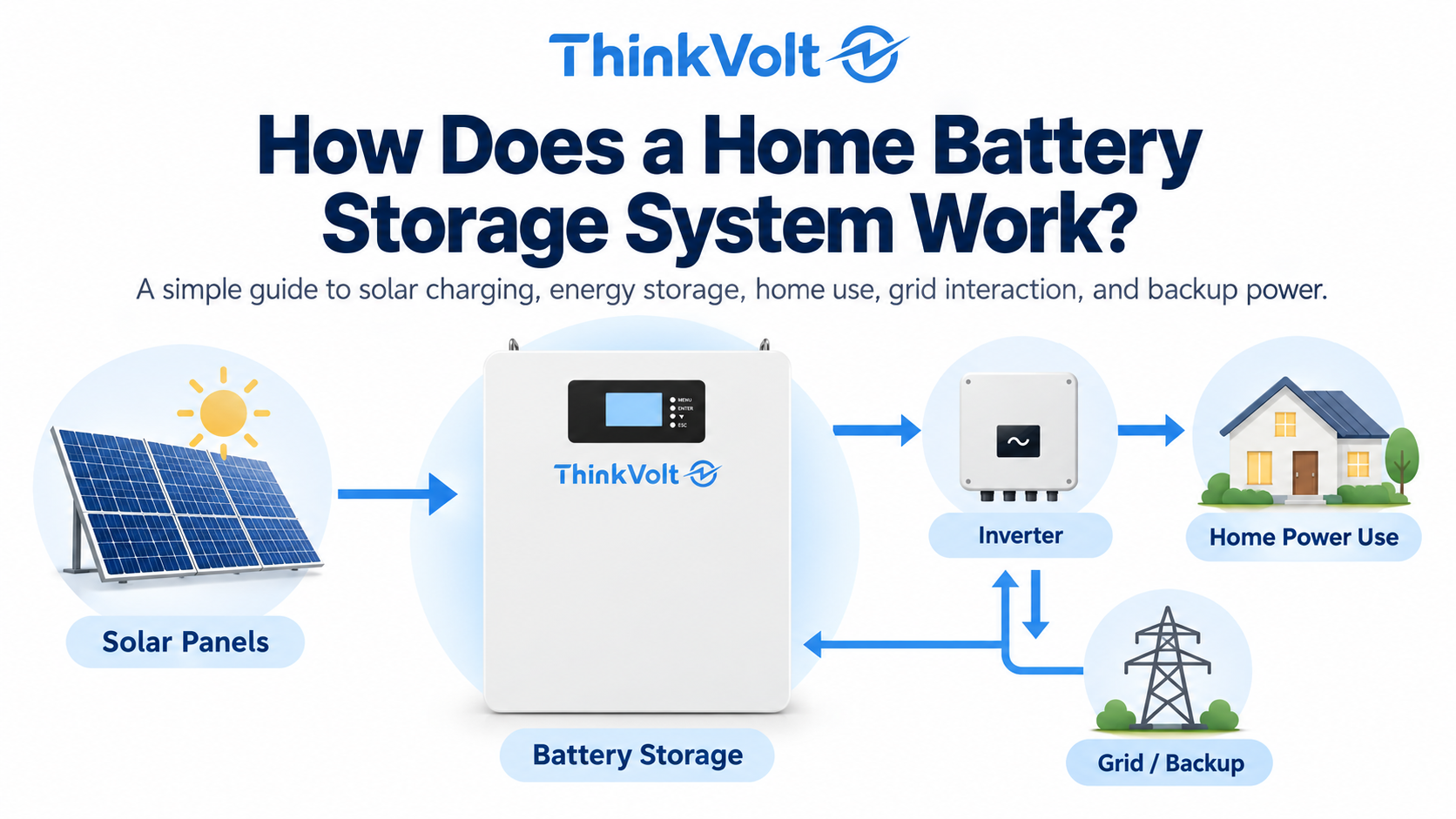
Solar and batteries can complement a heat pump by shifting daytime generation into evening demand. But solar availability and heating load often move in opposite directions on cold, cloudy days. Use hourly or subhourly load and generation estimates where possible rather than assuming the array will refill the battery every day.
For an existing solar system, determine whether AC-coupled storage or DC-coupled storage is supported. The key questions are backup-forming capability, supported inverter pairings, PV charging during an outage, export limits and conversion pathways. A retrofit may favor a different architecture from a new installation, but neither arrangement is automatically superior for every property.
Ask the installer to show the actual single-line diagram, compatible components and outage operating sequence. Verify that sufficient PV energy can reach the battery during islanded operation and that control logic can safely handle excess solar production when the battery is full.
Compare a system against a defined load rather than selecting by cell chemistry or nameplate kWh alone. LFP batteries are one established residential storage option, but chemistry by itself does not determine compatibility or backup performance. The inverter, battery management system, rated output, system controls and installation environment matter together.
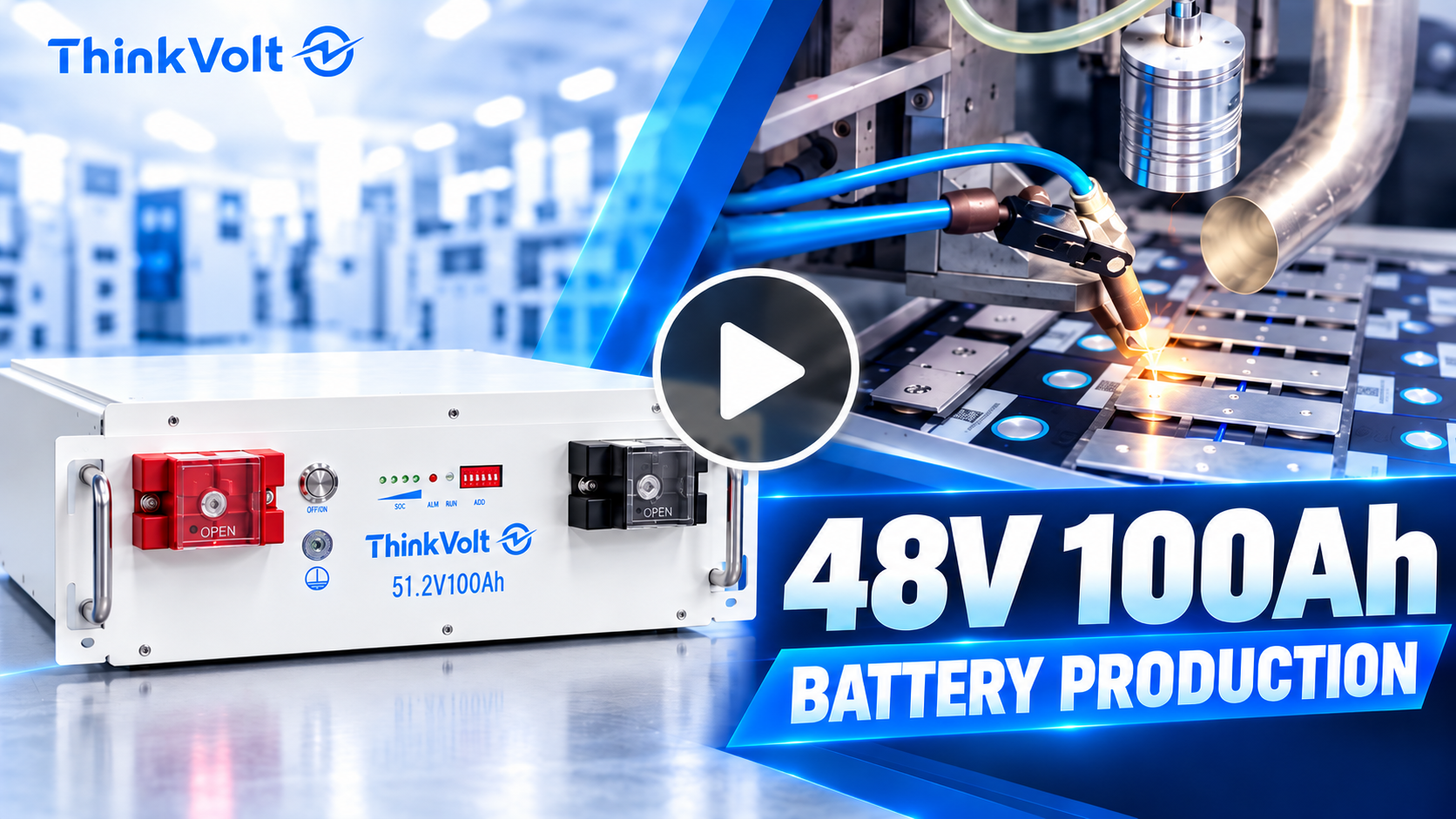
ThinkVolt's 2026 company knowledge base lists residential LiFePO4 battery formats including a 51.2 V, 100 Ah wall-mounted pack with 5.12 kWh nominal energy and a 51.2 V, 200 Ah floor-standing pack with 10.24 kWh nominal energy. These values are capacity examples—not verified heat-pump-ready configurations. Any proposal requires the current model datasheet and exact inverter-compatibility, discharge-current, backup-output and local-compliance checks.
Selection criterion | What to check |
Usable energy | AC kWh delivered over chosen SOC window and temperature |
Continuous/peak power | Inverter output, overload duration and battery discharge limits |
Electrical fit | Voltage, frequency, phase, circuit and compressor starting |
Backup operation | Transfer method, islanding, black-start and recharge |
Controls | Auxiliary-heat policy, defrost and load shedding |
Integration | Exact model/firmware/BMS communication compatibility |
Site and approvals | Clearances, ambient temperature and applicable local code |
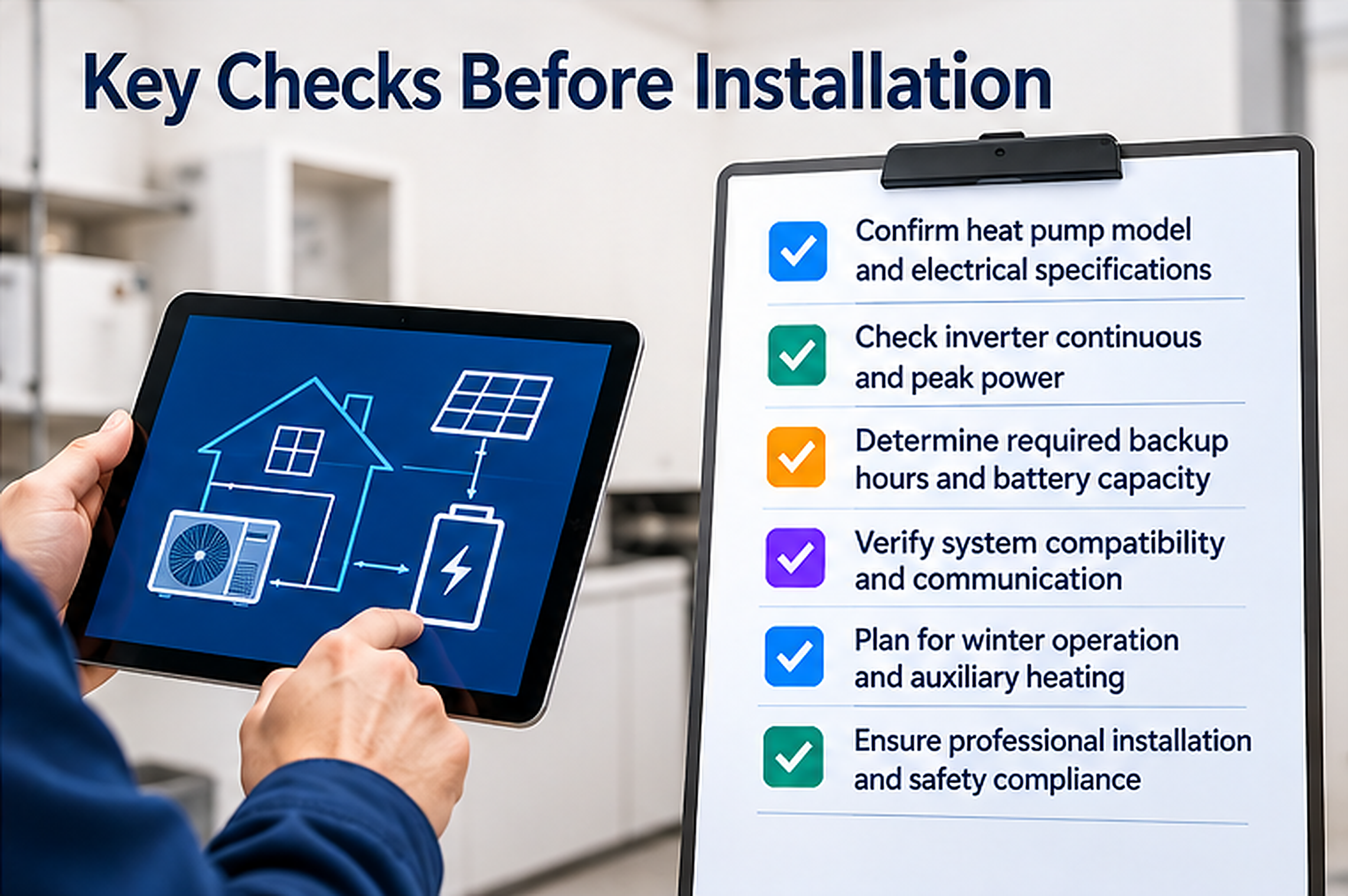
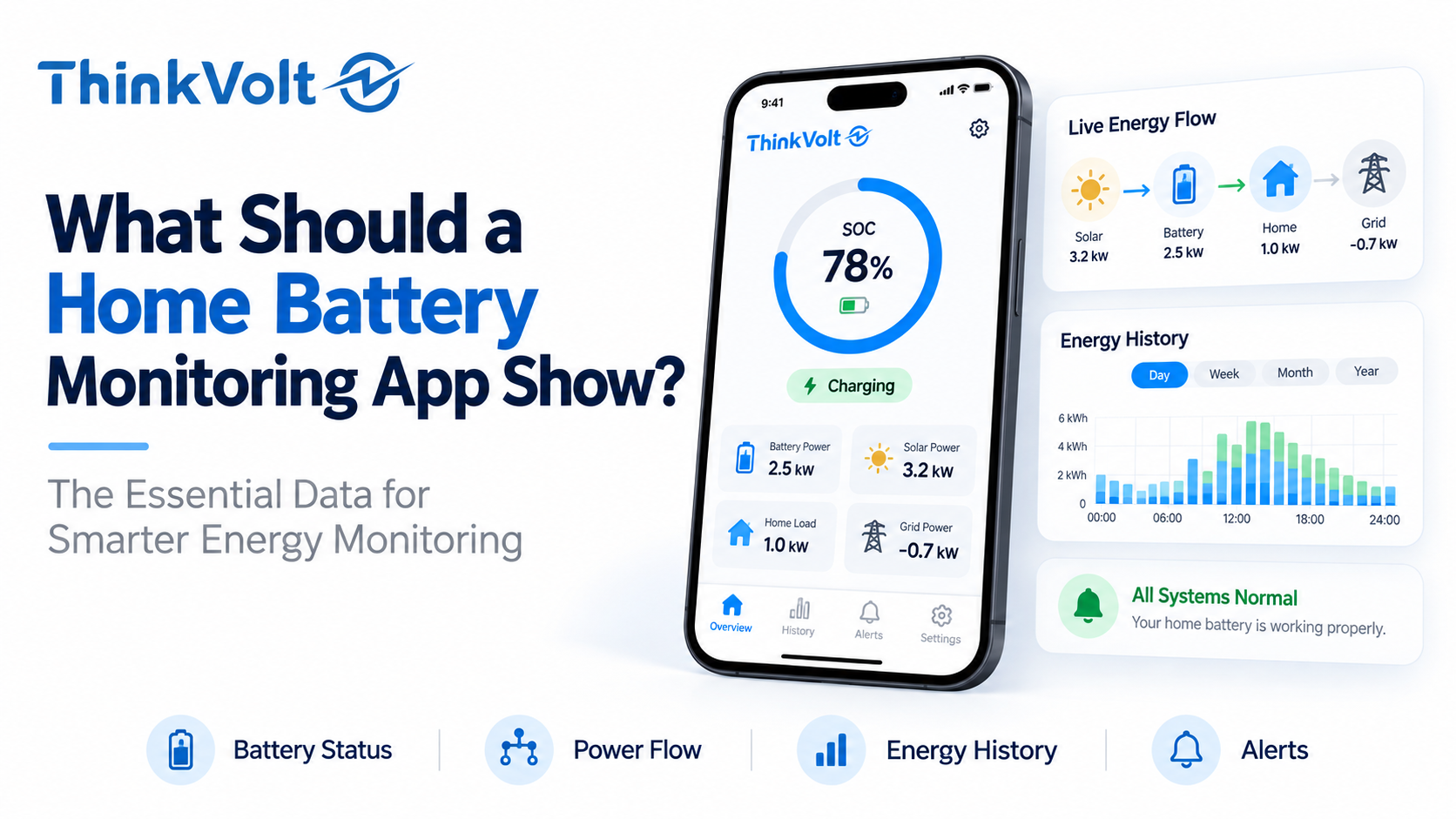
The final check is not just whether the system turns on during normal grid supply. Test a controlled grid-loss transition, restart behavior, compressor operation, communications, changes in household load and return to grid power. Where appropriate, test at different battery states of charge and document minimum supported reserve.
Confirm what happens when the backup battery reaches its low-SOC threshold. A heat pump may need a managed shutdown to prevent repeated restarts or equipment lockouts. Review winter backup settings with the homeowner, including any limitations on auxiliary heating and how to recognize insufficient capacity.
Provide an easy-to-read operating sheet: protected circuits, expected runtime under stated conditions, weather and solar assumptions, emergency heating plan, monitoring access and service contacts. Explain that energy estimates are planning scenarios rather than guaranteed runtimes.
Possibly, for a limited time, but only if the actual usable capacity and inverter output meet the heat pump's running and starting requirements. For example, 5 kWh nominal is not five hours at 1 kW of AC output after reserves and losses. Check the electrical load before selecting a system.
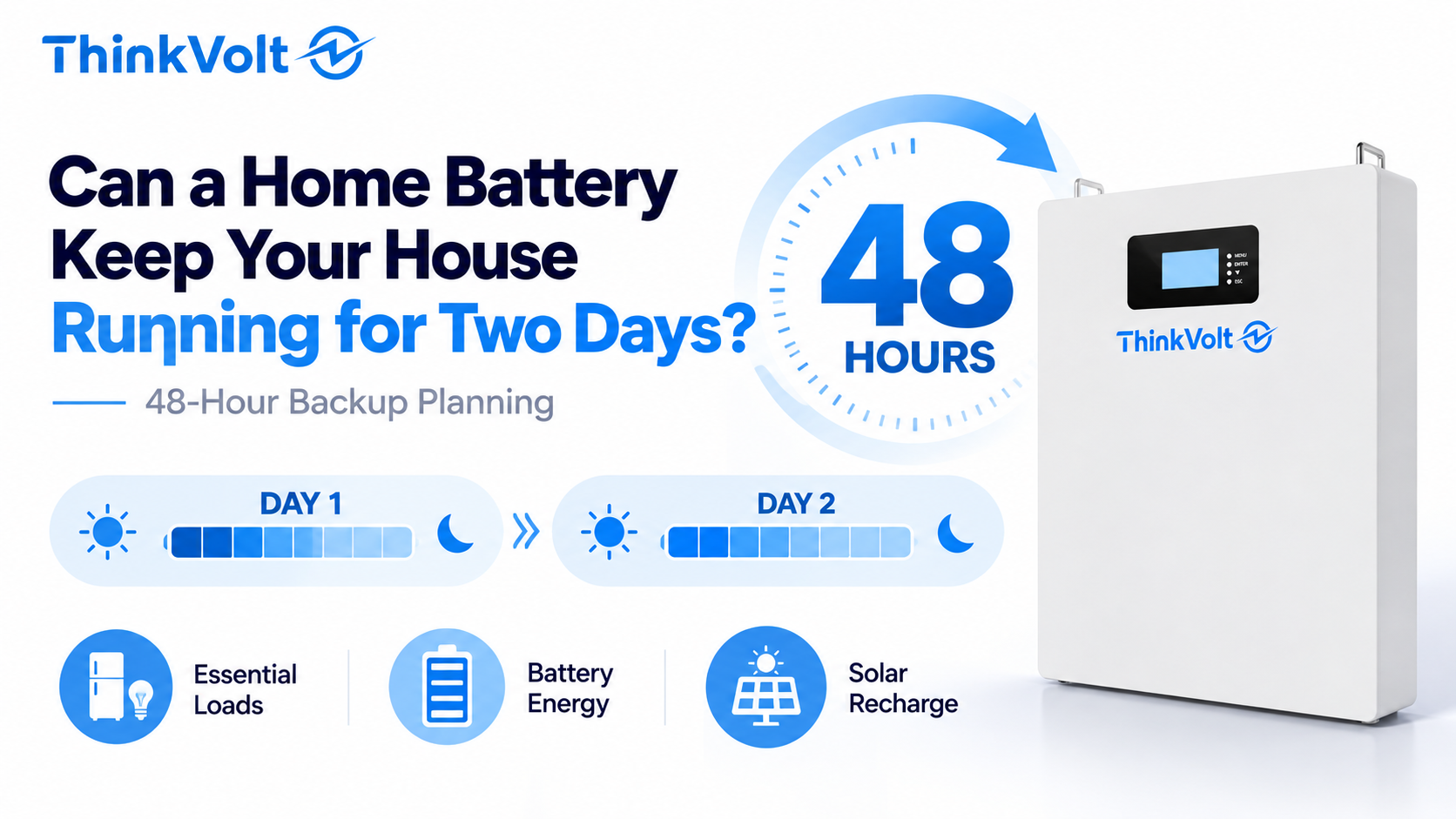
Sometimes, but an overnight answer depends on hourly electrical consumption, climate, building insulation, backup reserve and other loads. Ten kWh nameplate capacity may deliver less than ten kWh at the AC circuits. Use cold-weather load data and calculate the proposed hours explicitly.
No single battery chemistry is uniquely required. The complete storage system must provide the required voltage and frequency, continuous and transient AC power, approved controls and compatible backup topology. Verify the precise heat pump, inverter and battery combination rather than relying on a generic marketing claim.
They can in a correctly designed solar-plus-storage backup system, but ordinary grid-following solar may shut down when the grid fails. The site needs compatible islanding and backup controls, and solar output still depends on conditions. Check the installed equipment and single-line diagram.
Auxiliary resistance heating may sharply increase required inverter output and energy consumption. Some systems can limit its operation, but this is a controls and safety decision that needs professional review. In freezing weather, maintaining safe heating and freeze protection takes priority over extending battery runtime.
No. Heating capacity measures delivered heat, not electrical input. Use metered kW/kWh or manufacturer electrical input performance at relevant temperatures, including fans, pumps and auxiliaries. A system described as an 8 kW heat pump can draw a substantially different amount of electrical power.
Only if the manufacturer supports expansion of that exact system and the inverter and controls can accommodate it. Extra modules may extend runtime without increasing the inverter's continuous AC output. Verify module matching, communication, warranty conditions and commissioning requirements before purchasing.
Pairing a home battery with a heat pump is an exercise in matching real electrical loads, backup priorities and system controls—not just comparing battery capacity labels. Calculate both energy and power, plan for the coldest practical use case, and confirm the exact equipment combination before installation.
Planning a residential heat-pump storage project? Share the heat pump model, inverter model, site country and electrical supply, available solar capacity, measured load profile and desired backup hours with ThinkVolt for an application-specific technical discussion. Final product suitability remains subject to verified datasheets and engineering review.